Monetary policy affects spending and financial conditions through several transmission channels.
Must know
- Interest rates influence borrowing saving and disposable income.
- Exchange rates and asset prices can transmit policy.
- Confidence and bank lending affect pass-through.
Must know definitions
Monetary policy: the use of interest rates and the money supply to influence aggregate demand and achieve macroeconomic objectives.
Base rate: the central bank's official interest rate, which influences the rates commercial banks charge and pay.
Transmission mechanism: the channels through which monetary policy affects market rates, asset prices, expectations and the exchange rate, then spending and inflation, including import-price effects.
Wealth effect: the tendency of consumers to spend more when the value of their assets (e.g. housing, shares) rises.
Quantitative easing (QE): central-bank asset purchases financed by newly created reserves, intended to ease financial conditions; the effect on bank lending and broad money is not automatic.
Lending criteria: the conditions banks apply when deciding whether and how much to lend (e.g. deposit requirements, loan-to-income limits).
Reserve asset and liquidity requirements: rules requiring banks to hold specified reserves or liquid assets. Central-bank reserve balances and broader liquid assets are related but different concepts.
Lender of last resort: the central bank's role in lending to commercial banks facing liquidity shortages, to prevent bank failures.
Explain and apply
Mechanism in brief: A lower policy rate may reduce lending rates, easing debt costs and encouraging spending. It may also weaken the currency, affecting net exports and import costs; transmission depends on banks, borrowers and international conditions.
Distinguish: A policy-rate change need not pass through fully to borrowers; lower rates do not guarantee higher investment.
Use the extract: Look for fixed-rate debt, bank lending conditions, confidence and relative foreign interest rates; choose the channel supported by the extract.
Monetary policy is the use of interest rates and the money supply to influence the level of aggregate demand and achieve macroeconomic objectives, most notably the inflation target.
- In the UK, monetary policy is conducted by the Bank of England (specifically its Monetary Policy Committee), independently of the government, whereas fiscal policy remains under the government's direct control.
Common mistake: don't mix up who conducts each policy — monetary policy is set by the (independent) central bank, fiscal policy is set by the government.
Interest rates
An interest rate is the cost of borrowing or reward for saving, expressed as a percentage over a stated period. The central bank sets its policy rate; commercial lending and deposit rates also reflect risk, costs and competition.
- A change in the base rate does not affect AD directly — it passes through several distinct channels of the transmission mechanism before reaching consumption, investment, and net exports.
Start with the policy-rate decision, then follow the relevant transmission channel:
The central bank changes its base rate
A policy-rate cut tends to lower market borrowing and saving rates, but the size and timing of pass-through depend on banks, credit risk and contract terms.
Variable-rate contracts may adjust relatively quickly; existing fixed-rate loans usually adjust when refinanced. A policy-rate cut need not immediately reduce every borrower’s payments.
The following channels interact; asset prices and expectations may react to policy news before retail bank rates change:
Cost of borrowing and saving incentive
cheaper loans reduce the cost of borrowing for households and firms, while lower returns on savings accounts reduce the incentive to save
Lower financing costs can make more investment projects worthwhile → investment rises if firms expect sufficient sales and can obtain credit → AD shifts right. Household borrowing may also increase consumption.
Disposable income (cash-flow) effect
Lower payments on variable-rate debt can leave borrowers with more cash to spend. Fixed-rate borrowers may initially see no change, while savers may receive less interest income.
Lower debt-service payments → more cash available for consumption, other things equal. The total effect depends on how borrowers and savers change their spending.
A rate rise tends to squeeze borrowers as payments reset, but may raise savers’ interest income. The net effect is not identical for every household.
Asset prices and wealth effect
Lower expected interest rates can raise asset values by reducing the discount rate applied to future income. Falling expected profits or confidence may offset this effect.
→ household wealth ↑ → consumers feel more able to spend out of this wealth (the wealth effect) → C ↑
Exchange rate channel
A fall in domestic interest rates relative to foreign rates may reduce demand for domestic-currency assets. Expectations, risk and other capital flows also influence the exchange rate.
Possible depreciation → exports become cheaper abroad and imports dearer at home, subject to pricing → net exports may rise after quantities adjust. Elasticities and export capacity matter; import prices can affect inflation directly.
Expectations and confidence
A credible policy response may reassure households and firms and support spending. A rate cut can also signal a weak outlook and leave confidence low. Expectations therefore influence whether cheaper finance leads to extra consumption and investment.
Together, these channels may raise consumption, investment and net exports:
AD ↑, ceteris paribus — used to stimulate a slowing economy or close a negative output gap.
A rate rise tends to restrain demand through higher borrowing costs and other financial conditions. The strength of each channel depends on expectations, contract terms and the response of the exchange rate.
Weaker spending → AD shifts left → lower demand pressure. The effects on real output and inflation depend on spare capacity and supply conditions.
Transmission has variable lags. Financial markets can react quickly, while loan refinancing, investment decisions and spending take longer. Do not treat any single 12–18 month estimate as a fixed timetable.
Figure 2.27 Interest-rate transmission mechanism
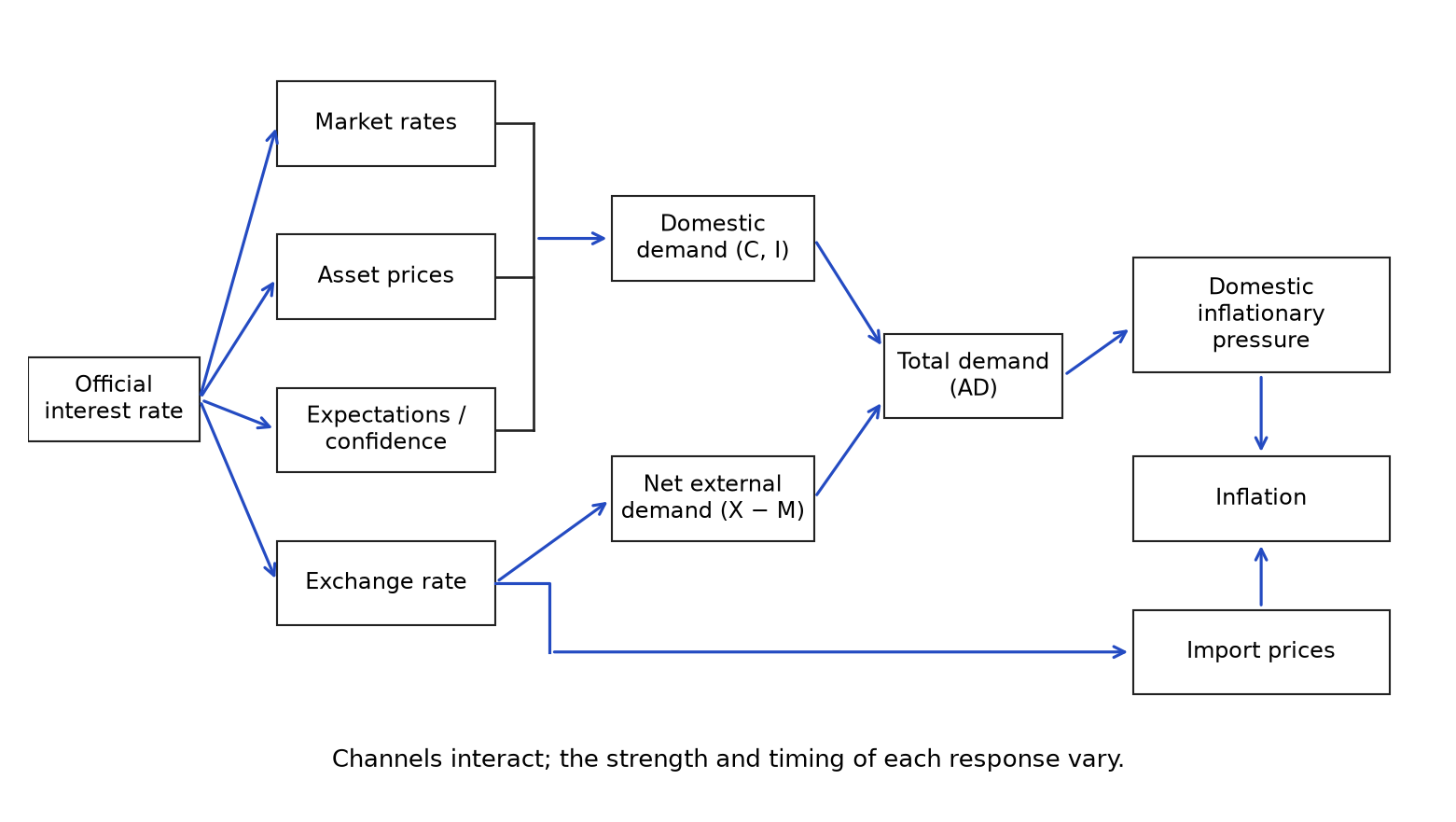
Read the diagram: A change in the official rate affects market interest rates, asset prices, expectations and confidence, and the exchange rate. These influence domestic spending and net exports, changing AD and domestic inflationary pressure. The exchange rate also affects import prices directly. A rate cut may stimulate demand and raise inflation; a rise may do the reverse. Spare capacity, bank lending, expectations and time lags affect the outcome; responses are not automatic.
Quantitative easing (QE)
Quantitative easing is the creation of new money by the central bank, used to purchase financial assets (mainly government bonds) from financial institutions, increasing the money supply.
- QE is typically used when interest rates are already close to zero and cannot be cut further to stimulate the economy.
Central bank creates money
Central bank buys bonds with newly created reserves → bond prices tend to rise and yields fall → investors may switch into other assets → broader financing conditions ease, supporting spending. Extra reserves do not automatically become extra loans.
QE may support demand through asset prices, yields and expectations. Its effectiveness depends on financial conditions and willingness to spend; inflationary pressure is greater when demand expands beyond available capacity.
Changes in lending criteria
Lending criteria — central banks and regulators can alter lending criteria, for example the minimum deposit required for a mortgage, the maximum amount a bank may lend relative to income, or the maximum lending age of a borrower.
Loosening lending criteria makes credit easier to obtain
borrowing and spending ↑ → AD ↑
Tightening criteria restricts credit
borrowing and spending ↓ → AD ↓
Reserve asset (liquidity) requirements
Reserve requirements specify required reserve holdings, often relative to deposit liabilities. Broader liquidity rules require assets that can meet cash outflows. Their design varies: reserves, liquid assets and bank capital are not interchangeable.
Raising reserve requirements
A binding increase in required holdings can raise banks’ funding costs or constrain balance-sheet choices → credit may become more expensive or less available → spending and AD may fall.
Lower requirements may ease a binding constraint, but do not guarantee new lending. Banks create deposits when lending; capital, credit risk, profitable loan demand and funding conditions also matter.
The role of central banks
| Function | Explanation |
|---|---|
| Implementing monetary policy | Using the instruments above (interest rates, QE, lending criteria, reserve requirements) to influence AD |
| Achieving the inflation target | Setting policy so that inflation converges on the government's target (e.g. 2% CPI in the UK) |
| Banker to the government | Handling government departments' accounts and making short-term advances to the government |
| Banker to the banks — lender of last resort | Lending directly to commercial banks that run into liquidity problems, preventing a banking crisis from spreading |
Strengths and weaknesses of monetary policy
- Strengths and weaknesses should always be assessed against the stated aim of the policy — e.g. whether it can hit the inflation target without excessive cost to growth or employment.
Strengths
Shorter decision lag than fiscal policy
the Monetary Policy Committee meets roughly every six weeks and can change the base rate immediately after a decision, without needing new legislation or a Budget — much faster than the process of passing a fiscal measure through government.
Operational independence from government
because the central bank sets rates independently of elected politicians, decisions are driven by the inflation target rather than short-term electoral incentives, which should improve the credibility and consistency of policy.
Fine-tuning and flexibility
the base rate can be adjusted in small increments (e.g. 0.25 percentage points) in either direction as new data arrives, allowing policy to be continuously recalibrated rather than committed to a single large change.
Additional channels beyond domestic demand
interest-rate changes can affect exchange rates as well as domestic spending. Depreciation may support net exports if quantity responses are sufficient, but import prices rise. Fiscal policy can also affect trade and exchange rates; neither instrument has an automatic advantage.
Weaknesses
Long and variable transmission lags
even though the decision itself is fast, the channels above (especially the wealth and exchange rate effects) take time to feed through to spending decisions — often many months, with timing varying across channels — so by the time the full effect is felt, the state of the economy may have already changed.
Dependent on the banking sector's response
Cautious banks or weak loan demand can weaken the bank-lending channel: lending rates may adjust incompletely and cheaper finance may not produce more borrowing. QE can also work through bond yields, portfolio rebalancing, asset prices and expectations, so additional bank lending is not required for every channel to operate.
Limited room at the zero lower bound
once interest rates are already close to zero, there is little scope left to cut further to stimulate demand, forcing central banks to rely on less conventional and more uncertain tools such as quantitative easing.
Confidence-dependent
the effect of cheaper credit assumes that consumers and firms respond as expected; in a period of low confidence (e.g. recession, political uncertainty), households may prefer to save rather than spend even when borrowing is cheap, and firms may postpone investment despite low interest rates, weakening the link between the policy and AD.
Common mistake: the channels share the same policy decision but do not all operate only through commercial-bank rates. Policy news can affect expectations, asset prices and exchange rates directly; the exchange rate also affects import prices.
Weak confidence, fixed-rate debt or cautious banks can delay or dilute transmission. Judge the supported channels and time lags; an adverse supply shock may make demand stimulus more inflationary and less effective at restoring output.
Rapid recap
Domestic channel: a rate cut can lower borrowing costs and debt-service payments → higher C and I → AD right. Confidence, pass-through and debt contracts affect the response.
External channel: lower relative returns may weaken the currency → changes in net exports and import prices. Exchange-rate movements and trade-balance improvement are not automatic.
QE: asset purchases can lower yields and support spending through portfolio, wealth and confidence channels; reserves do not guarantee new bank lending.
Judge: distinguish a demand shortfall from a supply shock. The same stimulus can have very different output and inflation effects depending on capacity and expectations.
Diagram cue: reconstruct the supported transmission channels, including import prices.
Related chapters: Unit 2 chapter 2 (p. 32) · Unit 4 chapter 7
Why this connects: Follow the exchange-rate channel into Unit 4: trade elasticities determine quantity responses, while import prices affect inflation directly.