Exchange rates connect trade, financial flows, prices and policy choices.
Must know
- Appreciation and depreciation occur under floating rates.
- Revaluation and devaluation change a fixed parity.
- Elasticities and time lags affect trade responses.
Must know definitions
Exchange rate: the price of one currency expressed in terms of another.
Floating exchange rate: a rate determined entirely by market demand and supply for the currency.
Fixed exchange rate: a rate set and maintained by the government/central bank at a target level.
Managed exchange rate: a rate that floats on the market but is influenced by central bank intervention.
Appreciation/depreciation: a market-driven rise/fall in a currency's value under a floating system.
Revaluation/devaluation: a government-directed rise/fall in a currency's value under a fixed system.
Marshall–Lerner condition: under the standard assumptions, depreciation improves the trade balance when the sum of the absolute export and import demand elasticities exceeds 1.
J-curve effect: a possible initial deterioration followed by improvement in the trade balance after depreciation, as prices adjust before trade volumes respond.
Hot money: short-term speculative capital flows moving between countries to chase higher interest rates or expected currency gains.
Must know relationship: Marshall–Lerner condition: |PED for exports| + |PED for imports| > 1 under the standard assumptions.
Interpretation: use absolute export and import demand elasticities. The standard condition assumes an initially balanced trade position, sufficient supply responsiveness and price pass-through; the short-run outcome can differ as contracts adjust.
Explain and apply
Mechanism in brief: A depreciation raises domestic-currency import prices and may lower foreign-currency export prices. Contracts initially limit quantity adjustment; later substitution can increase exports and reduce imports if buyers and suppliers respond.
Distinguish: Imports become dearer in domestic currency; the J-curve is a possible response, not a guaranteed path.
Use the extract: State the currency quotation and exchange-rate regime; identify the trade elasticities, contracts and export capacity.
The distinction between fixed, managed and floating exchange rates
An exchange rate is the price of one currency in terms of another.
- Floating exchange rate — the rate is determined freely by market demand and supply for the currency, with no government target.
- Export receipts and financial inflows can increase demand for domestic currency; import payments and financial outflows can increase its supply. These are drivers, not an accounting identity.
- The central bank does not intervene; the rate adjusts continuously as demand and supply shift.
Real-life example
the US dollar, the British pound, and the euro all float freely against other major currencies.
Fixed exchange rate — the monetary authority commits to maintain a parity or band against another currency or basket. It uses the relevant institutional arrangements and interventions to defend it; an official change to the parity is a revaluation or devaluation. Such a change does not generally require IMF mediation.
A central bank can use foreign-exchange transactions and monetary conditions to defend a peg. A currency board is a specific, rules-based arrangement with reserve-backing and convertibility commitments; not every fixed-rate system is a currency board.
Real-life example
the Hong Kong dollar has been pegged to the US dollar at around HK$7.80 = US$1 since 1983, with the Hong Kong Monetary Authority fully backing the monetary base with US dollar reserves.
Managed exchange rate — the rate floats on the market, but the central bank intervenes (buying/selling currency) to influence its value without fixing it to a precise level.
The central bank may intervene to smooth excessive volatility, or to keep the rate within an undisclosed or informal range, rather than defending a fixed target.
Real-life example
the Chinese yuan operates under a managed float, where the People's Bank of China intervenes to keep it broadly stable against a basket of currencies rather than letting it move entirely freely.
Figure 4.6 Floating exchange rate equilibrium
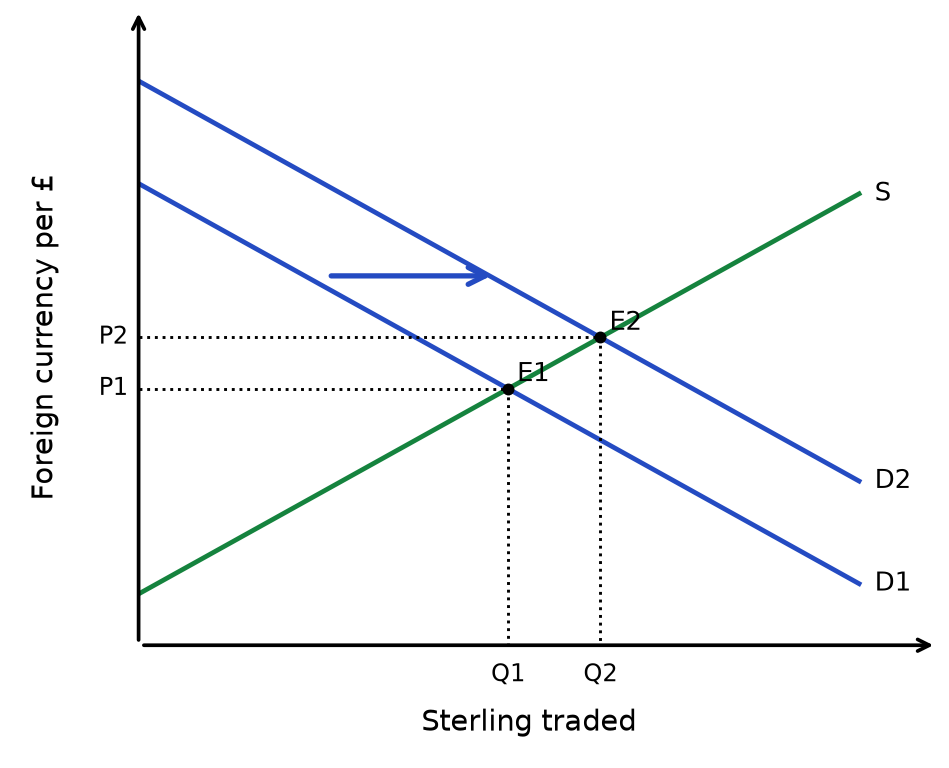
Read the diagram: Demand increases while supply is unchanged. The new equilibrium has a higher price and quantity; the price change is a movement along the existing supply curve. With the quoted foreign-currency price of sterling rising, sterling appreciates.
Figure 4.7 Defending a fixed exchange rate
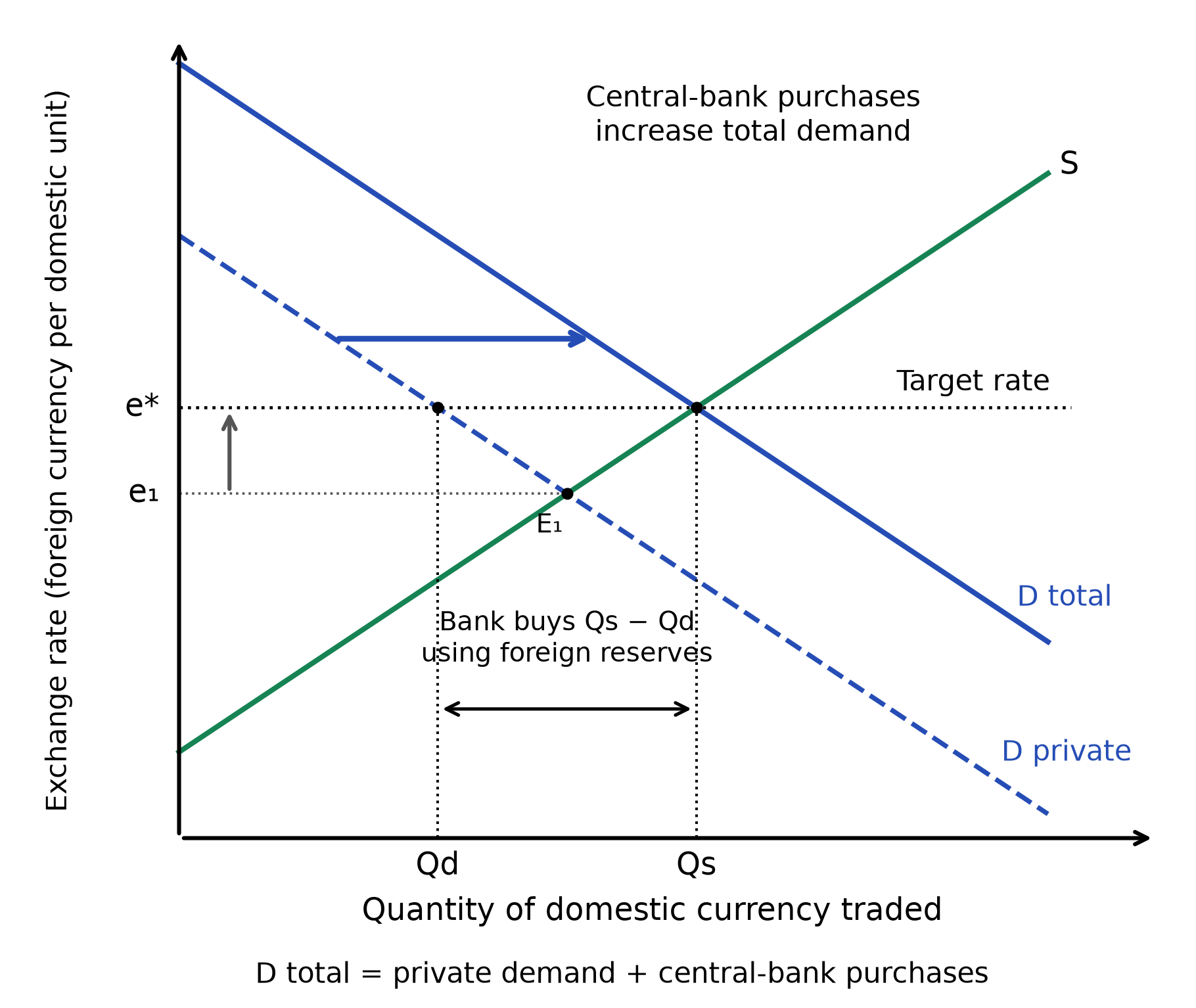
Read the diagram: After private demand falls, the exchange rate would fall to e₁ without intervention. To defend e*, the central bank buys Qs − Qd of domestic currency using foreign reserves. Its purchases add to private demand, shifting total demand right from D private to D total. The new intersection with S restores the target rate. The peg is unchanged; this is not devaluation. This is a hypothetical fixed-rate market.
Government intervention in currency markets
- Foreign currency transactions — a central bank can buy its own currency using foreign reserves to support its exchange rate, or sell its own currency to put downward pressure on it, other things equal. Reserve management is not itself evidence of exchange-rate targeting. The Bank of England manages the UK government’s official gold and foreign currency reserves as the Treasury’s agent; this institutional role should be distinguished from a specific decision to intervene in the sterling market.
- Use of interest rates — raising interest rates relative to other countries makes the country more attractive for investors seeking a higher return, raising demand for the currency and causing it to appreciate. This inflow of speculative funds is known as hot money.
- Quantitative easing — increases the money supply, which tends to cause the currency to depreciate. Used when standard monetary policy (interest rate cuts) is no longer effective, typically when inflation is already low.
interest rates ↑ (relative to other countries) → hot money inflows ↑ → demand for the currency ↑ → currency appreciates, ceteris paribus
A government may also intervene to deliberately keep its currency undervalued — for example, by building up large reserves of foreign currency (such as US dollar assets) to hold its own currency down and make its exports appear relatively cheaper.
Factors influencing floating exchange rates
- Relative interest rates — higher interest rates (relative to other countries) attract hot money inflows → currency appreciates.
- Relative inflation rates (purchasing power parity theory) — lower domestic inflation makes exports relatively more competitive → demand for the currency ↑ → currency appreciates.
- Current account of the balance of payments — exports create demand for the currency; imports create supply of it on the foreign exchange market. An improving current account (rising trade surplus) tends to appreciate the currency.
- Strength of the economy — a strong, growing economy attracts investment, increasing demand for the currency.
- Capital flight — a government with high debt risks losing investor confidence. Investors sell their bond holdings and capital flows out, causing the currency to depreciate.
- Expectations and speculation — if speculators expect a currency to appreciate, they buy it now to profit later, which itself increases demand and can cause it to appreciate.
- Global factors — e.g. a fall in commodity prices can weaken a commodity-exporting country's currency; concerns about a major trading partner's economy (e.g. investors moved into the Swiss Franc in 2010 amid EU-economy concerns) can also shift demand between currencies.
d/e. The distinction between revaluation/appreciation and devaluation/depreciation
- Appreciation — a rise in a currency's value against other currencies under a floating exchange rate, caused by market forces (a rise in demand for the currency and/or fall in supply).
- Revaluation — a deliberate upward adjustment of a currency's official value against other currencies (or a baseline, such as gold), decided by the central bank/government under a fixed exchange rate.
- Appreciation and revaluation both mean the currency now buys more of another currency — for example, if £1 = $1.50 becomes £1 = $1.70, each pound buys more dollars, making the country's exports relatively more expensive abroad and imports relatively cheaper.
- Depreciation — a fall in a currency's value under a floating exchange rate, caused by market forces (a fall in demand for the currency and/or rise in supply).
- Devaluation — a deliberate downward adjustment of a currency's official value, decided by the central bank/government under a fixed exchange rate.
- Depreciation and devaluation both mean the currency now buys less of another currency — for example, if £1 = $1.50 becomes £1 = $1.40, each pound buys fewer dollars, making exports relatively cheaper and more competitive abroad and imports relatively more expensive.
- The key distinction between the two pairs of terms is who/what causes the change: appreciation/depreciation happen automatically through market forces under a floating system, while revaluation/devaluation are deliberate policy decisions under a fixed system.
The impact of changes in exchange rates
Effects of a depreciation/devaluation:
- Trade balance: depreciation can make exports cheaper abroad and imports dearer at home, depending on price pass-through. Under the standard assumptions, the Marshall–Lerner condition supports an eventual improvement in the trade balance; income flows and other current-account items must be assessed separately.
- Using the inflow-positive convention adopted here, a smaller current-account deficit reduces the corresponding net financing requirement, allowing for the capital account and errors and omissions. This does not necessarily mean the country becomes a net lender: a deficit can narrow while remaining a deficit. The identity does not prove the behavioural effect of depreciation on individual financial flows.
- FDI flows — a depreciation can make domestic assets cheaper for foreign buyers and attract investment. However, expected further depreciation, imported input costs and weak confidence may deter investors. This is a possible effect on one financial-account component, not a guarantee about the total financial-account balance.
- Economic growth — net exports (a component of AD) rise → AD ↑ → economic growth ↑.
- Employment/unemployment — rising demand for domestically produced goods and services (both exports and import-substitutes) → derived demand for labour ↑ → unemployment ↓.
- Rate of inflation — imported raw materials and finished goods become more expensive → firms' costs ↑ → cost-push inflation; rising AD (from higher net exports) can add demand-pull pressure too.
An appreciation tends to lower import prices and weaken export price competitiveness. Effects on the trade balance, growth, employment and FDI depend on elasticities, capacity, expectations and other changes. The balance-of-payments identity records the corresponding financing position; it does not predict each type of capital flow.
The J-curve shows a possible trade response after depreciation: existing contracts and inelastic short-run demand may raise the import bill initially. Over time, export and import volumes adjust; the trade balance may improve if the relevant elasticity and supply conditions hold.
Figure 4.8 The J curve
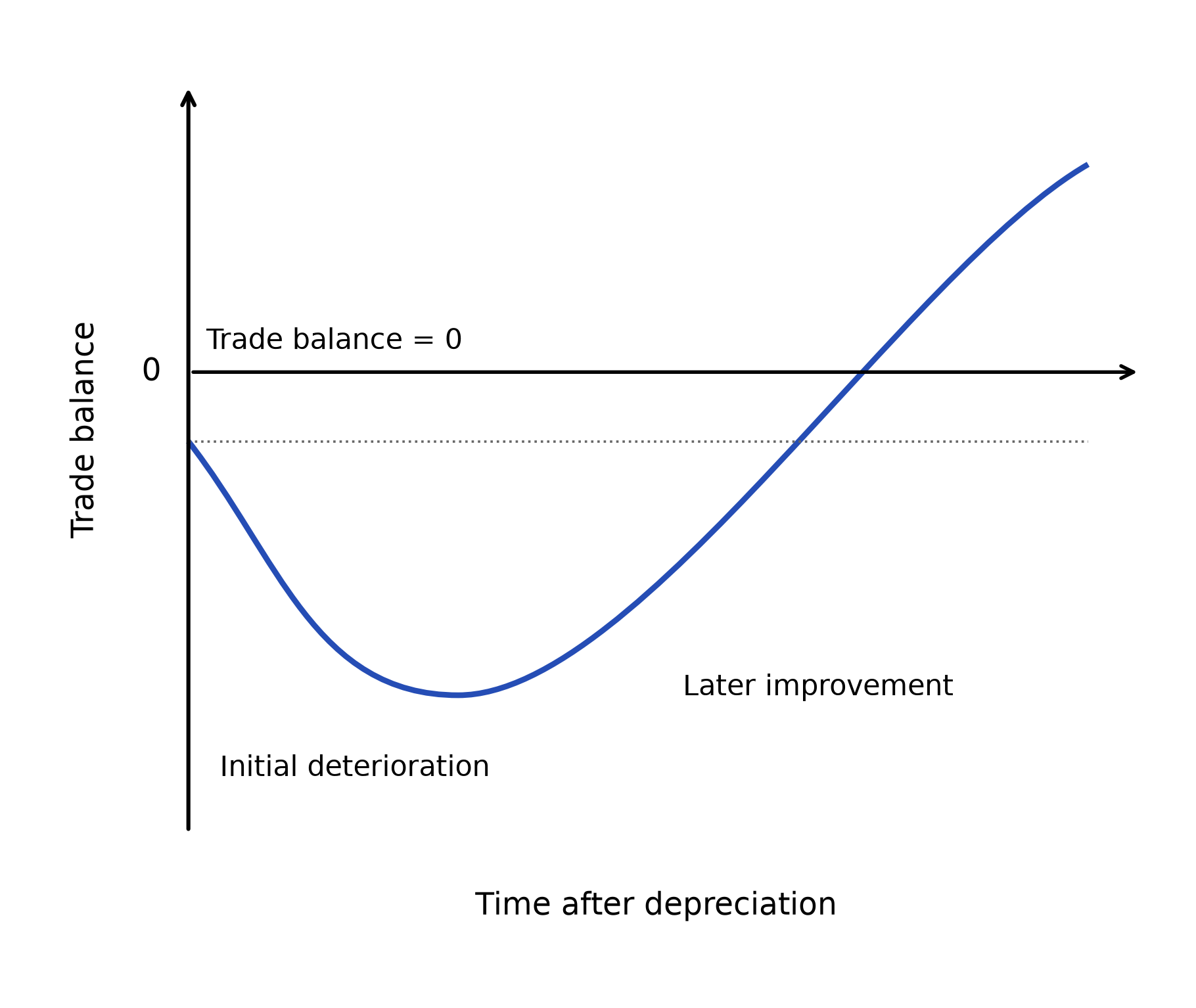
Read the diagram: Depreciation → import costs rise before contracted volumes adjust → the trade balance initially deteriorates → later quantity responses may improve it. The smooth curve shows a possible sequence, not a guaranteed forecast. Elasticities, supply capacity and other influences matter; later improvement need not produce a trade surplus.
Competitive depreciations/devaluations and their consequences
Competitive depreciation aims to improve trade competitiveness. Net exports may rise if elasticities and supply capacity permit, but import costs rise. Retaliation or depreciation abroad can erode the advantage; the result depends on relative exchange rates and trading conditions.
A useful mnemonic for remembering the direction of these effects is SPICED: Strong Pound → Imports Cheap, Exports Dear.
Elasticities, pass-through and export capacity determine the eventual effect. Imported-input costs can offset competitiveness gains, so assess both AD and cost pressures as well as the adjustment period.
Rapid recap
Currency market: state the quotation, identify the demand or supply change and show the new rate. To defend against depreciation, the central bank buys domestic currency using foreign reserves.
Trade channel: depreciation can improve the trade balance after adjustment under the relevant elasticity assumptions; fixed contracts and weak short-run quantity responses can produce a J curve.
Judge: pass-through, imported inputs, export capacity and reserves matter. A weaker currency does not guarantee stronger growth or a current-account improvement.
Diagram cue: show the currency-market change; use the J curve for a time-dependent trade response.
Related chapters: Unit 4 chapter 6 (p. 30) · Unit 4 chapter 8 (p. 42)
Why this connects: Exchange rates affect AD through net exports and SRAS through imported costs. Explain both before reaching a judgement.