Supply-side policies aim to improve incentives, productivity and the availability or use of resources.
Must know
- Market-based policies change incentives and competition.
- Interventionist policies directly support capabilities or infrastructure.
- Successful measures can raise potential output.
Must know definitions
Supply-side policies are measures intended to raise productive potential by improving resources, productivity or how markets function.
Productivity: output per unit of input, commonly output per worker per hour.
Market-based (free market) policy: a supply-side policy that relies on the free market mechanism, limiting the role of government.
Interventionist policy: a supply-side policy in which the government intervenes directly in markets to achieve macroeconomic goals.
Deregulation: the removal of rules and barriers to entry in a market in order to increase competition.
Red tape (bureaucracy): the administrative rules, paperwork and compliance requirements imposed on firms, which add to their costs.
Privatisation: the transfer of state-owned enterprises to the private sector.
Trade union: an organisation of workers that bargains collectively with employers over pay and conditions.
Replacement ratio: income when out of work as a proportion of income when in work.
Human capital: the skills, knowledge, experience and health of the workforce.
Geographical mobility: the ease with which workers can move between locations to take up jobs.
Occupational mobility: the ease with which workers can move between different types of job.
Structural unemployment: unemployment caused by a mismatch between workers' skills or location and the jobs available.
Explain and apply
Mechanism in brief: Training can raise worker productivity, reducing unit costs and increasing feasible output. Infrastructure and suitable jobs may be needed before the skills are fully used, linking the policy's success to complementary conditions.
Distinguish: More competition does not automatically solve every market failure; a policy announcement is not an immediate capacity increase.
Use the extract: Identify the specific skills, incentives, infrastructure or competition barrier the policy changes.
Supply-side policies designed to increase productivity, competition and incentives
Supply-side policies are measures intended to raise productive potential by improving resources, productivity or how markets function.
- Unlike demand-side policy, which works by shifting AD, supply-side policy aims to raise the economy's productive potential (its capacity), shifting LRAS to the right.
- It does this by improving productivity (output per worker per hour), strengthening competition, and sharpening incentives to work, invest and take risks.
- Successful supply-side policy therefore allows higher output without generating the same inflationary pressure as a pure AD expansion.
incentives ↑ and productivity ↑ → costs of production ↓ and productive capacity ↑ → LRAS shifts right → real output ↑ and price level ↓, ceteris paribus
Common mistake: separate the capacity effect from the spending effect. Training or infrastructure can raise LRAS later and also raise AD while expenditure takes place.
Free market (market-based) policies
Market-based policies focus on the power of the free market, relying on the market mechanism rather than the state.
- The forces of supply and demand are left to eliminate imbalances such as unemployment or shortages, so the role of government is deliberately limited.
- The underlying view is that intervention interferes with the market mechanism and blunts the incentives that drive efficiency.
Reduction in taxation
A reduction in taxation covers cuts in income tax, which raise the net reward from working, and cuts in corporation tax, which raise post-tax profit and so the funds and incentive to invest.
Lower marginal income tax rates are argued to draw more people into the labour force and encourage longer hours; lower corporation tax also makes the country a more attractive location for foreign direct investment.
income tax ↓ → net reward from working ↑ → incentive to work ↑ → labour supply ↑; corporation tax ↓ → post-tax profit ↑ → investment ↑ → capital stock ↑ → LRAS shifts right
Strength: sharpens incentives to work and invest, and the higher activity may partly recoup the lost revenue.
Weakness: holding the tax base constant, a lower rate reduces revenue. The final effect depends on the behavioural response and starting rate; cuts in top rates may also widen disposable-income inequality.
Changing the levels of welfare payments
Reducing welfare payments (or tightening eligibility) widens the gap between income in work and income out of work, cutting the replacement ratio and so the voluntary unemployment caused by weak search incentives.
The aim is to move workers off benefits and into employment, raising the effective supply of labour.
welfare payments ↓ → replacement ratio ↓ → incentive to search for and accept work ↑ → labour supply ↑ → LRAS shifts right
Strength: raises labour supply and reduces the benefit bill, easing the fiscal position.
Weakness: hits the poorest hardest and worsens both absolute and relative poverty, and does nothing if there are simply no vacancies.
Deregulation
Deregulation is the removal of rules, red tape and barriers to entry in product and labour markets.
In product markets it exposes incumbent firms to new entrants, so competition ↑ and firms are pushed towards productive and dynamic efficiency.
In labour markets it makes hiring and firing easier, improving flexibility.
barriers to entry ↓ → new firms enter → competition ↑ → firms cut costs and innovate → efficiency ↑ → LRAS shifts right
Strength: lower prices, more choice and greater efficiency at little direct cost to government.
Weakness: some regulation exists for good reason (safety, environmental and consumer protection), so deregulation may create negative externalities or weaken worker protection.
Privatisation
Privatisation is the transfer of state-owned enterprises to the private sector.
The argument is that the profit motive and shareholder pressure force private firms to cut waste and respond to consumers, whereas state firms face soft budget constraints.
Privatisation also raises one-off revenue for the government.
state ownership → private ownership → profit motive → costs cut and X-inefficiency ↓ → productivity ↑ → LRAS shifts right
Strength: raises productive efficiency where the privatised market is genuinely competitive, and generates sale proceeds.
Weakness: if the firm is a natural monopoly, privatisation simply replaces a state monopoly with a private one that may raise prices and cut quality without tight regulation.
Labour market reform
Labour market reform here means reducing trade union power (for example restricting strike action) and reducing or freezing the National Minimum Wage.
Both are intended to make wages more flexible and lower firms' labour costs, so that employment can clear at a lower real wage and firms hire more workers.
union power ↓ and real minimum wage ↓ → wage costs ↓ → firms' costs of production ↓ → employment ↑ and flexibility ↑ → LRAS shifts right
Strength: lower unit labour costs improve international competitiveness and can cut real-wage unemployment.
Weakness: weaker bargaining power and lower pay increase in-work poverty and inequality, and lower wages may reduce worker motivation and productivity.
Cutting the costs of bureaucracy for firms
Cutting the costs of bureaucracy means simplifying tax administration, planning permission, licensing and reporting requirements so that firms spend less time and money on compliance.
This lowers fixed costs, particularly for small firms, and makes it easier for new businesses to start up and expand.
compliance costs ↓ → firms' costs ↓ and start-up rate ↑ → enterprise and investment ↑ → productive capacity ↑ → LRAS shifts right
Strength: reducing unnecessary compliance requirements can lower business costs. Small firms may benefit particularly where fixed administrative costs account for a larger share of their turnover; the size of the gain depends on the rules removed and the cost of implementing the reform.
Weakness: gains are often small relative to other constraints such as finance, and stripping back reporting rules can reduce transparency and consumer protection.
Interventionist policies
Interventionist policies are ways in which the government intervenes directly in markets to achieve its macroeconomic goals.
- They rest on the view that markets left alone will not deliver enough investment in productive capacity, because education, infrastructure and research generate positive externalities that private firms do not fully capture.
- The state therefore spends, subsidises or regulates to raise the economy's long-run capacity.
Common mistake: don't confuse market-based (limited government, relies on incentives/market forces) with interventionist (active government spending/regulation) supply-side policies — e.g. cutting welfare is market-based, but spending on education/training is interventionist.
Investment in education, training and skills
- Government spending on education, training and skills (and on healthcare) raises human capital — the skills, knowledge, experience and health of the workforce.
- Better-skilled and healthier workers are more productive and more occupationally mobile, which directly attacks structural unemployment caused by skills mismatch.
spending on education & training ↑ → skills and human capital ↑ → labour productivity ↑ → unit costs ↓ → LRAS shifts right → trend growth ↑
Strength: relevant education and training can reduce skills mismatch and increase productive capacity. The gains depend on quality, access and demand for the skills; they are not necessarily permanent as skills can become obsolete or go unused.
Weakness: very long time lags and high fiscal cost, with a risk of training workers in the wrong skills (government failure).
Incentives to encourage investment
The government can use tax incentives such as investment allowances and capital-expenditure reliefs, or direct subsidies and grants, to lower the effective cost of new capital.
This is intended to correct the under-investment that arises when firms cannot capture all the benefits of R&D and new technology.
investment subsidies and allowances → cost of capital ↓ → expected return on investment ↑ → investment ↑ → capital stock and technology ↑ → LRAS shifts right (and AD ↑ in the short run via I)
Strength: directly targets the capital stock and can be aimed at high-productivity sectors.
Weakness: expensive and open to abuse, with a risk that firms take the subsidy for investment they would have made anyway.
Infrastructure investment
Infrastructure investment covers transport networks, ports, energy supply and broadband.
Better infrastructure lowers firms' transport and communication costs, improves geographical labour mobility and raises the productivity of private capital; it also raises AD while it is being built.
infrastructure spending ↑ → transport & logistics costs ↓ and mobility ↑ → firms' costs ↓ and capacity ↑ → LRAS shifts right
Strength: infrastructure spending can support AD and employment during construction and raise productive capacity by easing transport, energy or communications bottlenecks. The multiplier and longer-run gains depend on spare capacity, financing, project selection and effective delivery.
Weakness: major projects can have substantial upfront costs and long construction lags. Delays, cost overruns and weak demand for the completed infrastructure can reduce value for money, so benefits must be assessed against the opportunity cost.
Finance for business start-ups
Governments provide finance for business start-ups through state-backed loans, loan guarantees and grants, addressing the market failure by which lenders see new small firms as too risky.
Easier access to capital raises the rate of new firm formation, which adds capacity and increases competition.
access to finance ↑ → start-ups ↑ → enterprise, competition and innovation ↑ → productive capacity ↑ → LRAS shifts right
Strength: well-targeted support can help viable businesses overcome financing constraints, encouraging enterprise, employment and innovation. Cost per additional lasting job depends on the programme and should not be assumed to be low.
Weakness: some supported firms may fail, while others would have started without support. Poor targeting and displacement of existing firms can reduce net benefits. Evaluate additional jobs, survival, productivity and programme costs rather than assuming that governments always fail to select viable projects.
Regional policy
Regional policy directs support to depressed regions through enterprise zones, regional grants, tax breaks and subsidised relocation to improve geographical mobility.
The aim is to reduce regional unemployment disparities by either bringing jobs to workers or helping workers move to jobs.
regional grants and relocation subsidies → firms locate in depressed regions and workers relocate → geographical mobility ↑ → structural unemployment ↓ → LRAS shifts right
Strength: cuts regional inequality and brings unused labour back into production.
Weakness: risks simply displacing activity from one region to another, and housing costs may still block relocation.
Competition policy
Competition policy is government-enforced regulation to prevent the abuse of monopoly power — blocking anti-competitive mergers, breaking up dominant firms and banning collusion.
It is the interventionist counterpart to market-based deregulation: rather than trusting entry to discipline firms, the state enforces competitive behaviour directly.
anti-monopoly enforcement → monopoly power ↓ → competitive pressure ↑ → prices ↓ and efficiency & innovation ↑ → LRAS shifts right
Strength: protects consumers from high prices and raises productive and dynamic efficiency.
Weakness: regulators face information problems and regulatory capture, and heavy enforcement may deter beneficial economies of scale.
Figure 2.28 Long-run aggregate supply
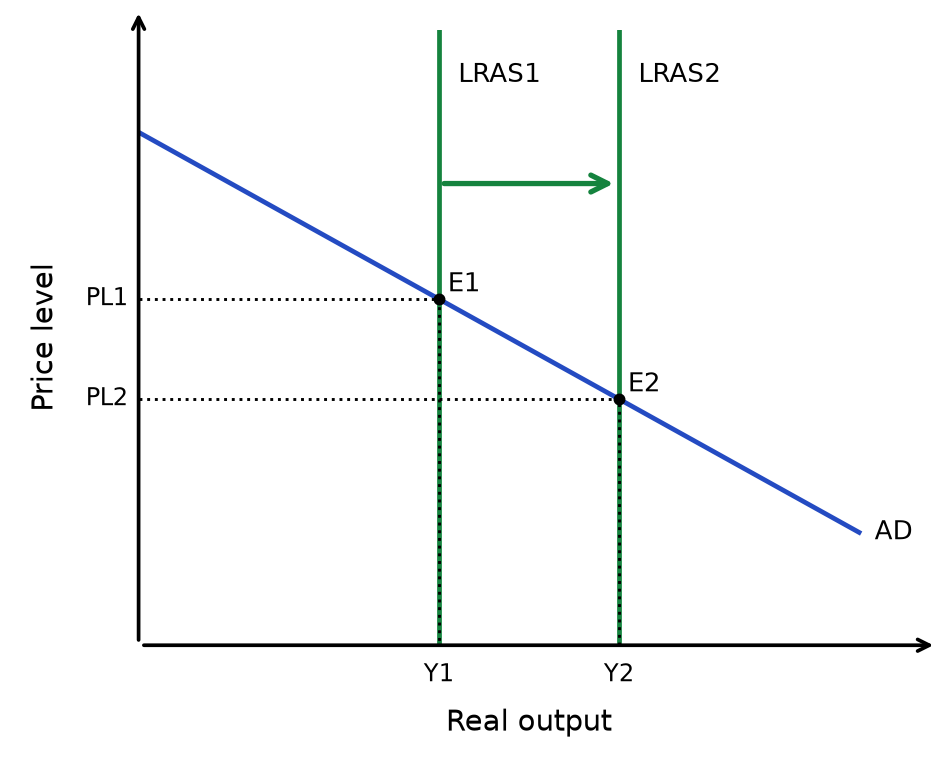
Read the diagram: A rise in productive capacity shifts LRAS right → find the new intersection with unchanged AD → read higher potential output and a lower price level in this classical illustration. The short-run transition can differ.
Strengths and weaknesses of different supply-side policies
- Strengths and weaknesses must always be judged against the stated aim of the policy — for example whether it is intended to cut unemployment, raise trend growth, or reduce inflationary pressure.
Strengths
Tackles the root cause of structural unemployment
education, training and labour mobility schemes address skills mismatches and immobility directly, which demand-side policy cannot do — supply-side policy is therefore better suited to structural unemployment, while demand-side policy is better for cyclical (demand-deficient) unemployment.
Non-inflationary growth
because LRAS shifts right, output can rise while the price level falls, so growth is achieved without the demand-pull inflation that a pure AD stimulus risks.
Improved international competitiveness
lower unit costs from higher productivity and better infrastructure make exports more price-competitive → (X − M) ↑, supporting the current account as well as growth.
Permanent rather than temporary gains
an increase in productive capacity raises the sustainable level of output, so the benefits persist rather than fading once a stimulus is withdrawn.
Weaknesses
Long time lags
education, training and infrastructure projects often take many years to affect output — a far longer lag than monetary policy — so supply-side policy is a poor tool for a short-run demand shock.
Limited direct effect on deficient demand
Retraining alone does not create enough demand for labour. Public training and infrastructure spending can also raise AD, while longer-term capacity gains depend on effective delivery.
Equity and distributional concerns
market-based measures such as cutting benefits, freezing the NMW or cutting top rates of income tax tend to benefit higher earners most and can widen income and wealth inequality.
Opportunity cost and fiscal cost
interventionist policies require substantial government spending, which either worsens the budget position or crowds out other spending such as healthcare — spending that may be wasted if the government misjudges which skills or projects are needed (government failure).
Uncertain behavioural response
tax cuts only raise labour supply and investment if workers and firms actually respond as assumed, and privatisation only raises efficiency if the market is genuinely competitive rather than a private monopoly.
Match the policy to the binding constraint. Training alone cannot solve weak labour demand, and deregulation can have external costs; compare likely capacity gains, implementation time and opportunity cost.
Rapid recap
Match the constraint: education and training target skills; infrastructure targets production costs and access; competition and tax reforms target incentives and market functioning.
Explain: the policy must change resources, productivity or effective incentives before LRAS can shift right. Spending on implementation may also affect AD initially.
Judge: suitable jobs, complementary investment, delivery time and opportunity cost determine whether extra capacity becomes higher output and living standards.
Diagram cue: show the productive-capacity shift and identify the resource or productivity change.
Related chapters: Unit 2 chapter 3 (p. 44) · Unit 3 chapter 17