Fiscal policy uses taxation and public spending to influence economic outcomes.
Must know
- Expansionary policy tends to raise AD.
- Contractionary policy tends to reduce AD.
- Automatic stabilisers respond without a new policy decision.
Must know definitions
Fiscal policy: the use of government spending and taxation to influence the level of aggregate demand and achieve macroeconomic objectives.
Direct tax: a tax imposed on income or profit, paid directly to the government by the taxpayer.
Indirect tax: a tax imposed on expenditure on goods and services, raising production costs and market price.
Expansionary fiscal policy: an increase in G and/or a cut in T designed to increase AD.
Deflationary (contractionary) fiscal policy: a cut in G and/or a rise in T designed to decrease AD.
Automatic stabilisers: government spending and taxation that adjust automatically over the economic cycle without new policy decisions.
Discretionary fiscal policy: deliberate changes to government spending and/or taxation to achieve economic objectives.
Crowding out: a reduction in private sector spending or investment caused by increased government borrowing.
Explain and apply
Mechanism in brief: Government purchases raise demand directly and can generate further spending through the multiplier. Productive infrastructure may later increase capacity, so the demand effect and supply effect occur through different mechanisms and time horizons.
Distinguish: Benefits are transfer payments; a budget deficit is a flow rather than the debt stock.
Use the extract: Identify the spending or tax change, the recipients and the budget position; trace the effect through spending and capacity separately.
Demand-side policies are policies designed to influence the level of aggregate demand in an economy.
- Monetary policy involves using interest rates and the money supply to affect AD, and is conducted by the central bank (the Bank of England in the UK).
- Fiscal policy involves government spending and taxation, and is conducted by the government.
- Reflationary (expansionary) policies are designed to increase AD, while deflationary (contractionary) policies are designed to decrease AD — this distinction applies to both fiscal and monetary policy.
Fiscal policy is the use of government spending (G) and taxation (T) to influence the level of aggregate demand and achieve macroeconomic objectives.
- AD = C + I + G + (X − M). Government purchases directly affect G; income taxes and transfer payments influence households’ disposable income and therefore C. Business taxes may also affect investment. Do not subtract T again as a separate component of AD.
Government spending
- Government spending covers current spending (e.g. public sector wages, healthcare, education) and capital spending (e.g. infrastructure, hospitals, schools).
- Governments can target spending increases at specific areas of the economy that need stimulating, influencing the size of the circular flow of income directly, since G is itself a component of AD.
Taxation
Taxation is compulsory revenue collected by the government from households and firms, and is split into direct and indirect taxes.
| Tax type | Definition | Examples |
|---|---|---|
| Direct tax | Imposed on income/profit, paid directly to the government by the taxpayer | Income tax, corporation tax, national insurance contributions, inheritance tax |
| Indirect tax | Imposed on expenditure on goods and services; raises production costs for producers, which raises market price and contracts demand | VAT (ad valorem — a percentage of price, e.g. 20%), fuel duty (specific — a fixed amount per unit, e.g. 57.95p per litre on petrol and diesel in the UK from 23 March 2011 to 22 March 2022) |
Income-tax changes affect consumption through disposable income
Income-tax cut
Disposable income rises → households spend a proportion of the increase → C and AD rise. Saving, debt repayment and spending on imports limit the domestic demand effect.
Income-tax rise
Disposable income falls → consumption tends to fall → AD shifts left. The response depends on savings buffers, expectations and which households are affected.
Expansionary and deflationary (contractionary) fiscal policy
Expansionary fiscal policy aims to increase AD, typically used to close a negative output gap or stimulate growth during a downturn.
Governments increase G and/or cut T
Higher government purchases raise G directly. An income-tax cut instead works through disposable income and C; a business-tax cut may affect I. Identify the instrument before shifting AD right. With spare capacity, the output gain is usually larger relative to the price-level effect.
The multiplier magnifies the initial spending change. Government purchases enter AD directly; a tax cut first raises disposable income, and only the portion spent initially raises consumption. Do not apply the spending multiplier directly to the full tax cut.
This normally worsens the government's budget position (a larger fiscal deficit), and may require more borrowing — an important trade-off examiners expect you to weigh against the growth benefit.
Figure 2.25 AD and AS equilibrium
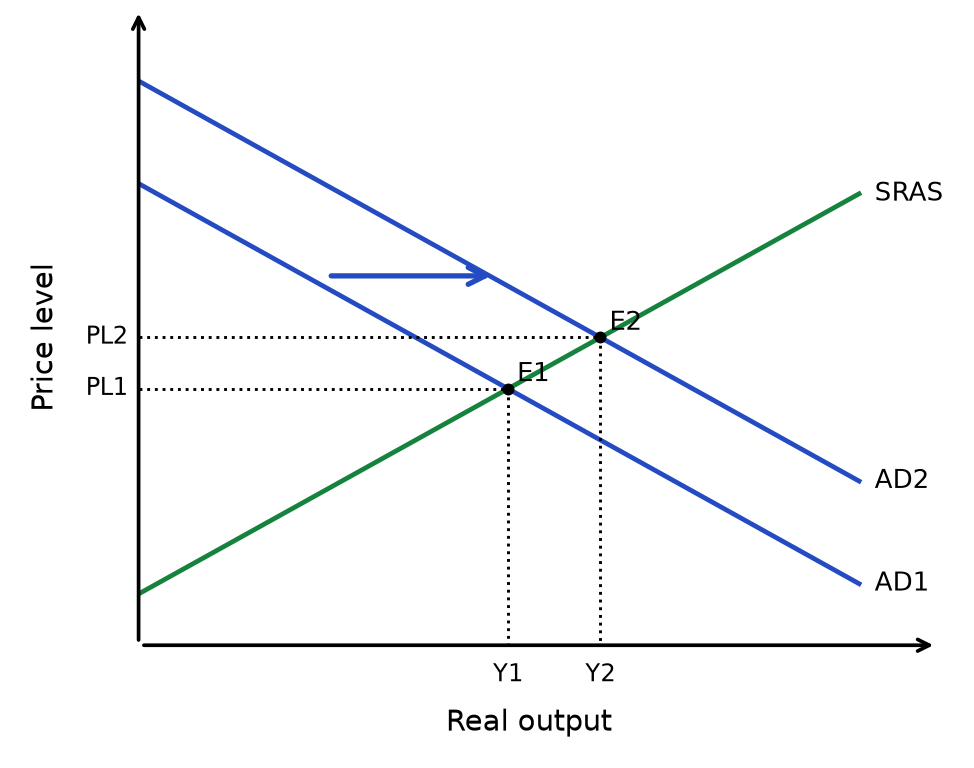
Read the diagram: Identify a non-price determinant that changes AD → shift AD right, holding the other curve fixed → find the new intersection → price level rises and real output rises. The price-level change is a movement along the unchanged curve. This result assumes upward-sloping SRAS; spare capacity and the curve’s slope determine the real-output response. A higher price level is not the same as a permanently higher inflation rate.
Deflationary (contractionary) fiscal policy aims to decrease AD, typically used to control demand-pull inflation or cool an overheating economy.
Governments cut G and/or raise T
Lower government purchases reduce G directly. Higher income tax tends to reduce C through disposable income. AD shifts left; the balance between lower output and lower inflationary pressure depends on spare capacity and supply conditions.
This normally improves the government's budget position, but risks slowing growth and raising unemployment if withdrawn from the economy too aggressively — a classic policy conflict between inflation control and growth/employment objectives.
Figure 2.26 AD and AS equilibrium
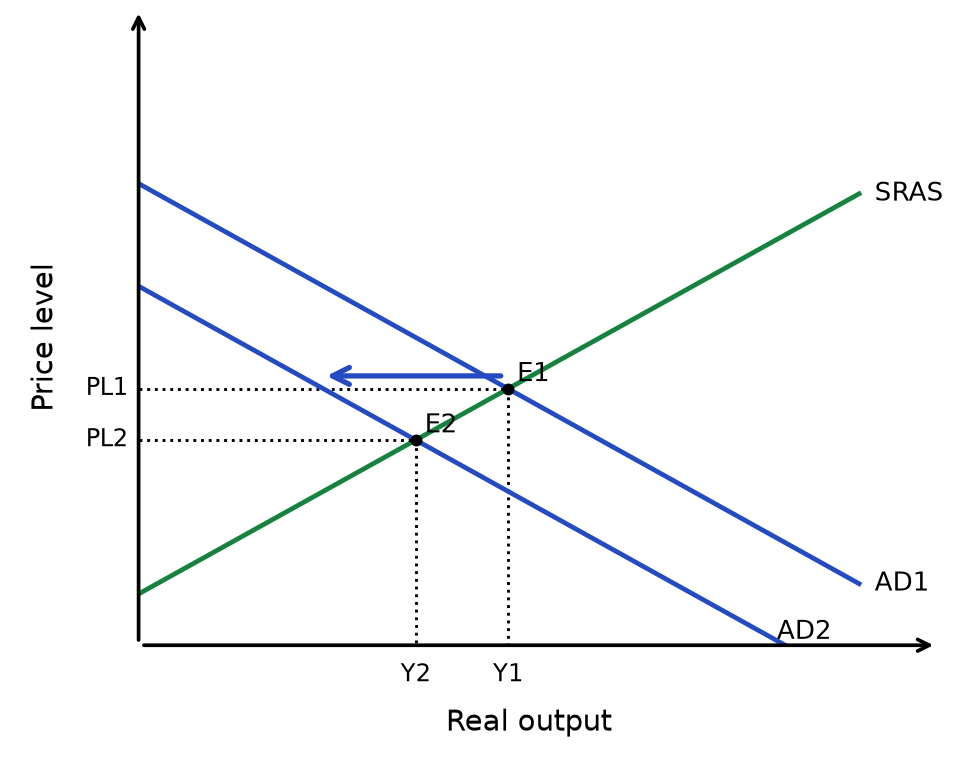
Read the diagram: Identify the spending component that falls → shift AD left with SRAS unchanged → read the lower real output and price level at the new intersection. This static comparison shows a lower price level than otherwise; it does not by itself establish ongoing deflation.
Common mistake: the size of the effect on real output versus price level depends on the shape of the AS curve at the point of intersection.
- On a Keynesian LRAS, a rightward AD shift on the flat section raises real output with little effect on the price level, whereas near/beyond full capacity the same AD shift is mostly inflationary.
- On a classical (vertical) LRAS, any AD shift only affects the price level in the long run, with real output unchanged.
Automatic stabilisers and discretionary fiscal policy
Automatic stabilisers are changes in government spending and taxation that occur automatically as the economy moves through the business cycle, without any deliberate policy decision.
- In a downturn, unemployment benefit payments tend to rise and tax receipts tend to fall automatically. These changes support disposable income and consumption. Benefits are transfers, not purchases of current output, so they do not enter G directly in the AD identity.
Discretionary fiscal policy is the deliberate, active alteration of government spending and/or taxation to achieve specific economic objectives, such as a Budget announcement to cut income tax to stimulate growth.
| Automatic stabilisers | Discretionary fiscal policy | |
|---|---|---|
| Trigger | Built into the system — reacts automatically to the economic cycle | Deliberate government decision |
| Example | Unemployment benefits rise in a recession without new legislation | Government announces a tax cut or new infrastructure spending programme |
Limitations of fiscal policy
- For an evaluation question, explain a limitation, identify a condition that strengthens or weakens it, and use that condition to judge the likely policy outcome. A list of limitations does not establish their importance.
| Limitation | Explanation | Evaluation |
|---|---|---|
| Imperfect information | Governments may lack accurate, timely data on the size of the output gap, risking a wrongly-sized or wrongly-timed policy | More serious near capacity, where an overestimated output gap risks inflation. A clear demand shortfall supports a stronger case for stimulus despite imperfect data. |
| Time lags | Recognition, decision, and implementation lags mean fiscal policy can take months to years to take effect | The economy may shift phase before impact — a bigger criticism of discretionary policy than automatic stabilisers, which act immediately |
| Crowding out | Government borrowing competes with the private sector for funds → interest rates ↑ → private investment ↓ | Spare capacity and supportive monetary policy can reduce crowding out. Financing risks or central-bank tightening can still limit stimulus; near capacity, competition for workers and materials is stronger. |
| Size of the multiplier | The spending multiplier magnifies the initial injection. A tax cut first affects disposable income; its initial consumption effect depends on how much is spent. | Larger when MPC is high and leakages are low, so identical stimulus size can have very different effects |
| High interest rates | Tax cuts or spending rises are less effective when borrowing is already expensive | Works best when accommodated by loose monetary policy; a hiking central bank blunts the stimulus |
| Debt sustainability | Persistent deficits raise the national debt and future debt-servicing costs | Recovery can reduce the cyclical deficit, but does not automatically reverse accumulated debt. Sustainability depends on financing costs, growth and the returns from spending, not the deficit label alone. |
Common mistake: crowding out is often confused with the multiplier effect — crowding out is a limitation on fiscal policy (higher borrowing pushes up interest rates, reducing private investment), not a magnification mechanism like the multiplier.
Spare capacity makes real-output gains more likely; resource or financing constraints increase crowding-out risks. Prefer a project with demonstrable productivity benefits and deliverable timing when judging whether borrowing is worthwhile.
Rapid recap
Instrument → demand: higher G enters AD directly; income-tax cuts affect C through disposable income and the amount spent. Do not apply the spending multiplier to the full tax cut.
Outcome: stronger AD can raise real output and employment with spare capacity; nearer capacity, inflationary pressure is more likely. Import spending can weaken the current account.
Judge: compare timing, leakages, crowding out and financing costs. Productive investment may also raise capacity; a deficit alone does not show whether spending is worthwhile.
Diagram cue: show the AD effect and any separately justified capacity effect.
Related chapters: Unit 2 chapter 5 (p. 64) · Unit 4 chapter 13
Why this connects: The multiplier explains repeated demand effects of spending; the debt chapter in Unit 4 asks whether financing and future returns make borrowing sustainable.