Wages and employment depend on supply, demand, bargaining and market power.
Must know
- Competitive equilibrium uses labour supply equals labour demand.
- Monopsony uses marginal employment cost equals MRP.
- A suitable minimum wage can raise employment in monopsony.
Must know definitions
Wage rate: the price of labour, determined by the interaction of labour demand and labour supply.
Participation rate: the proportion of the working-age population that is employed or actively seeking work.
Under-employment: a situation where a worker is employed but working fewer hours than desired, or in a role below their skill level.
Monopsony: a labour market with a single (or dominant) buyer of labour, able to pay a wage below the competitive level.
Trade union: an organisation of workers that negotiates pay and conditions with employers through collective bargaining.
Minimum wage: a wage floor set by a government (or negotiated by a union) below which employers may not legally pay workers.
Bilateral monopoly: a labour market with both a monopsony employer and a monopoly union, where the final wage depends on relative bargaining strength.
Kinked supply curve: a binding wage floor creates a horizontal effective labour-supply segment at that wage up to the quantity willing to work, followed by the original rising supply curve.
Explain and apply
Mechanism in brief: Under monopsony, an appropriately set wage floor can flatten marginal hiring cost over a range. This can raise both wages and employment; a sufficiently high floor instead makes labour too costly and reduces demand.
Distinguish: Read the monopsony wage from supply, not MRP; a wage floor set too high can reduce employment in either model.
Use the extract: Identify competitive conditions or buyer power, then compare the proposed wage with the model's relevant wage levels.
Labour market equilibrium
- The wage rate is the price of labour, determined in a competitive labour market by the interaction of labour demand and labour supply.
- If the wage rate is above the market-clearing level, labour supply exceeds labour demand — there is excess supply, meaning some workers cannot find jobs at that wage, so the wage rate tends to fall towards equilibrium.
- If the wage rate is below the market-clearing level, labour demand exceeds labour supply — there is excess demand and a labour shortage, so firms must raise wages to attract enough workers, pushing the wage rate up towards equilibrium.
wage rate above equilibrium → labour supplied > labour demanded → excess supply of labour (unemployment at that wage) → wage rate falls towards We, ceteris paribus
wage rate below equilibrium → labour demanded > labour supplied → excess demand for labour (labour shortage) → wage rate rises towards We, ceteris paribus
- The participation rate — the proportion of the working-age population that is either employed or actively seeking work — matters for labour market equilibrium because it determines the size of the labour supply available at any wage rate.
- A rise in the participation rate shifts labour supply to the right, and a fall shifts it left, independently of the wage rate itself.
- Equilibrium in the labour market does not mean everyone of working age has a job: unemployment occurs when someone actively seeking work cannot find any, while under-employment occurs when someone is employed but working fewer hours than they would like, or in a role below their skill level — both represent labour that is not being fully utilised even when the market has technically cleared.
Figure 3.25 Labour market equilibrium
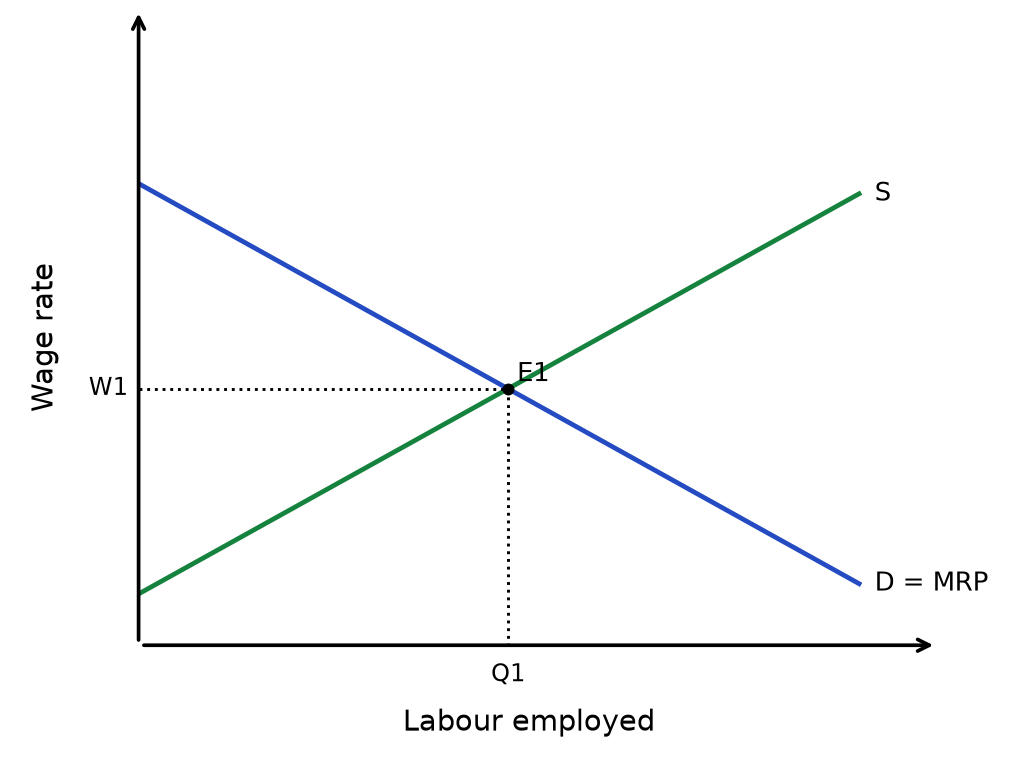
Read the diagram: At the intersection, planned demand equals supply. Read the two equilibrium coordinates from the axes.
Causes of changes in the equilibrium wage rate and quantity of labour
- Any factor that shifts the demand curve or supply curve for labour will change the equilibrium wage rate and quantity of labour employed.
- For example, an increase in net inward migration of a particular type of worker shifts the labour supply curve to the right, lowering the equilibrium wage rate for that occupation and increasing the equilibrium quantity employed.
- Conversely, a rise in demand for the final product a group of workers helps produce shifts the labour demand curve to the right, raising both the equilibrium wage rate and quantity employed.
net migration into an occupation ↑ → labour supply curve shifts right → equilibrium wage rate ↓, equilibrium quantity of labour ↑, ceteris paribus
demand for the final product ↑ → derived demand for labour shifts right → equilibrium wage rate ↑, equilibrium quantity of labour ↑, ceteris paribus
Figure 3.26 Labour market equilibrium
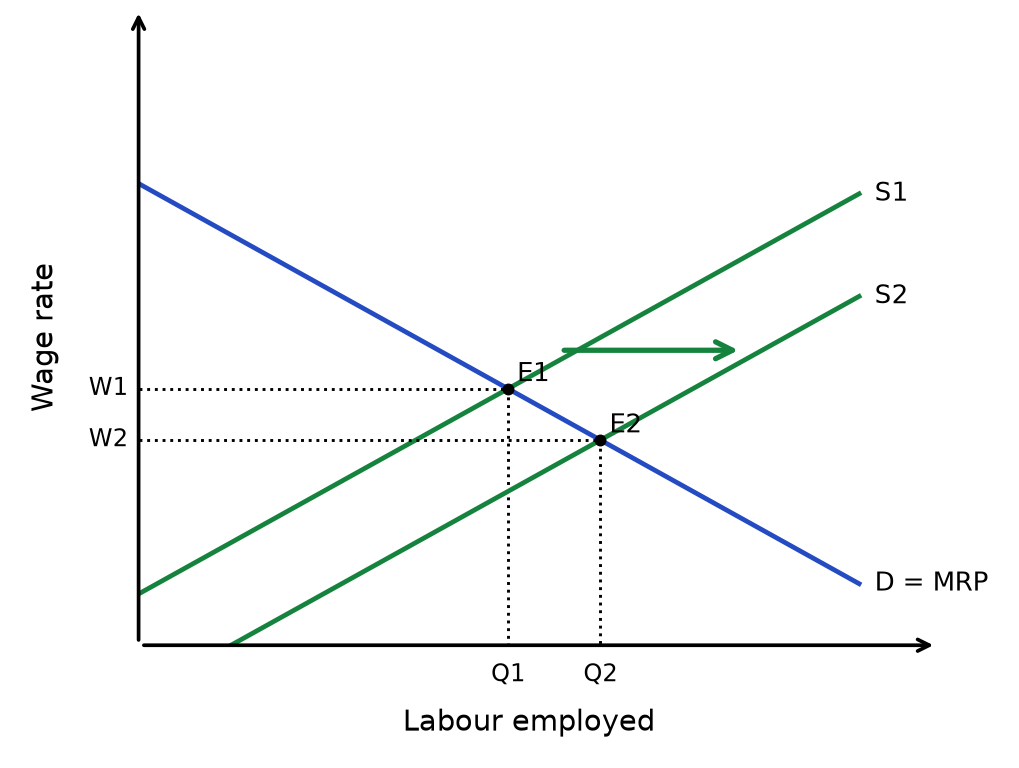
Read the diagram: Identify a non-price determinant that changes labour supply → shift labour supply right, holding the other curve fixed → find the new intersection → wage falls and employment rises. The price change causes movement along the unchanged curve. Elasticities determine the size of the response.
Wage setting in the public sector/state-owned enterprises
- Government wage-setting decisions in the public sector can influence the wider labour market.
- If public-sector wages rise relative to private-sector wages, private employers may be forced to raise their own wages to retain staff, since workers can otherwise move to the now-relatively-better-paid public sector.
- In the short run the government can set public-sector wages largely independently of market pressure — for example, a public-sector pay freeze puts downward pressure on private-sector wages, since few workers are likely to leave the private sector for a frozen public-sector wage, letting private employers point to this as a reason to limit their own pay rises.
- In the long run, if private-sector wages rise while public-sector wages do not, some workers may move to comparable private-sector jobs. Recruitment and retention difficulties can put pressure on the government to raise public-sector wages, but the response depends on budgets, bargaining arrangements and the availability of alternative jobs.
Public-sector pay becomes less attractive relative to available alternatives → recruitment and retention may worsen → government faces pressure to improve pay or conditions. Its response depends on budgets, bargaining and policy choices; staffing shortages can persist.
Wage determination in non-competitive markets
- In an imperfectly competitive labour market, wages are not simply determined where demand equals supply — one side of the market can exert power over the wage rate.
- A significant case is monopsony power, which causes a form of labour market failure, and which a trade union or a government-set minimum wage can act to correct.
Monopsony as a labour market failure
where there is a single major buyer of labour (a monopsonist employer), the firm faces an upward-sloping labour supply curve (AC) but its marginal cost of labour (MC) lies above it, because hiring one extra worker raises the wage that must be paid to all workers, not just the marginal one.
The monopsonist maximises profit by employing where MC = D (=MRP), giving a lower quantity of labour Lm and a lower wage Wm (read off the supply curve at Lm) than the competitive outcome of Lc at wage Wc.
This is a market failure because workers are paid below the value of their marginal revenue product and fewer of them are employed than the competitive, allocatively efficient outcome — the gap between Wc and Wm, and between Lc and Lm, represents labour exploited by the monopsonist's market power.
MC of labour lies above the supply curve → monopsonist profit-maximises where MC=MRP at Lm → wage paid (read off supply curve) is Wm < competitive wage Wc, and quantity employed Lm < competitive quantity Lc → workers paid below their MRP and under-employed relative to the competitive outcome → market failure
Figure 3.27 Monopsony and a minimum wage
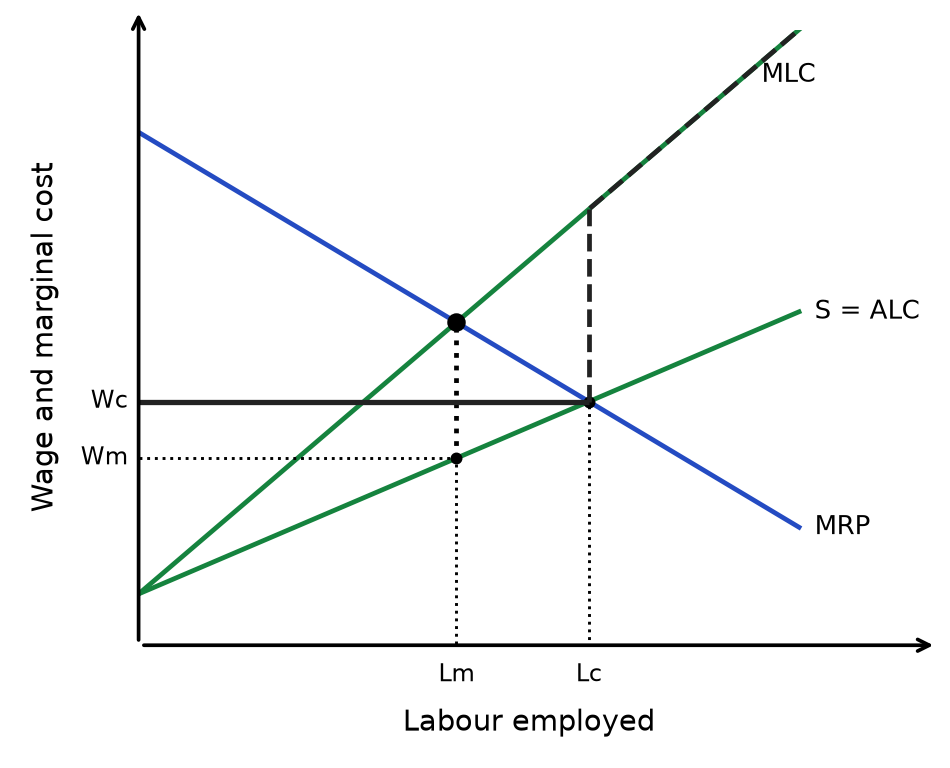
Read the diagram: Find Lm where MRP = MLC and read Wm from supply → introduce the illustrated minimum wage Wc → marginal labour cost is flat up to Lc → employment and pay can both rise. A substantially higher wage floor can instead reduce employment.
Correcting monopsony power
trade unions and the minimum wage — a negotiated or statutory wage floor can counter monopsony power. Over the range where enough workers are willing to work at that wage, the firm can hire extra workers at the same wage, so marginal labour cost equals the wage. A suitably set floor can raise both wages and employment relative to the unregulated monopsony outcome; a floor set too high can reduce employment.
A trade union acting as the sole seller of labour can set a minimum acceptable wage below which its members will not work; a government can achieve the same effect for the whole market through a legally-set minimum wage.
A binding wage floor creates a horizontal effective labour-supply segment at that wage up to the quantity willing to work, followed by the original rising supply curve.
Crucially, when the starting point is a monopsony (rather than a competitive market), setting the floor between the monopsony wage Wm and the competitive wage Wc can raise both the wage and employment simultaneously — correcting the market failure — rather than trading off higher wages against lower employment as a union would in an otherwise competitive market.
Set the floor too high, above the competitive wage Wc, and the usual trade-off returns: wages rise further but employment falls below Lc as firms cut back along their demand curve.
trade union or minimum wage sets a wage floor Wu between the monopsony wage Wm and the competitive wage Wc → monopsonist can no longer depress wages by restricting hiring → both wage and quantity of labour employed rise towards the competitive outcome → monopsony market failure is corrected; but wage floor set above Wc → firms cut employment along the demand curve → wages rise further but employment now falls below the competitive quantity Lc
Bilateral monopoly
some labour markets combine monopsony (on the buying/employer side) with union monopoly power (on the selling/labour side) — a bilateral monopoly.
The employer, left alone, would set a low wage and low quantity of employment; the union, left alone, would set a higher minimum wage.
The wage actually agreed depends on the relative bargaining strength of each side, which itself depends on factors such as the size and unity of the union and the state of the wider economy — unions typically have stronger bargaining power in periods of low unemployment/full employment, and weaker power during recessions when jobs are scarcer.
monopsony employer (wants a low wage) meets union monopoly power (wants a high minimum wage) → final wage is indeterminate from the model alone → outcome depends on relative bargaining strength of each side
Impact on stakeholders
| Stakeholder | Pros | Cons |
|---|---|---|
| Workers/labour | A trade union or minimum wage correcting monopsony power can raise both wages and employment; even in an otherwise competitive market, union power can raise wages with little employment loss if demand for labour is inelastic | Monopsony power depresses both wages and employment below the competitive level; a wage floor set above the competitive wage cuts employment |
| Employers | Monopsony power lowers labour costs, supporting higher profits | Union monopoly power raises wage costs and can reduce the quantity of labour a firm chooses to employ |
| Government | Can influence the wider labour market through public-sector wage setting without directly regulating private wages | Must balance public-sector pay against pressure on the public finances and knock-on effects on private-sector wages |
| Consumers | Lower labour costs under monopsony can feed through to lower prices | Higher wage costs from union bargaining power can be passed on as higher prices |
| Society | — | Wages set away from the competitive equilibrium (by either monopsony or union power) represent a departure from allocative efficiency in the labour market |
State the market structure before judging wage policy. Employment effects depend on the floor relative to the relevant wages, employer responses and enforcement; the competitive excess-supply prediction is not universal.
Rapid recap
Competition: labour demand and supply determine the market wage and employment. A binding minimum above equilibrium creates excess labour supply in the basic competitive model.
Monopsony: employment comes from MRP = MLC and the wage from supply. A minimum between the monopsony and competitive wage can raise pay and employment in the standard model.
Judge: specify the wage level, market structure, labour-demand responsiveness and enforcement. Higher pay for retained workers need not improve outcomes for every worker.
Diagram cue: compare wage-setting outcomes under competition and monopsony.
Related chapters: Unit 3 chapter 15 (p. 72) · Unit 3 chapter 20 (p. 96)
Why this connects: Use the labour-market structure to interpret intervention: a wage floor changes marginal hiring cost differently under competition and monopsony.