Demand for labour is derived from the additional revenue labour can generate.
Must know
- MRP equals MPP times MR.
- Own wage changes quantity demanded.
- Productivity and product demand can shift labour demand.
Must know definitions
Derived demand: demand for a factor of production (such as labour) that arises from demand for the final good or service it helps produce.
Marginal revenue product (MRP): the extra revenue a firm gains from employing one additional unit of labour (MRP = MPP × MR).
Wage elasticity of demand for labour: the responsiveness of the quantity of labour demanded to a change in the wage rate.
Must know relationship: MRP = MPP × MR; only for a product-market price taker does MR equal P.
Units: MPP is additional output per extra worker and MR is revenue per extra unit, so MRP is additional revenue per extra worker. Compare MRP with the marginal labour cost over the same period.
Explain and apply
Mechanism in brief: Higher worker productivity or product marginal revenue raises the revenue generated by an extra worker. This shifts MRP and can increase desired employment at each wage, other things equal.
Distinguish: MR equals product price only for a price taker; labour demand is not independent of product demand.
Use the extract: Identify changes in product demand, worker productivity or product marginal revenue; link them to MRP.
Factors that influence the demand for labour to a particular occupation
The demand for labour is a derived demand: firms hire workers to produce goods and services, so demand for labour depends on demand for the final product that labour produces, not on labour itself.
Worked example: an additional worker produces 5 extra units per hour. If each unit adds $8 to revenue, MRP is 5 × $8 = $40 per hour. Compare the marginal revenue product with the marginal cost of employing the worker, not with total revenue.
Demand for labour depends on marginal revenue product
MRP = marginal physical product of labour × marginal revenue from selling the additional output. If the firm is a price taker in the product market, MR = price and MRP = MPP × price.
The demand curve for labour is downward sloping because the law of diminishing marginal returns means that, holding other factors of production fixed, each additional worker adds progressively less extra output, so a firm will only hire more workers if the wage rate falls.
demand for the final good ↑ → firms need more output → derived demand for labour ↑, ceteris paribus
worker productivity ↑ (e.g. better skills/training) → MRP of labour ↑ → demand for labour ↑ at any given wage rate
Several other factors shift demand for labour:
A rise in the price of the final product raises MRP and therefore demand for labour, as it becomes more profitable for firms to supply the product.
A rise in the price of capital relative to labour makes labour the relatively cheaper input, encouraging substitution towards labour where this is feasible. The overall effect on labour demand also depends on whether higher costs reduce output and whether capital and labour are substitutes or complements.
Figure 3.21 Shifts of D = MRP — Increase
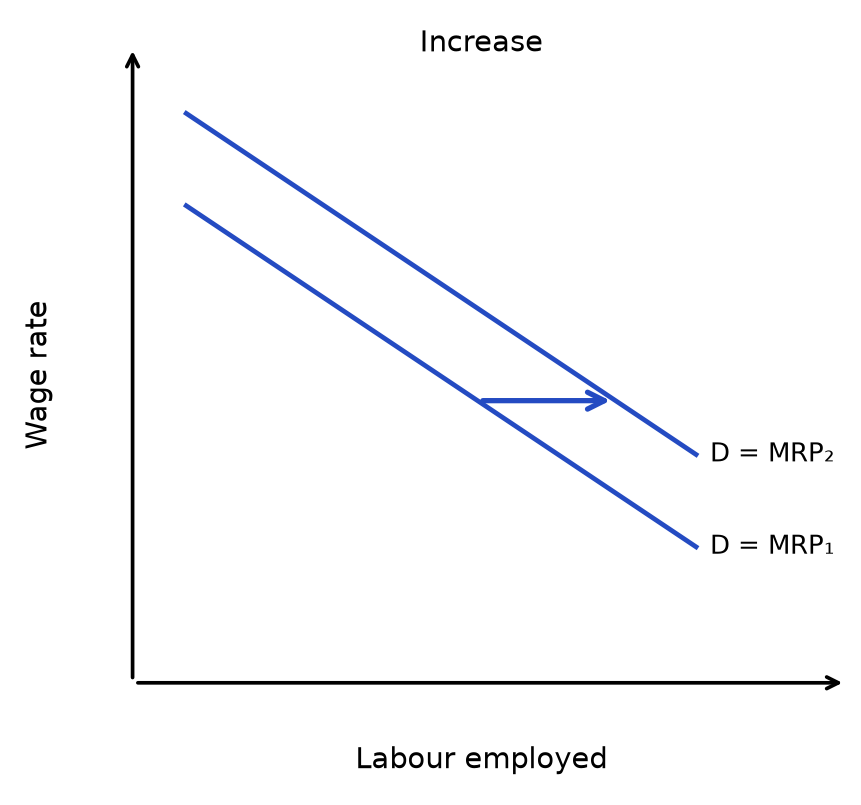
Figure 3.22 Shifts of D = MRP — Decrease
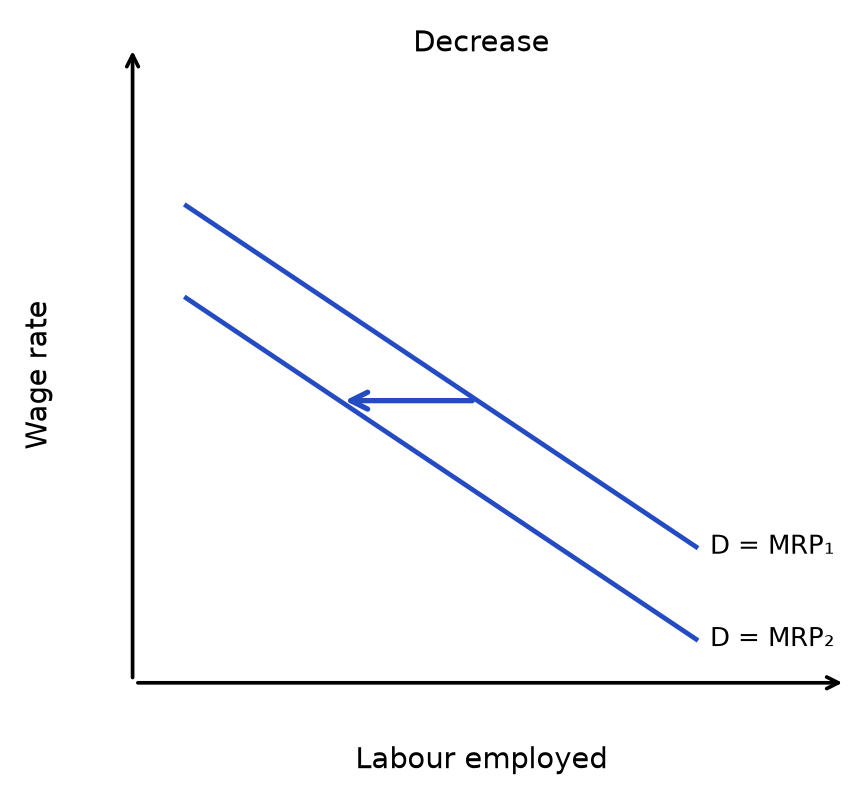
Read the diagram: Each panel shows a change in a non-price determinant, holding other influences fixed. The arrow runs from curve 1 to curve 2: an increase is a rightward shift; a decrease is a leftward shift. Compare quantities at the same vertical-axis value.
Factors that influence the elasticity of demand for labour
The wage elasticity of demand for labour measures how responsive the quantity of labour demanded is to a change in the wage rate.
- Where demand is elastic, firms cut employment sharply when wages rise and expand rapidly when labour becomes relatively cheap; where demand is inelastic, employment responds only modestly to wage changes.
- Elasticity depends on the proportion of labour costs in total costs (a higher proportion makes demand more elastic, since wage changes have a bigger impact on overall costs), the ease and cost of substituting labour for capital (easier substitution makes demand more elastic), the price elasticity of demand for the final product (a more elastic PED for the product makes labour demand more elastic, since a wage-driven price rise then causes a larger fall in sales and therefore in labour required), and the time period under consideration (demand for labour tends to be more elastic in the long run, once firms have time to invest in machinery or relocate production).
| Factor | Effect on wage elasticity of demand for labour |
|---|---|
| Labour cost as a proportion of total costs | Higher proportion → more elastic |
| Ease/cost of substituting capital for labour | Easier substitution → more elastic |
| PED of the final product | More elastic product demand → more elastic labour demand |
| Time period | Longer run → more elastic |
| Level of skill required | Highly skilled, hard-to-replace labour → more inelastic |
skilled/specialised labour with few substitutes → harder for firms to replace workers with machinery or other labour → demand for that labour is more wage-inelastic
The employment response depends on wage costs, substitution and adjustment time. Productivity growth can raise MRP but labour-saving technology may also replace tasks, so distinguish the affected occupations and mechanisms.
Rapid recap
Labour demand is derived from product demand. MRP = marginal physical product × marginal revenue; MR equals product price only under price-taking conditions.
Diagram cue: show the MRP shift caused by product demand or productivity.
Related chapters: Unit 3 chapter 4 (p. 19) · Unit 3 chapter 17 (p. 79)
Why this connects: Product demand affects labour demand through MRP. This is why a change in consumers’ demand can alter both output-market revenue and employment.