Labour supply to an occupation depends on pay and the attractiveness or accessibility of the work.
Must know
- Own wage causes movement along occupational supply.
- Training migration and working conditions can shift supply.
- Mobility and qualification times affect elasticity.
Must know definitions
Supply of labour: the quantity of labour that workers are willing and able to offer at a given wage rate, for a particular occupation.
Net migration: the difference between the number of people migrating into and out of a country or region, affecting the size of the available workforce.
Wage elasticity of supply of labour: the responsiveness of the quantity of labour supplied to a change in the wage rate.
Explain and apply
Mechanism in brief: Higher relative pay attracts people to an occupation or encourages additional hours. Training requirements and mobility costs can delay the response, making short-run occupational supply relatively inelastic.
Distinguish: Occupational labour supply is not the same as one individual's labour supply; a wage rise does not itself shift the curve.
Use the extract: Use training duration, migration, participation and working conditions to explain the available workforce.
Factors that influence the supply of labour to a particular occupation
- The supply of labour to a particular occupation shows the number of workers willing and able to work at each wage rate, and slopes upward.
- A higher wage generally attracts more workers into that occupation, both by drawing in new workers from other industries or from unemployment, and by encouraging existing workers to supply more hours.
Supply is also influenced by non-wage factors
Changes in the size of the population, influenced by natural change and by net migration (since migrants are typically of working age).
Income tax rates, which affect the incentive to work by changing take-home pay.
The level of welfare benefits, since generous out-of-work benefits can reduce the incentive to take a job.
Government regulations, such as employment legislation affecting a firm's ability to hire and fire workers.
The power of trade unions, which can restrict entry to an occupation (e.g. requiring a specific qualification) and so limit the pool of eligible workers.
An occupation’s wage rises → quantity of labour supplied increases along its supply curve. Migration, qualifications and non-wage conditions can instead shift supply.
Figure 3.23 Shifts of S — Increase
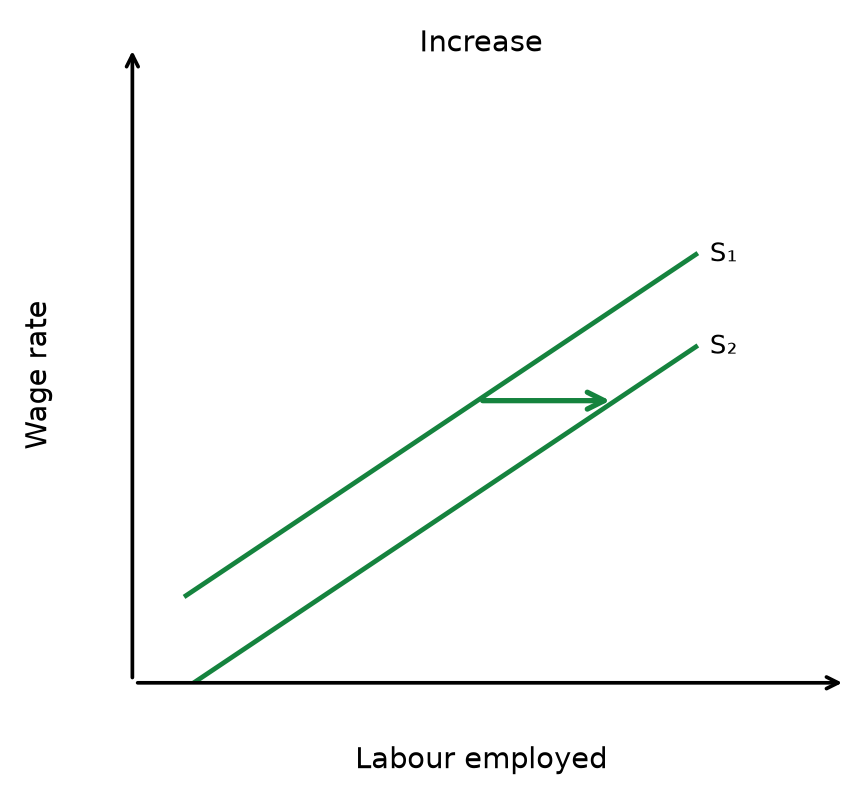
Figure 3.24 Shifts of S — Decrease
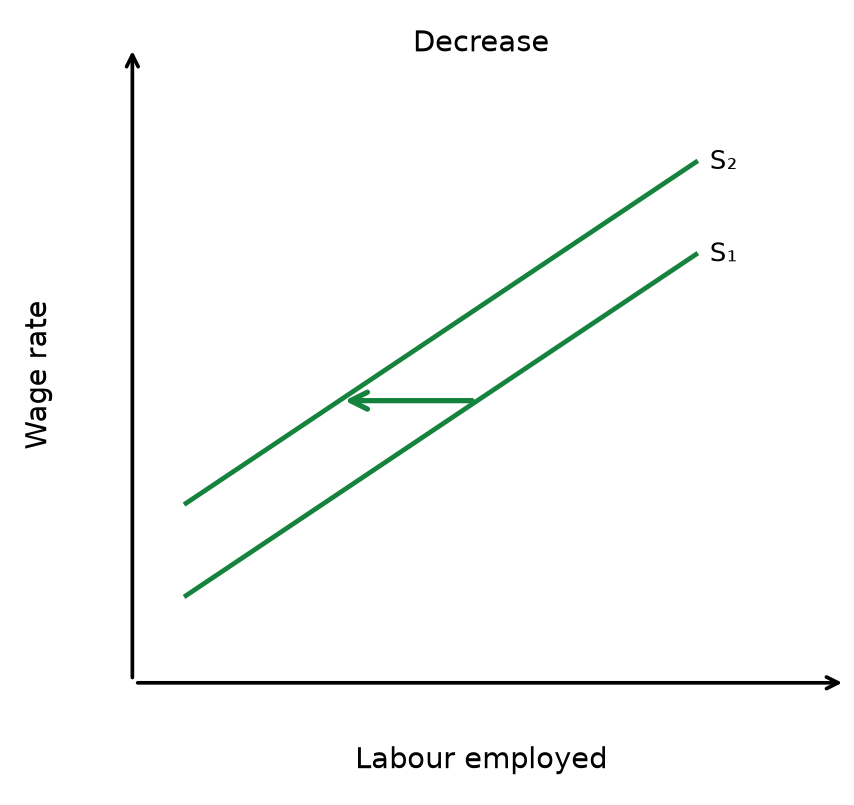
Read the diagram: Each panel shows a change in a non-price determinant, holding other influences fixed. The arrow runs from curve 1 to curve 2: an increase is a rightward shift; a decrease is a leftward shift. Compare quantities at the same vertical-axis value.
Factors that influence the elasticity of supply of labour
- The wage elasticity of labour supply measures how responsive the quantity of labour supplied is to a change in the wage rate.
- In low-skilled occupations, supply tends to be elastic, since there is usually a ready pool of available workers who can enter with little delay.
- Where jobs require specific skills, extensive training, or formal qualifications, supply is more inelastic in the short run, because the workforce cannot be expanded quickly.
- Supply becomes more elastic over the long run once time allows new workers to complete the necessary training.
| Factor | Effect on wage elasticity of supply of labour |
|---|---|
| Level of qualifications/training required | Higher requirement → more inelastic |
| Availability of suitable labour in other industries | Easier to "poach" from other industries → more elastic |
| Time period | Longer run → more elastic (time to train/relocate) |
| Vocational nature of the job | Highly vocational → more inelastic (workers stay even if wages fall) |
high skill/qualification requirement → workforce cannot be expanded quickly → supply of labour to that occupation is wage-inelastic, at least in the short run
Distinguish one worker's hours from total occupational supply. An individual's income effect can reduce desired hours after a wage rise, while entrants may still increase the occupation's overall labour supply.
Rapid recap
Labour supply depends on pay, non-wage conditions, participation, migration and qualifications. A change in the occupation's wage causes movement along its supply curve.
Diagram cue: distinguish a labour-supply shift from movement caused by a wage change.
Related chapters: Unit 3 chapter 15 (p. 72) · Unit 3 chapter 20 (p. 96)