Labour-market policies target pay, mobility, inequality and discrimination.
Must know
- Wage controls affect quantities differently.
- Training and relocation support address different barriers.
- Enforcement matters for discrimination policy.
Must know definitions
Maximum wage: the highest wage firms are legally permitted to pay workers.
Minimum wage: the lowest wage firms are legally permitted to pay workers.
Geographical immobility: the difficulty workers face in moving location to take up a job.
Occupational immobility: the difficulty workers face in switching between different types of job, usually due to a lack of relevant skills.
Explain and apply
Mechanism in brief: Training or mobility support can improve job matching, while a wage floor changes hiring incentives directly. These are different mechanisms and need different evidence about the barrier and the likely response.
Distinguish: A maximum wage creates a shortage in the standard competitive model; a minimum wage creates excess supply only under the relevant assumptions.
Use the extract: Identify whether the barrier is skills, location, discrimination or wage-setting power; match the instrument to it.
The case for government intervention
- Governments intervene in labour markets to address immobility of labour, inequality, and discrimination.
- Left to the free market, wages and employment levels may leave some workers unable to move into better-paid work, earning too little to live on, or paid less than others doing the same job because of unfair treatment.
labour is geographically/occupationally immobile or discriminated against → free market wage outcomes are inequitable or inefficient → case for government intervention in the labour market
Types of government intervention in labour markets and their effects
- Maximum wage controls cap the highest wage a firm may legally pay.
- If set below the free market wage in an industry, firms face a shortage of workers, since fewer people are willing to supply their labour at the capped wage than firms would like to hire at that wage.
maximum wage set below equilibrium wage → quantity of labour supplied falls below quantity demanded → shortage of workers in that industry
Figure 3.28 Maximum wage
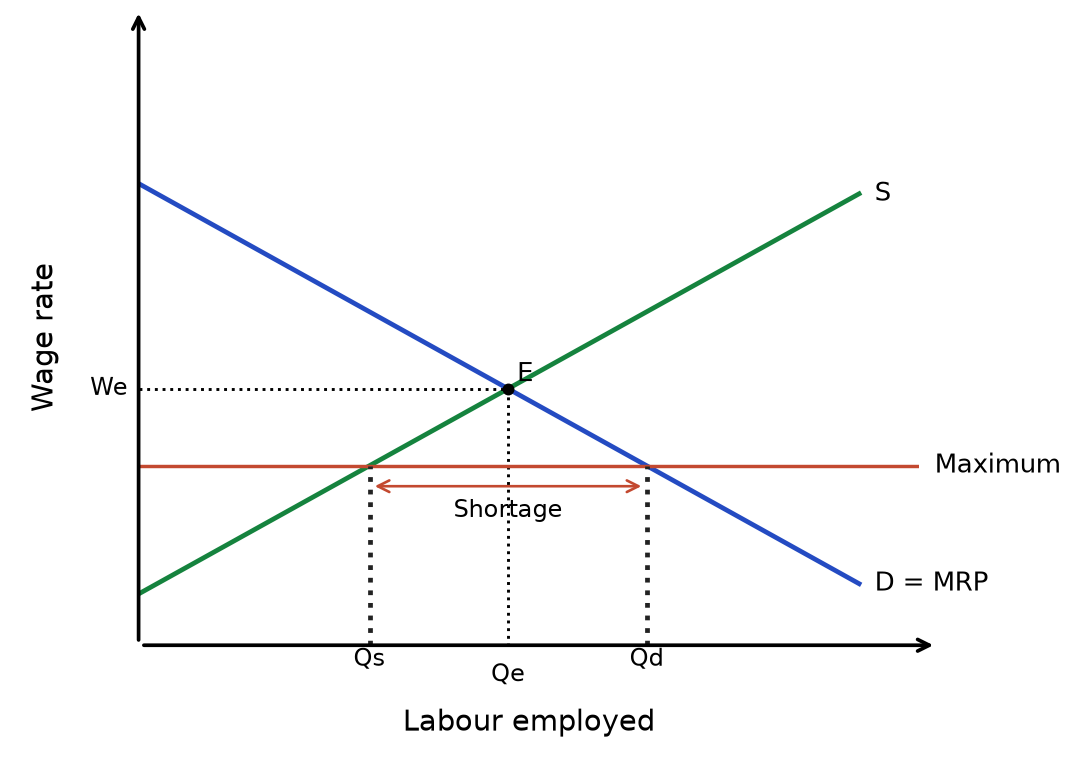
Read the diagram: A binding ceiling below equilibrium makes quantity demanded exceed quantity supplied. The gap is a shortage. This is the competitive labour-market model; a monopsony requires a different analysis.
| Pros | Cons |
|---|---|
| Can limit excessive pay in a specific role or sector (e.g. capping executive pay to reduce inequality) | Causes a shortage of workers if set below the market wage, as fewer people are willing to work at that capped rate |
| May be used to control a firm's costs, indirectly supporting employment elsewhere in the business | Firms facing a labour shortage may struggle to fill vacancies, harming output and service quality |
- Minimum wage controls set the lowest wage a firm may legally pay.
- A binding minimum wage above the competitive equilibrium wage We raises labour supplied to Qs and reduces labour demanded to Qd. Employment is Qd; excess labour supply is Qs − Qd.
- For a minimum wage in a competitive market, weigh higher pay for retained workers against possible lower employment and higher costs. For a maximum wage, assess lower pay, labour shortages, recruitment and retention, and distributional effects. In a monopsony, a suitably set minimum wage can raise both wages and employment; apply the relevant market model.
Minimum wage above We → labour supplied rises to Qs, labour demanded falls to Qd → excess supply of labour = Qs − Qd in the competitive model.
Figure 3.29 Minimum wage
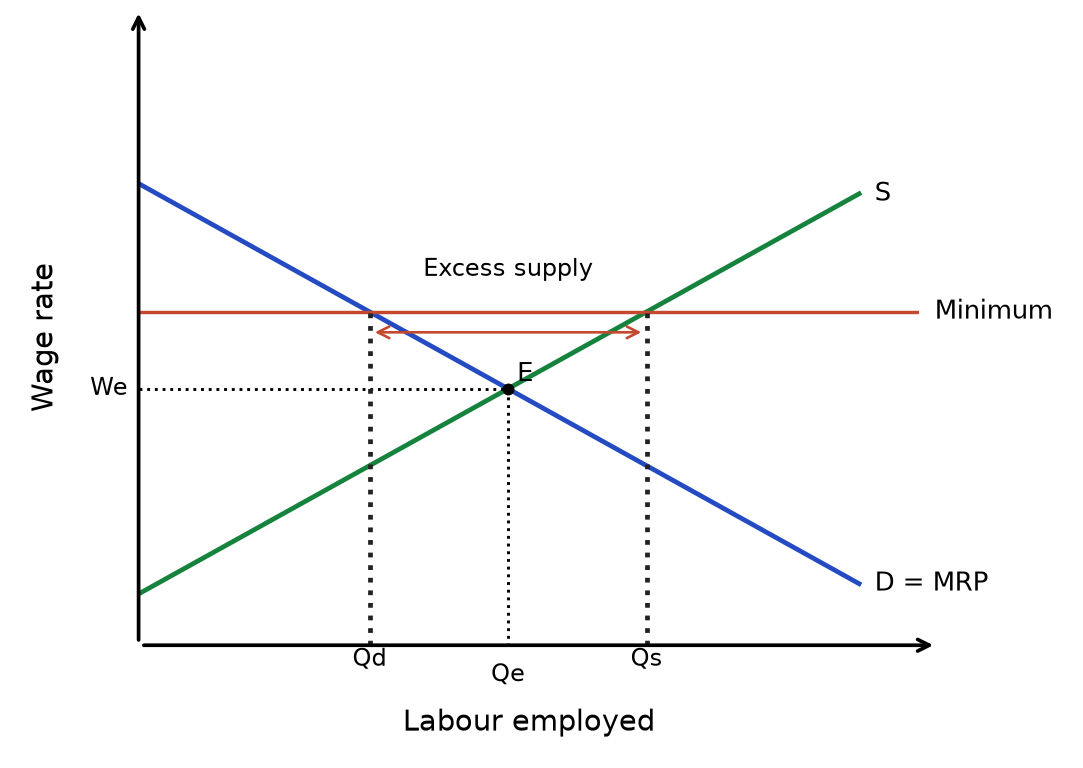
Read the diagram: A binding floor above equilibrium makes quantity supplied exceed quantity demanded. The gap is excess supply. This is the competitive labour-market model; a monopsony requires a different analysis.
| Pros | Cons |
|---|---|
| Raises income for the workers who remain employed, reducing in-work poverty and narrowing pay inequality | Can create excess labour supply (Qs − Qd) if set above the competitive wage, as firms reduce labour demanded |
| Can correct monopsony power — if a dominant employer was previously paying below the competitive wage, a minimum wage set at (or near) the competitive rate can raise both the wage and employment simultaneously | Raises firms' costs, which may be passed on to consumers as higher prices, or absorbed as lower profit |
| Encourages firms to invest in productivity (automation, training) to justify the higher wage cost | If set too high above the competitive wage, particularly in low-productivity sectors, job losses are more severe |
- Employer payroll taxes directly increase the cost of employing labour. Corporation tax is a tax on profits; it may affect investment and labour demand, but it is not itself a per-worker employment cost.
- Employers' national insurance contributions are an example of a payroll tax. A higher contribution raises the cost of employing workers; incidence depends on wage adjustment and labour-demand and labour-supply elasticities. Corporation tax is a separate tax on profits.
employer NIC/payroll tax imposed → firm's cost per worker ↑ → firm's profit ↓ and/or employment ↓, ceteris paribus
| Pros | Cons |
|---|---|
| Raises government revenue that can fund public services, including those (e.g. training schemes) that support the labour market | Raises the cost of employing labour, which can reduce a firm's profit and/or reduce the quantity of labour it demands |
| A lower employer payroll-tax rate can reduce employment costs and encourage hiring; the effect depends on labour demand and wage adjustment. | Higher payroll taxes may be passed on to workers via lower wages, or to consumers via higher prices |
- Measures to reduce geographical and occupational immobility of labour help workers move to where jobs are, or retrain for new roles.
- Housing and removal subsidies can reduce geographical immobility by covering the cost of relocating for work; training and education can reduce occupational immobility by equipping workers with skills for a different type of job.
housing/removal subsidies ↑ → cost of relocating for work ↓ → geographical immobility ↓ → workers can move to where labour demand is higher
training and education provision ↑ → workers acquire new skills → occupational immobility ↓ → workers can move into growing sectors
| Pros | Cons |
|---|---|
| Directly tackles the root cause of some structural/frictional unemployment, rather than just its symptoms | Subsidies and training programmes are costly to the government and take time to design and deliver |
| Improves the long-run flexibility and productivity of the workforce, benefiting both workers and firms | Retraining takes time, so the benefits are not immediate; some workers may not take up training even if offered |
- Measures to reduce discrimination and exploitation are typically enforced through legislation, backed by the threat of fines or imprisonment for firms found breaking anti-discrimination or exploitation laws.
| Pros | Cons |
|---|---|
| Improves equity in the labour market and can bring previously excluded workers into employment, raising output | Compliance and enforcement (monitoring, legal action) impose costs on both firms and government |
| Can improve productive efficiency by ensuring workers are allocated to jobs based on ability rather than discrimination | Legislation alone cannot eliminate more subtle or hard-to-prove forms of discrimination |
Policy success requires access, take-up and suitable jobs. A wage intervention can raise pay for some while reducing opportunities for others; combine the market model with the level of the policy and enforcement evidence.
Rapid recap
Labour-market policies address wages, skills, mobility, information or discrimination. Their effects depend on the diagnosed failure and labour-market structure.
Diagram cue: show the relevant wage control using the stated labour-market structure.
Related chapters: Unit 3 chapter 16 (p. 76) · Unit 3 chapter 17 (p. 79)