Economic profit deducts opportunity costs as well as explicit production costs.
Must know
- Profit equals TR minus TC.
- Normal profit is included in economic cost.
- Short-run shutdown and long-run exit use different cost thresholds.
Must know definitions
Normal profit: the minimum reward needed to keep an entrepreneur in an industry; occurs where TR = TC; treated as a cost of production.
Supernormal (abnormal) profit: profit earned above normal profit; occurs where TR > TC.
Loss: occurs where TR < TC.
Profit-maximising output: the feasible output giving the highest profit; at an interior maximum, MC = MR and MC crosses MR from below.
Short-run shutdown point: AR = AVC at the relevant best operating output, so TR = TVC. The firm is indifferent between producing and shutting down. For a competitive firm, the threshold is P = minimum AVC.
Long-run exit condition: the firm exits if no feasible output can cover total economic cost over time. AR = ATC gives normal profit at the relevant output; in long-run competitive equilibrium, P = minimum ATC.
Must know relationship: Profit = TR − TC = (P − AC) × Q.
Interpretation: P > AC gives supernormal profit; P = AC gives normal profit; P < AC gives a loss. The rectangle’s height is money per unit and its width is output, giving a money amount of profit or loss.
Explain and apply
Mechanism in brief: Choose feasible output using marginal revenue and marginal cost, then compare revenue with relevant costs. In the short run, unavoidable fixed costs remain during shutdown, so the decision depends on avoidable cost.
Distinguish: Normal profit is not zero accounting profit; P below AC does not automatically require immediate shutdown.
Use the extract: Compare price with AC and AVC at the chosen output; use the time horizon to assess continued production.
Normal profit, supernormal profit and losses
- Profit is the difference between total revenue and total cost, and it is the reward entrepreneurs receive for bearing the risk of running a business.
- For an interior profit maximum, MR = MC with MC crossing MR from below. Around this output, an extra unit raises profit when MR > MC and reduces it when MC > MR. Compare the best operating outcome with shutdown where relevant.
MR > MC → an extra unit adds more revenue than cost → increasing output raises profit locally.
MC > MR → an extra unit adds more cost than revenue → reducing output raises profit locally.
MC crosses MR from below → an interior profit maximum; compare it with any other feasible outcome and shutdown.
- Normal profit is the minimum reward needed to keep an entrepreneur supplying their enterprise rather than using their funds elsewhere; it covers the opportunity cost of the entrepreneur's time and capital, so it is treated as a cost of production rather than a "profit" in the everyday sense. Normal profit occurs where total revenue equals total cost (TR = TC).
- Supernormal profit (also called abnormal or economic profit) is any profit earned above normal profit, occurring where total revenue exceeds total cost (TR > TC) — this is the reward in excess of what was needed to keep the entrepreneur in the industry.
- A firm makes a loss when total revenue fails to cover total cost (TR < TC).
| Outcome | Condition | Meaning |
|---|---|---|
| Normal profit | TR = TC | Just enough to cover the opportunity cost of the entrepreneur's funds; treated as a cost |
| Supernormal profit | TR > TC | Profit in excess of the minimum needed to stay in the industry |
| Loss | TR < TC | Total revenue fails to cover total cost |
Figure 3.9 Firm output price and profit
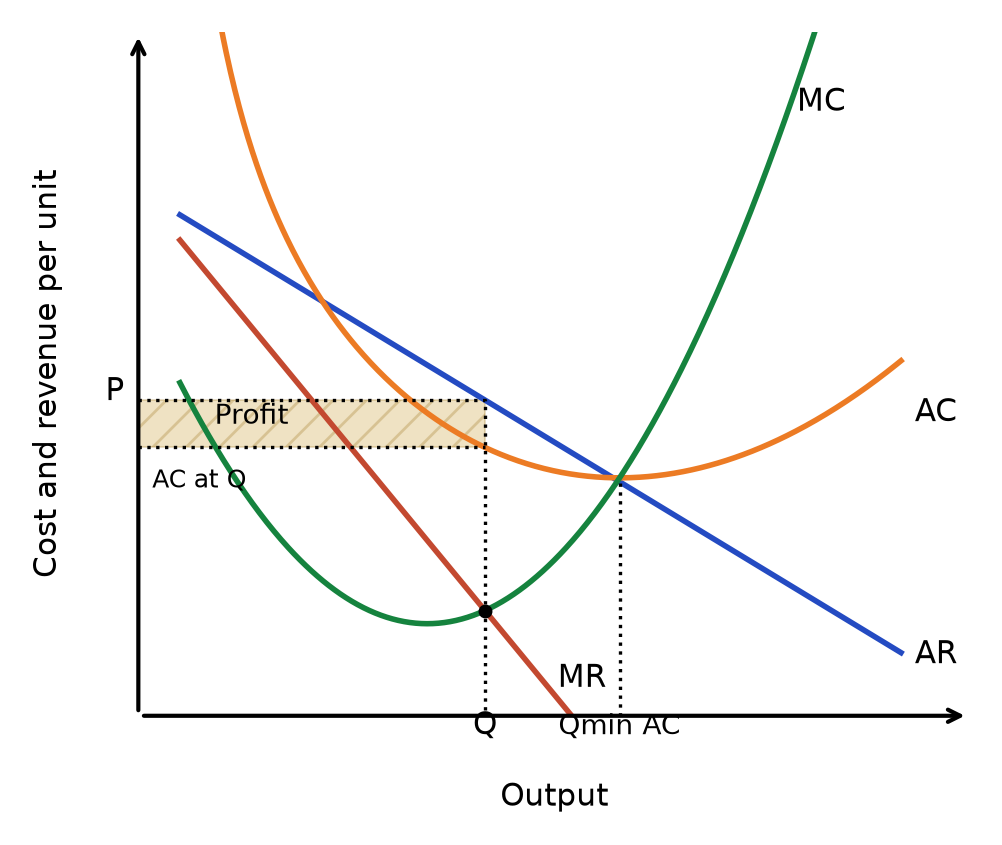
Read the diagram: Find Q where rising MC crosses MR → read P vertically above Q on AR → read AC at the same Q → profit is (P − AC) × Q, shown by the rectangle. Higher AC could turn this profit into a loss; downward-sloping demand alone does not guarantee profit.
Short-run and long-run shutdown points
- In the short run, compare total revenue with total variable cost at the best operating output. If TR > TVC (AR > AVC), production contributes towards unavoidable fixed costs and can reduce a loss. If no positive output covers variable cost, shutting down limits the loss to fixed cost.
- At the shutdown threshold, TR = TVC (AR = AVC at the relevant output): operating and shutting down give the same loss, equal to fixed cost. For a competitive firm, this threshold is P = minimum AVC.
At the best operating output: AR > AVC → revenue contributes towards fixed cost → operating is preferable to shutdown.
No positive output covers variable cost → shutdown avoids a further loss.
AR = AVC at the threshold → the firm is indifferent under the model assumptions.
- In the long run, all costs are variable, since a firm can eventually change all its factors of production, including exiting the industry entirely.
- In the long run, the firm must cover total economic cost, including opportunity costs, to remain viable. AR = ATC at the relevant output gives normal profit; AR > ATC gives supernormal profit. If no feasible output covers total cost over time, the firm exits. Under long-run perfect competition, entry and exit lead to P = minimum ATC.
| Time frame | Shutdown condition | Reasoning |
|---|---|---|
| Short run | AR < AVC at the best operating output | Fixed costs are paid regardless of output, so only variable costs matter for the shutdown decision |
| Long run | No feasible output covers total economic cost over time | All costs are avoidable in the long run, so the firm must at least earn normal profit to remain in the industry |
Figure 3.10 Firm output price and profit
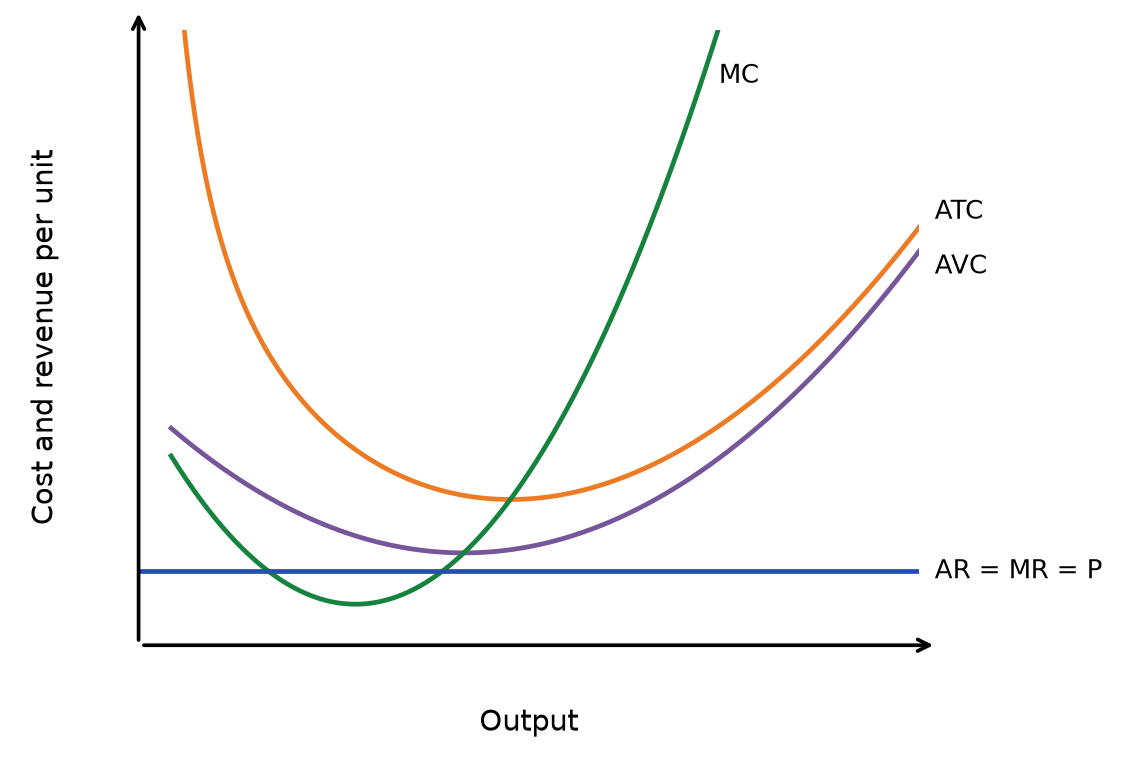
Read the diagram: Compare the horizontal price with minimum AVC → P lies below minimum AVC → no positive output covers variable cost → the firm shuts down in the short run. Fixed costs still remain.
Figure 3.11 Firm output price and profit
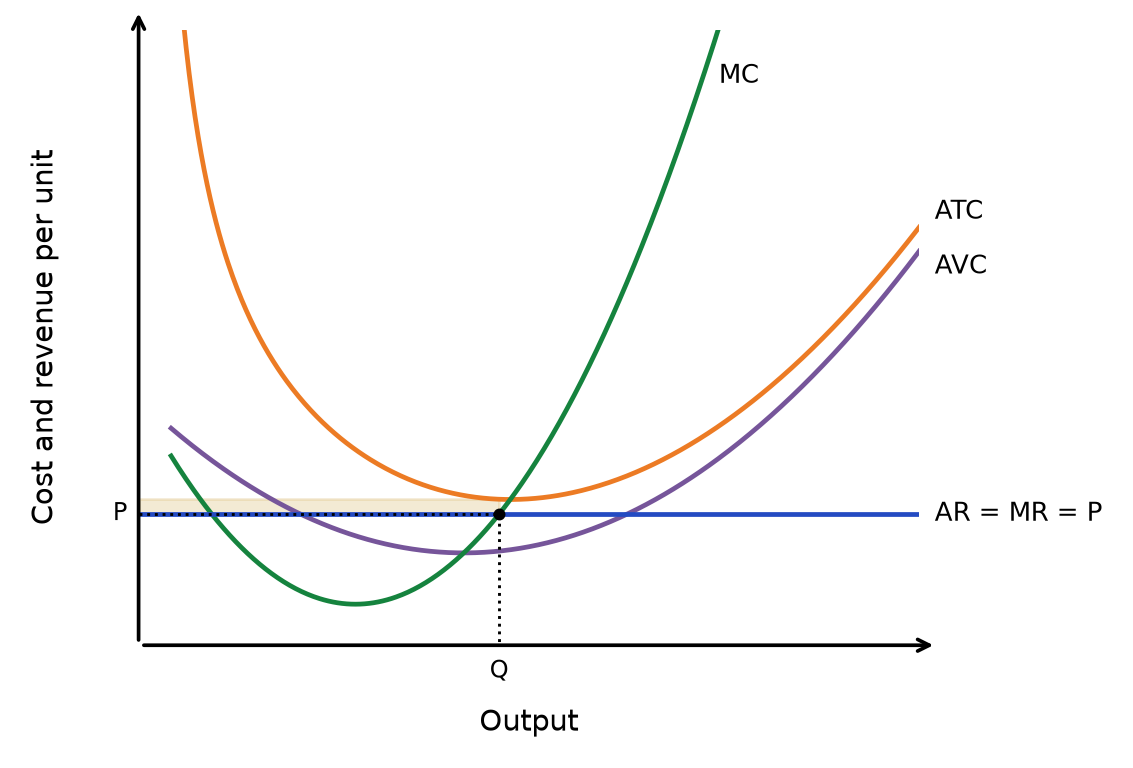
Read the diagram: Find the operating Q at rising MC = MR → compare P with AVC and ATC at Q → P covers AVC but not ATC, so operating contributes to fixed costs in the short run. If this position persists, the firm exits in the long run.
A common slip in exams: don't assume a firm shuts down the moment it makes a loss — when AR > AVC at its chosen output in the short run, continuing to produce loses less than shutting down, since some contribution is made towards fixed costs. At AR = AVC, operating and shutting down give the same loss, equal to fixed costs.
State the time horizon. At the standard short-run threshold the firm is indifferent; persistent inability to cover all economic costs threatens long-run viability. A loss alone does not prove that immediate closure minimises loss.
Rapid recap
Choose Q: find the profit-maximising output, then read P from AR and unit cost from AC. Economic profit = (P − AC) × Q, including opportunity costs.
Short run: producing at a loss can be preferable if revenue covers avoidable variable costs and contributes to fixed costs. Below the relevant shutdown threshold, production increases the loss.
Long run: all costs must be covered for continued operation. Normal profit is included in economic cost; zero economic profit does not mean the owner earns nothing.
Diagram cue: find output from MR=MC, price from AR and profit or loss using AC.
Related chapters: Unit 3 chapter 3 (p. 13) · Unit 3 chapter 5 (p. 23)