Economies and diseconomies of scale describe changes in long-run average cost as scale changes.
Must know
- Internal economies arise within a firm.
- External economies arise from industry development.
- Minimum efficient scale is the smallest scale attaining minimum LRAC.
Must know definitions
Economies of scale: falling long-run average cost as output increases.
Diseconomies of scale: rising long-run average cost as output increases.
Minimum efficient scale: the lowest output at which long-run average cost is minimised.
Internal economies of scale: cost advantages to an individual firm as it grows larger.
External economies of scale: cost advantages to all firms as the whole industry/local area grows.
X-inefficiency: average costs that are higher than necessary due to a lack of competitive pressure to minimise costs.
Explain and apply
Mechanism in brief: Larger scale can spread specialist equipment or management over more output and improve purchasing terms. Beyond some scale, coordination and monitoring difficulties may raise cost per unit.
Distinguish: Falling total costs are not required for economies of scale; external economies can benefit firms that have not grown.
Use the extract: Look for bulk purchasing, technical scale or coordination problems; link each to cost per unit rather than total cost.
Long-run cost curves and economies/diseconomies of scale
- Economies of scale occur when a firm's long-run average cost (LRAC) falls as output increases — the firm becomes more efficient as it grows larger.
- Diseconomies of scale occur when LRAC rises as output increases beyond a certain point — the firm becomes less efficient as it grows even larger.
- Both concepts only apply in the long run, since they describe how average costs change as a firm alters its entire scale of production (all factors variable), not how costs change in the short run with a fixed factor.
output ↑ (long run) → firm exploits economies of scale → LRAC ↓, up to the optimal scale output ↑ beyond optimal scale → diseconomies of scale set in → LRAC ↑
Minimum efficient scale
- The minimum efficient scale (MES) is the lowest level of output at which a firm minimises its long-run average cost — the point at the bottom of the LRAC curve.
- Below the MES, a firm has not yet fully exploited the available economies of scale, so it is producing at a higher average cost than necessary.
- In the U-shaped curve shown, diseconomies of scale raise average cost beyond the MES. In other cases, minimum average cost may persist over a range of outputs before diseconomies of scale begin.
The LRAC curve is therefore typically drawn as U-shaped
falling as economies of scale are exploited, flattening at the minimum efficient scale, then rising as diseconomies of scale set in.
Figure 3.8 Economies and diseconomies of scale
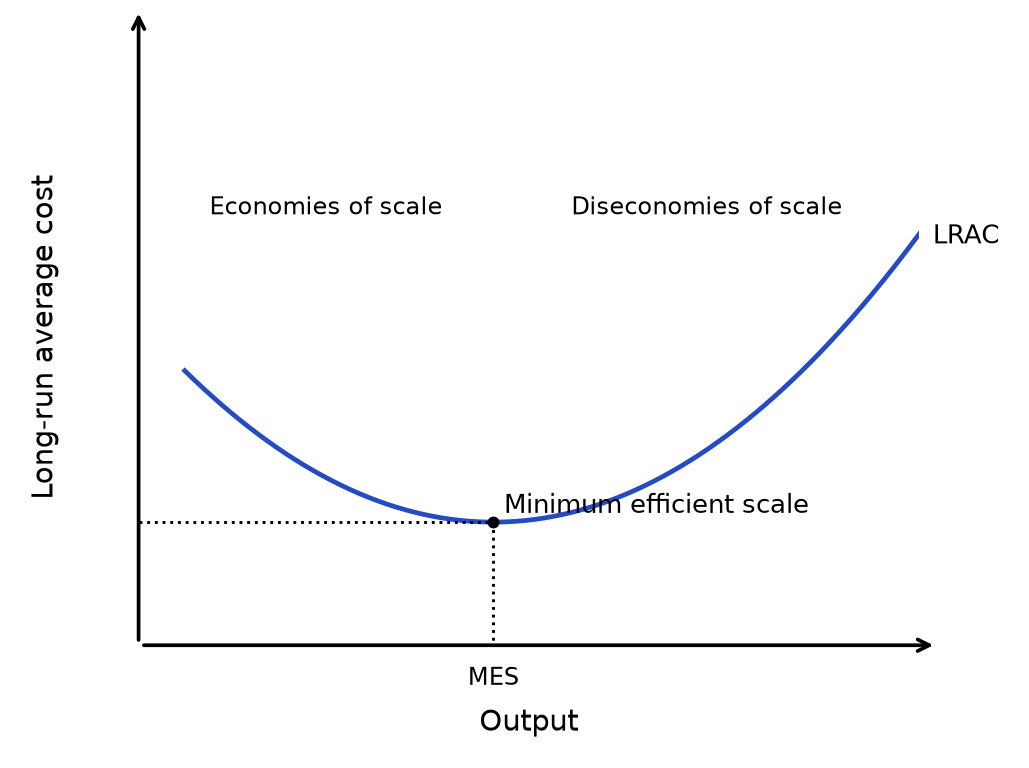
Read the diagram: Average cost falls as scale economies are realised, then rises if coordination and other diseconomies dominate. MES is the smallest output attaining minimum LRAC; the exact curve can differ between industries.
Internal and external economies of scale
- Internal economies of scale are cost advantages that benefit an individual firm as it grows larger, arising from decisions and changes within that firm alone.
- External economies of scale are cost advantages available to all firms in an industry when the whole industry expands, regardless of any individual firm's own size.
- The distinction matters because internal economies depend on a single firm's scale, while external economies depend on the scale of the industry or local area as a whole — a small firm can benefit from external economies of scale even without growing itself, as long as its industry is growing.
| Internal economies of scale | External economies of scale |
|---|---|
| Benefit only the individual firm as it grows | Benefit all firms as the whole industry/local area grows |
| Caused by the firm's own decisions (e.g. buying in bulk, hiring specialist managers) | Caused by industry-wide or local factors (e.g. better infrastructure, a larger pool of skilled labour) |
| A small firm does not gain these unless it grows itself | A small firm can gain these even without growing, if its industry grows |
Sources of internal economies of scale
- There are six main types of internal economies of scale, often remembered with the mnemonic "Really Fun Mums Try Making Pies" (Risk-bearing, Financial, Managerial, Technical, Marketing, Purchasing).
- Risk-bearing economies arise because a larger firm can diversify across a wider range of products or markets, spreading the cost of uncertainty. If one product line or market underperforms, the firm has other revenue streams to fall back on, so the average cost of bearing risk per unit falls as the firm expands its range of operations.
larger firm → diversifies across more products/markets → risk of failure spread across a wider base → average cost of uncertainty per unit ↓
- Financial economies arise because banks and other lenders see larger firms as less risky borrowers (often due to greater collateral and a track record of stability), so they are willing to lend to them at lower interest rates. Cheaper access to credit lowers the firm's average cost of financing its operations and investment compared with a smaller firm facing higher borrowing costs.
- Managerial economies arise because a larger firm can afford to employ specialist managers and supervisors for different functions (e.g. finance, marketing, human resources) rather than relying on generalists. This division and specialisation of management labour raises the efficiency of decision-making across the firm, which lowers average costs per unit compared with a smaller firm where one or two managers must cover every function.
- Technical economies arise because larger firms can afford to invest in more advanced, specialised and productive machinery and capital equipment, which a smaller firm producing on a smaller scale could not justify the cost of. This more productive capital lowers the average cost of production per unit as output rises, since the large upfront cost of the machinery is spread over a much bigger output.
- Marketing economies arise because a larger firm can spread the same (or a modestly higher) marketing and advertising budget across a much larger output, lowering the average cost of advertising per unit sold. A national advertising campaign, for example, costs a similar amount whether the firm sells 10,000 or 1,000,000 units, so average marketing cost per unit falls sharply as output rises.
- Purchasing (bulk-buying) economies arise because larger firms buying raw materials or stock in bulk can negotiate lower prices per unit from suppliers, since suppliers benefit from securing a large, reliable order. A large supermarket chain, for instance, has far more bargaining power over its suppliers than a small corner shop, allowing it to negotiate lower per-unit costs and pass on some of the saving through lower average costs.
| Type of internal economy | Source of the cost saving |
|---|---|
| Risk-bearing | Diversification across products/markets spreads the cost of uncertainty |
| Financial | Larger firms borrow more cheaply as banks see them as lower risk |
| Managerial | Specialist managers/supervisors raise efficiency of decision-making |
| Technical | Investment in more advanced, productive machinery becomes affordable |
| Marketing | A fixed advertising budget is spread over a much larger output |
| Purchasing | Bulk-buying power lets the firm negotiate lower input prices |
- A further source of economies of scale in the digital economy is spreading the fixed costs of an online platform over more transactions, where serving additional users has a low marginal cost. This is distinct from a network effect: the platform becomes more valuable to users as more people use it.
Sources of external economies of scale
- External economies of scale benefit every firm in an industry as that industry (or the local area in which it is concentrated) grows in size, rather than depending on any one firm's own scale.
Infrastructure/transport links
as an industry expands in a local area, local roads, ports or rail links may be improved to serve it, lowering transport costs for every firm in that area.
Skilled labour availability
a growing industry attracts and trains a larger pool of workers with relevant skills nearby, reducing recruitment and training costs for every firm that needs those skills.
Knowledge sharing/research
firms clustered together in a growing industry can share research, training facilities and innovations more easily (e.g. through supplier networks or industry bodies), lowering costs for the industry as a whole.
industry expands in a local area → infrastructure improves + skilled labour pool grows + knowledge spreads more easily → average costs fall for every firm in that industry, not just the firm that grew
Sources of diseconomies of scale
- As a firm grows beyond its minimum efficient scale, it can become harder to manage effectively, causing diseconomies of scale — a rise in long-run average cost.
- Control problems arise because it becomes harder for management to monitor and supervise a much larger workforce, reducing productivity.
- Coordination problems arise because organising and coordinating the activities of thousands of employees across departments and sites becomes increasingly complex, leading to inefficiencies and delays.
- Communication problems arise because workers in a very large firm may feel alienated and disconnected from decision-making, which can reduce motivation and productivity.
A separate cost risk is X-inefficiency
Weak competitive pressure may reduce the incentive to minimise costs, leaving a firm above its attainable cost at a given output. This is X-inefficiency; it can occur without an increase in scale and is distinct from diseconomies caused by managing a larger organisation.
firm grows beyond minimum efficient scale → harder to control, coordinate and communicate across a larger workforce → productivity per worker ↓ → average cost ↑
| Source of higher average costs | Cause |
|---|---|
| Control | Harder to monitor and supervise a much larger workforce |
| Coordination | More complex to organise activities across departments/sites |
| Communication | Workers feel alienated, motivation and productivity fall |
| X-inefficiency (separate from scale diseconomies) | Weak competitive pressure may leave costs above the attainable level at a given output; this need not result from increased scale. |
A common slip in exams: economies and diseconomies of scale are long-run concepts about the LRAC curve, not the short-run average cost curve — don't confuse them with diminishing returns to a single variable factor, which is a short-run phenomenon.
Relate efficient scale to market size. If one efficient plant can serve most demand, competition may conflict with low unit cost; a large firm can still be inefficient if internal organisation is poor.
Rapid recap
Economies of scale lower LRAC as scale rises; diseconomies raise it. Minimum efficient scale is the smallest output achieving minimum LRAC under the stated conditions.
Diagram cue: locate falling and rising LRAC and minimum efficient scale.
Related chapters: Unit 3 chapter 2 (p. 8) · Unit 3 chapter 5 (p. 23)