Market failure occurs when market incentives do not produce an efficient allocation of resources.
Must know
- Distinguish private external and social costs and benefits.
- Public goods create a free-rider problem.
- Information problems and speculation can distort decisions.
Must know definitions
Market failure: when the free market fails to allocate resources efficiently; too much or too little is produced/consumed compared to the socially optimal level.
Externality: a cost or benefit imposed on a third party outside the market mechanism.
Marginal private cost (MPC): the cost to a firm of producing one extra unit.
Marginal social cost (MSC): the total cost to society of producing one extra unit; MSC = MPC + marginal external cost.
Marginal private benefit (MPB): the benefit to the consumer of consuming one extra unit.
Marginal social benefit (MSB): the total benefit to society of consuming one extra unit; MSB = MPB + marginal external benefit.
Social optimum: where MSC = MSB; the point of maximum welfare.
Deadweight welfare loss: the loss of total economic welfare when output differs from the social optimum; it can result from either overproduction or underproduction.
Welfare gain: the potential gain in welfare from increasing output to the social optimum (positive externalities).
Public good: a good that is non-rival and non-excludable.
Private good: a good that is rival and excludable.
Free-rider problem: people can benefit without paying, weakening incentives for private provision and often causing underprovision.
Asymmetric information: when one party has more knowledge than the other in a transaction.
Principal-agent problem: when an agent acts in their own interests rather than those of the principal.
Moral hazard: when one party takes a risk knowing another party will bear the cost.
Market bubble: when asset prices rise excessively due to speculation and poor lending, before eventually bursting.
Merit good: a good whose private benefits consumers may underestimate, leading to underconsumption because of imperfect information. It may also create external benefits.
Demerit good: a good whose private costs or harmful effects consumers may underestimate, leading to overconsumption. It may also create external costs.
Geographical immobility: barriers preventing labour from moving between areas.
Occupational immobility: barriers preventing labour from changing occupations.
Labour market flexibility: how willing and able labour is to respond to changes in market conditions.
Must know relationship: MSC = MPC + marginal external cost; MSB = MPB + marginal external benefit.
Explain and apply
Mechanism in brief: When production imposes unpaid external costs, MSC exceeds MPC. Private incentives lead to output beyond the social optimum, and the excess units create a welfare loss where social cost exceeds social benefit.
Distinguish: Merit goods are not necessarily public goods; equal information does not guarantee complete information.
Use the extract: Identify the third party, missing information or public-good characteristic; name the specific allocation problem.
Why market failure occurs
Market failure occurs where too much or too little of a good is produced and/or consumed compared with the socially optimal level of output, or when the price mechanism leads to an inefficient allocation of resources.
- Economic and social welfare is not maximised.
- It can mean over-provision (e.g. demerit goods) or under-provision (e.g. merit goods, public goods).
market failure means resources are misallocated, not that no market exists.
The main sources of market failure are:
Externalities (positive and negative)
Non-provision of public goods
Imperfect market information
Moral hazard
Speculation and market bubbles
Positive and negative externalities
An externality is the cost or benefit a third party receives from an economic transaction, outside of the market mechanism.
- It is the spill-over effect of the production or consumption of a good or service.
- Externalities can be positive (external benefits) or negative (external costs).
Four distinctions
negative production externality — factory emissions harm nearby residents
positive production externality — a firm’s research creates knowledge spillovers for other firms
negative consumption externality — second-hand smoke harms bystanders
positive consumption externality — vaccination reduces infection risk for others.
For the required marginal-analysis diagrams, use negative externalities of production (MSC > MPC, with MSB = MPB) and positive externalities of consumption (MSB > MPB, with MSC = MPC). State the assumptions and identify market output, the social optimum and the relevant welfare area.
- Because third-party effects are ignored by the market price, output settles away from the social optimum.
the third party is someone outside the transaction — the buyer and seller are not third parties.
| Private | External | Social | |
|---|---|---|---|
| Cost | Costs borne by the producer (e.g. rent, wages, raw materials) | Costs imposed on third parties (e.g. pollution, noise) | Social cost = private cost + external cost |
| Benefit | Benefit received by the consumer from consuming the good; the payment to the producer is not an additional social benefit. | Benefit to third parties (e.g. higher skilled workforce from education) | Social benefit = private benefit + external benefit |
Marginal private cost (MPC)
the cost to a firm of producing one extra unit
Marginal social cost (MSC)
MSC = marginal external cost + MPC
Marginal private benefit (MPB)
the benefit to the consumer of consuming one extra unit
Marginal social benefit (MSB)
MSB = marginal external benefit + MPB
Social optimum position
where MSC = MSB — the point of maximum welfare
For a negative production externality, MSC exceeds MPC. With MPB = MSB, private equilibrium is Qm and socially efficient output is Qs. The area between MSC and MSB on the excess units from Qs to Qm is the welfare loss.
Figure 1.33 Negative production externality
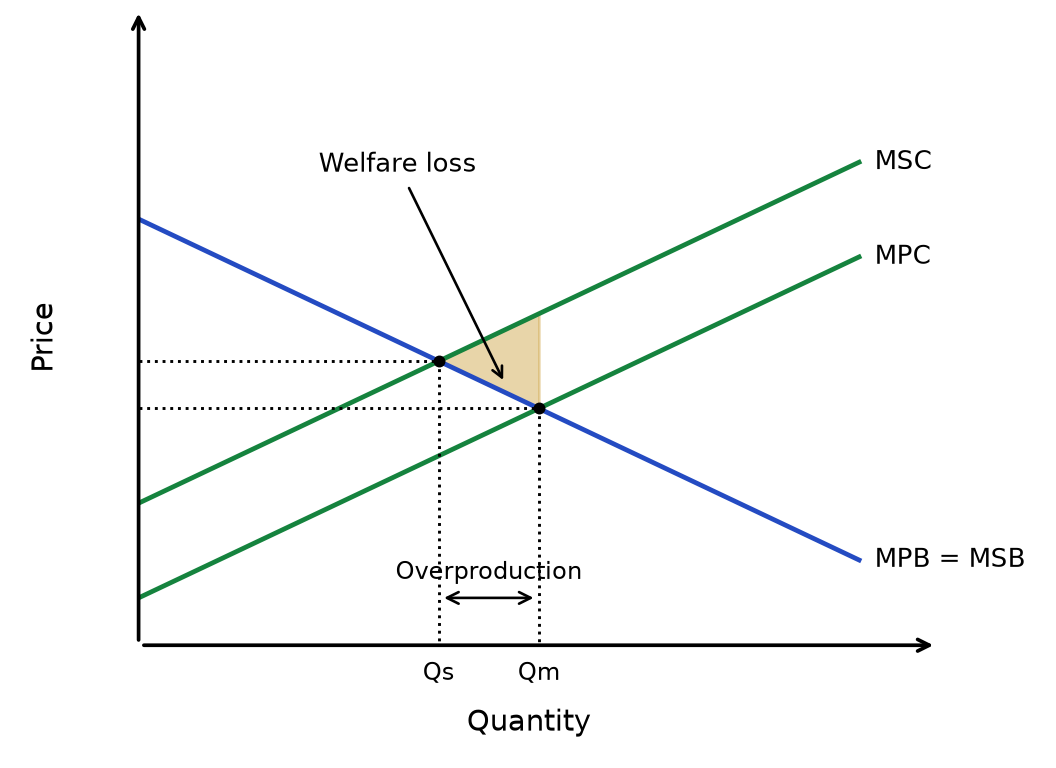
Read the diagram: Find Qm where MPB = MPC → find Qs where MSB = MSC → compare Qm with Qs to identify overproduction → the shaded triangle is the social cost above social benefit on the excess units. The diagram assumes a negative production externality and MPB = MSB.
Positive externalities of consumption, such as benefits to others from vaccination, mean MSB exceeds MPB. With no other distortion, market output is below the social optimum. The area between MSB and MSC over the missing units is the welfare loss from underconsumption, or the potential welfare gain from increasing output to the optimum.
Figure 1.34 Positive consumption externality
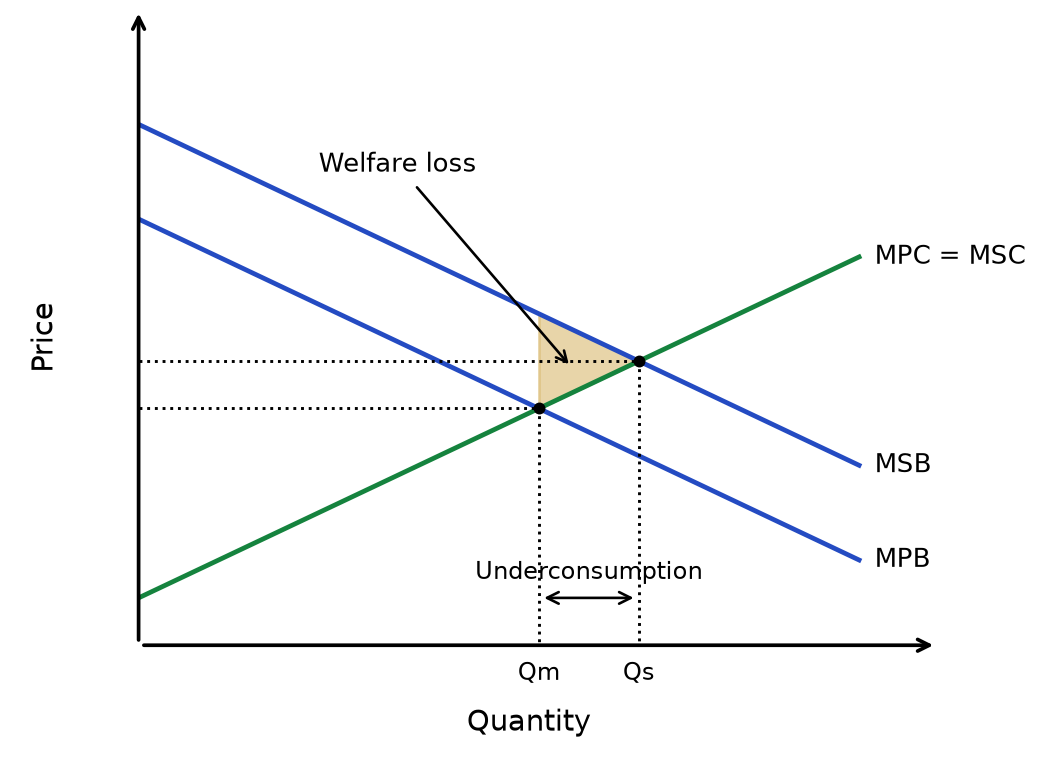
Read the diagram: Find Qm where MPB = MPC → find Qs where MSB = MSC → compare Qm with Qs to identify underconsumption → the shaded triangle is the forgone social benefit above social cost. The diagram assumes a positive consumption externality and MPC = MSC.
Merit and demerit goods: consumers may underestimate the long-run private benefits of merit goods, such as education, or the long-run private costs of demerit goods, such as smoking. This information failure can lead to under-consumption or over-consumption. Externalities are a separate issue: education may benefit other people, while second-hand smoke harms bystanders. A good can involve both information failure and externalities, but one does not imply the other.
Estimating the monetary value of an externality, such as pollution damage, can be difficult because the evidence is incomplete or uncertain. This makes it harder to estimate the welfare loss and choose the size of a corrective tax or subsidy. Measurement uncertainty is different from a value judgement: deciding how much weight to give to the interests of different groups or generations involves normative judgement.
Externalities can be applied to various contexts including transport, health, education, the environment, and financial services.
Non-provision of public goods
A public good is non-rival and non-excludable, which is why the free market fails to provide it.
Non-rival
consumption by one person does not reduce the amount available to others.
Non-excludable
once provided, it is impossible to stop non-payers from using it.
"public good" does not mean "provided by the government" — it is defined by non-rivalry and non-excludability.
| Public goods | Private goods | |
|---|---|---|
| Non-rival | Consumption by one person does not prevent another from consuming it (e.g. street lighting) | Rival — one person's consumption prevents another's (e.g. a chocolate bar) |
| Non-excludable | Once provided, impossible to stop people from using it (e.g. a lighthouse) | Excludable — people can be prevented from consuming if they don't pay (e.g. a car) |
Public goods are under-provided by the private sector because of the free-rider problem: since they are non-excludable, people benefit without paying, so firms cannot make a profit. It is also difficult to measure the value consumers place on public goods — consumers undervalue to pay less, producers overvalue to charge more. The government therefore provides public goods funded by tax revenue, though the quantity provided may still be less than the socially optimum level.
Imperfect and asymmetric information
Asymmetric information exists when one party in a transaction has more knowledge than the other, leading to a misallocation of resources.
- Symmetric information means the parties have the same relevant information; both may still be imperfectly informed. Symmetry alone does not guarantee efficient resource allocation.
- With asymmetric information, consumers may pay too much or too little and firms produce the wrong amount.
Examples
a car dealer knowing about a fault the buyer cannot see; doctors prescribing unnecessary treatment for profit.
| Symmetric information | Asymmetric information | |
|---|---|---|
| Definition | Consumers and producers have the same level of knowledge about a product | One party has more knowledge than the other |
| Outcome | Equal information alone does not guarantee efficiency | Misallocation of resources — consumers pay too much/too little, firms produce the wrong amount |
| Example | — | A car dealer knowing about a fault the buyer is unaware of; doctors prescribing unnecessary treatment for profit |
Asymmetric information can be linked to the principal-agent problem: the agent makes decisions for the principal but acts in their own interests rather than the principal's. For example, managers (agents) may pursue personal gain rather than maximising dividends for shareholders (principals).
Imperfect information can be applied to healthcare (doctors know more than patients), education, pensions, and insurance (consumers know more about their health than insurers).
Moral hazard
Moral hazard occurs when one party takes a risk knowing that another party will bear the cost.
- It can arise when actions are difficult to observe and protection from losses weakens incentives to avoid risk; insurance cover or an expected bailout can therefore change behaviour.
- Insurance and banking are the classic contexts.
Stakeholder effects of moral hazard: consumers may face higher premiums or restricted credit; insurers and banks may face higher claims or loan losses; workers may lose jobs if firms fail; governments may face bailout costs and an opportunity cost for public spending. Monitoring, excess payments, regulation and credible limits on bailouts may reduce the problem, but also have costs.
- The result is excessive risk-taking and a misallocation of resources.
| Context | How moral hazard occurs | Impact |
|---|---|---|
| Health insurance | People with comprehensive insurance may visit the doctor more often or engage in riskier activities, knowing they won't bear the medical costs | Higher insurance premiums for everyone; over-consumption of healthcare |
| Banking | Banks lend to risky borrowers (e.g. subprime mortgages pre-2008), knowing that shareholders, depositors, or taxpayers will bear the consequences if loans default | Financial instability; bank failures; taxpayer-funded bailouts |
Speculation and market bubbles
A market bubble occurs when the price of an asset rises far above its fundamental value, driven by speculation and excessive lending, before eventually crashing back down.
- Bubbles are a form of market failure because resources are misallocated — capital flows into overvalued assets rather than productive uses.
Stock-market application: investors buy shares expecting further price increases rather than because expected earnings justify the price. Rising prices attract further speculative demand. When expectations reverse, share prices can fall sharply: shareholders lose wealth, firms find equity finance harder to obtain, investment and employment may fall, and tax revenues may weaken. Not every share-price rise or fall is a bubble; compare valuations with underlying earnings and risks.
- Herding behaviour and fear of missing out drive prices further above fundamental value.
- When the bubble bursts, forced sales collapse prices and a negative wealth effect cuts consumer spending.
Bubbles typically arise through the following process:
1. Easier credit and optimistic expectations → borrowing and speculative demand for assets rise. Low interest rates may encourage this process, but a bubble is not an inevitable result.
2. Rising prices and early gains → more investors expect capital gains → speculative demand pushes prices further above fundamental value.
3. Herding and fear of missing out → borrowing and exposure increase → the market becomes more vulnerable.
4. Expectations reverse or finance tightens → forced sales increase → asset prices fall → wealth and spending may fall further.
This causes market failure because the price mechanism is distorted — rising prices signal high demand and attract resources into the bubbled asset, but the prices do not reflect genuine consumer demand or the asset's true value. When the bubble bursts, those resources are left stranded in an overvalued asset, resulting in a net welfare loss to society.
The impact of a housing bubble varies across stakeholders:
| Stakeholder | During the bubble (prices rising) | After the bubble bursts (prices crash) |
|---|---|---|
| Home owners | Benefit from wealth effect — equity rises, consumer spending increases | Negative wealth effect — equity falls, consumer spending contracts |
| First-time buyers | Priced out of the market — cannot afford a house | May benefit from lower prices, but banks may have tightened lending so mortgages are harder to obtain |
| Construction firms | Benefit from higher revenues and profits — build more homes | Oversupply of housing — revenues and profits fall, potential bankruptcies |
| Workers | May struggle to relocate if house price increases are not uniform across the country — reduces geographical mobility of labour | May face unemployment if construction sector contracts |
| Banks/lenders | Higher profits from increased mortgage lending | Defaults rise — bad debts, potential bank failures, taxpayer bailouts |
| Government | Higher tax revenue (e.g. stamp duty) | Lower tax revenue; may need to spend on bank bailouts and welfare for unemployed |
Factor immobility
Factor immobility is a source of market failure because it prevents labour from moving to where it is needed most, so resources are not allocated efficiently.
There are two types
geographical and occupational immobility of labour.
Both leave willing workers unemployed while firms have unfilled vacancies.
Geographical immobility of labour refers to the obstacles which prevent workers from moving between areas.
Labour cannot relocate from areas of high unemployment to areas where jobs are available.
The result is unemployment in some regions alongside labour shortages in others.
Geographical immobility arises because:
Family and social ties make workers reluctant to leave their community
Financial costs of moving are high (deposit, removal costs, legal fees)
Regional variations in house prices and living costs — e.g. a worker in the North East may be unable to afford housing in London even if a job is available
Imperfect knowledge of job opportunities elsewhere — workers may not know what jobs exist in other regions
As a result, the labour market does not clear — unemployment persists in some regions while labour shortages exist in others, leading to a misallocation of resources and a loss of potential output.
Occupational immobility of labour refers to the obstacles which prevent workers from changing occupations or industries.
Workers who lose jobs in a declining industry cannot easily transfer to a growing one, even where demand for labour exists.
This produces persistent structural unemployment.
Occupational immobility arises because:
Insufficient education and training — workers lack the qualifications needed for new roles
Lack of transferable skills — e.g. a coal miner's skills are specific to mining and not easily applied to other industries
Time and cost of retraining — workers may not be able to afford to stop earning while they retrain
A key example is the collapse of the UK mining industry — mining workers did not have transferable skills to find other work, leading to persistent structural unemployment in former mining communities. This is a loss of economic welfare because willing and able workers remain idle while resources that could be productive are wasted.
Labour market flexibility — how willing and able labour is to respond to changes in market conditions — is directly linked to factor immobility. A more flexible labour market means workers can move between areas and occupations more easily, reducing geographical and occupational immobility:
| Factor | How it affects flexibility | Links to which type of immobility |
|---|---|---|
| Trade union power | Can increase job security but may reduce flexibility if they restrict hiring/firing or strike action | Occupational |
| Regulation | More freedom to hire and fire → firms can adjust workforce more easily; excessive regulation → less flexible | Occupational |
| Welfare payments and income tax | High welfare/tax → lower reward for working → less incentive to move or retrain | Both |
| Training | More widely available training → more skilled and adaptable workforce → easier to switch occupations | Occupational |
| Infrastructure | Better transport links → easier and cheaper to commute or relocate → improves geographical mobility | Geographical |
| Housing | More affordable housing → workers can afford to move to areas with jobs → improves geographical mobility | Geographical |
Developing analysis into evaluation
Explain the market failure first, then assess a specific condition that changes its importance or the case for intervention. The examples below illustrate both stages; adapt them to the question and evidence.
- Negative production externality: producers consider MPC rather than MSC, so Qm exceeds Qs when MPB = MSB. Units between Qs and Qm have social costs above social benefits, creating welfare loss. Judgement: a corrective tax is more convincing when marginal external costs can be estimated reliably; poor measurement may leave overproduction or cause excessive contraction.
- Merit goods and information: consumers may underestimate long-run private benefits, so consumption can be too low. A positive consumption externality is a separate reason for under-consumption: where MSB exceeds MPB, Qm is below Qs. Judgement: information provision addresses misunderstanding, but cannot by itself ensure that consumers account for benefits to third parties; a subsidy may be needed, subject to its cost and effectiveness.
- Public goods: non-excludability encourages free riding, making direct charging difficult and weakening private provision. Judgement: government provision is stronger where benefits are widespread and hard to charge for; voluntary funding, bundling or public contracts can sometimes support provision, so complete non-provision is not inevitable.
- Asymmetric information: a better-informed supplier may recommend unnecessary services that buyers cannot assess, causing over-consumption and wasted resources. Judgement: professional standards and independent advice can limit this problem, but their benefit depends on monitoring and enforcement costs.
- Moral hazard: expected protection from losses may encourage excessive risk-taking, creating costs for others. Judgement: monitoring, deductibles or credible limits on support can reduce the incentive, but removing protection completely may also deter beneficial activity or threaten stability.
- Asset bubbles: speculative demand can push prices away from underlying returns and attract excessive investment. A collapse can reduce wealth, spending and employment. Judgement: intervention is difficult because fundamental values are uncertain; a mistaken response may restrict productive investment.
- Factor immobility can leave workers unemployed while vacancies exist elsewhere, reducing output below its potential. Occupational immobility reflects a mismatch of skills; geographical immobility reflects barriers to moving. Judgement: retraining is more effective where suitable vacancies exist and workers can acquire the required skills; housing or transport support may be needed when location is the main barrier.
- "The final judgement on whether government intervention is justified depends on whether the welfare loss from the market failure exceeds the welfare loss created by the intervention (government failure). If the deadweight loss, information failure, or immobility is severe, intervention may be justified — but only if the policy corrects more of the failure than it creates."
Diagnose the failure before choosing a remedy. A tax may internalise an external cost but does not automatically resolve poor information or public-good provision; effectiveness depends on targeting and the size of the distortion.
Rapid recap
Diagnose: externalities create a gap between private and social marginal costs or benefits; locate the social optimum where MSB = MSC.
Distinguish: public goods create a free-rider problem; information gaps can distort choices; immobility can prevent resources moving to productive uses. These failures need different remedies.
Judge: explain the lost social benefit or excess social cost, then test whether the proposed policy targets that cause without larger unintended costs.
Diagram cue: locate market and socially efficient output, then identify welfare loss.
Related chapters: Unit 1 chapter 13 (p. 58) · Unit 1 chapter 16 (p. 80)
Why this connects: Identify the gap between private and social incentives first; use that diagnosis to choose an intervention and then evaluate the risk of government failure.