Prices ration scarce goods, signal changing conditions and create incentives.
Must know
- Rationing limits demand to available supply.
- Signalling conveys information.
- Incentives encourage changes in consumption and production.
Must know definitions
Price mechanism: the system where price determines how resources are allocated in a free market; the "invisible hand" (Adam Smith).
Rationing function: when demand exceeds supply, price rises to ration scarce resources to those willing and able to pay.
Incentive function: price changes encourage producers to shift production towards more profitable goods and away from less profitable ones.
Signalling function: price changes signal to consumers and producers where resources are needed, guiding allocation.
Mass market: the largest group of consumers for a product.
Niche market: a smaller, specific segment of a market focused on a particular product.
Invisible hand: Adam Smith's concept that market prices guide resources to their most efficient use without central direction.
Explain and apply
Mechanism in brief: A shortage raises price, signalling scarcity to consumers and potential profitability to producers. Consumers economise while firms seek to expand output, helping reduce the shortage where supply can respond.
Distinguish: The three functions can operate together; a high price does not prove that demand has shifted.
Use the extract: Use the shortage, surplus or price change to explain a signal and the response of buyers or producers.
The rationing, incentive and signalling functions of the price mechanism
The price mechanism determines the market price and allocates resources in a free market economy.
- Adam Smith called this the "invisible hand of the market".
- Price moves resources towards where they are demanded or where there is a shortage.
- Price removes resources from where there is a surplus.
It does this through three functions
rationing, incentive, and signalling.
the three functions overlap in one price change — name the specific function the question asks about rather than describing "price rises" generally.
Rationing function
The rationing function means that when demand is greater than supply, price rises so the good is rationed out only to those willing and able to pay.
- Due to scarcity, not everyone is able to buy everything they want.
- The increase in price discourages demand and consequently rations resources.
Example
plane ticket prices rise as seats are sold out → higher price discourages some consumers → tickets are rationed to those willing and able to pay.
Incentive function
The incentive function means price changes encourage a change in the behaviour of consumers or producers.
- When the price of a product rises relative to its production costs, firms have an incentive to shift production towards it because supplying it may become more profitable.
- Falling prices create an incentive for firms to move away from producing that product.
Example
higher price relative to production costs → greater potential profitability → incentive for firms to increase production.
Signalling function
The signalling function means price acts as a signal to consumers and to new firms entering the market, showing where resources are needed.
- A high price signals relative scarcity: demand is high relative to available supply. It may encourage producers to increase production where this is profitable and feasible.
- The same high price signals to consumers to reduce quantity demanded.
- An own-price change causes movement along existing demand and supply curves. Longer-run entry or investment may separately shift supply; explain that additional mechanism.
Example
rising house prices → signals housing is becoming scarcer relative to demand → may encourage builders to construct more homes where profitable and feasible → resources allocated towards housing.
Figure 1.29 Excess demand
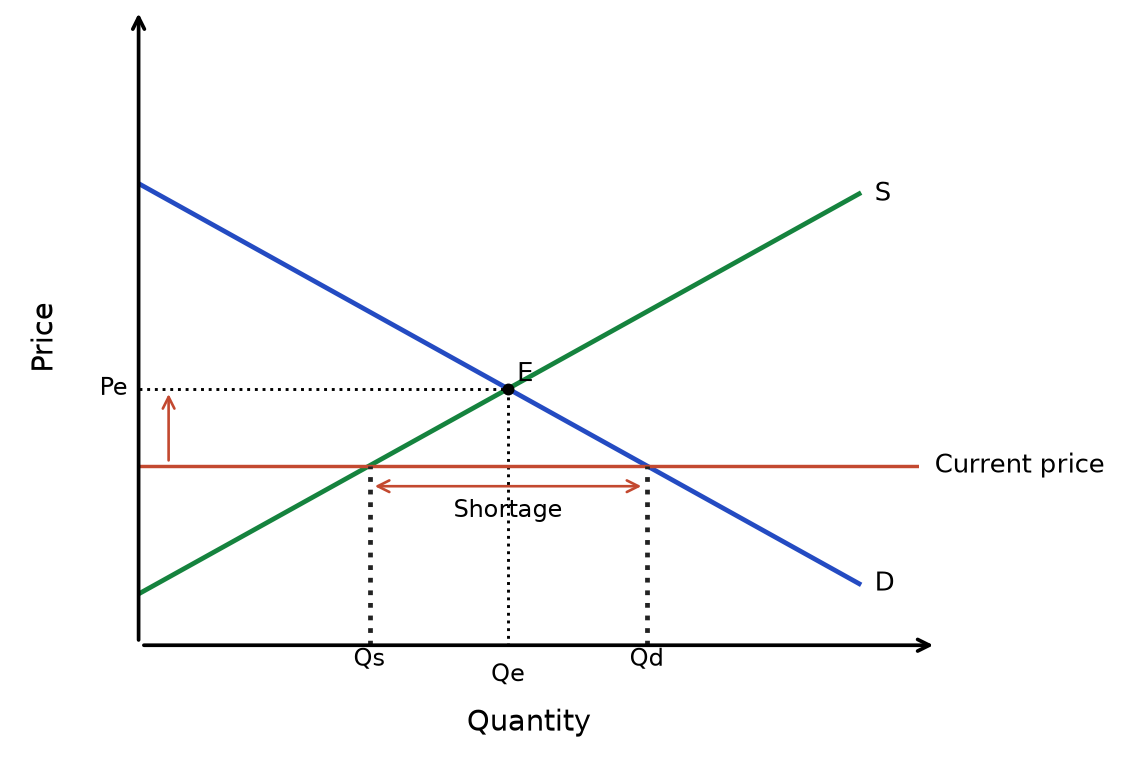
Read the diagram: At a price below equilibrium, quantity demanded exceeds quantity supplied. Buyers bidding for scarce output put upward pressure on price. With no price control, movement along the existing curves restores equilibrium; the curves do not need to shift.
Figure 1.30 Excess supply
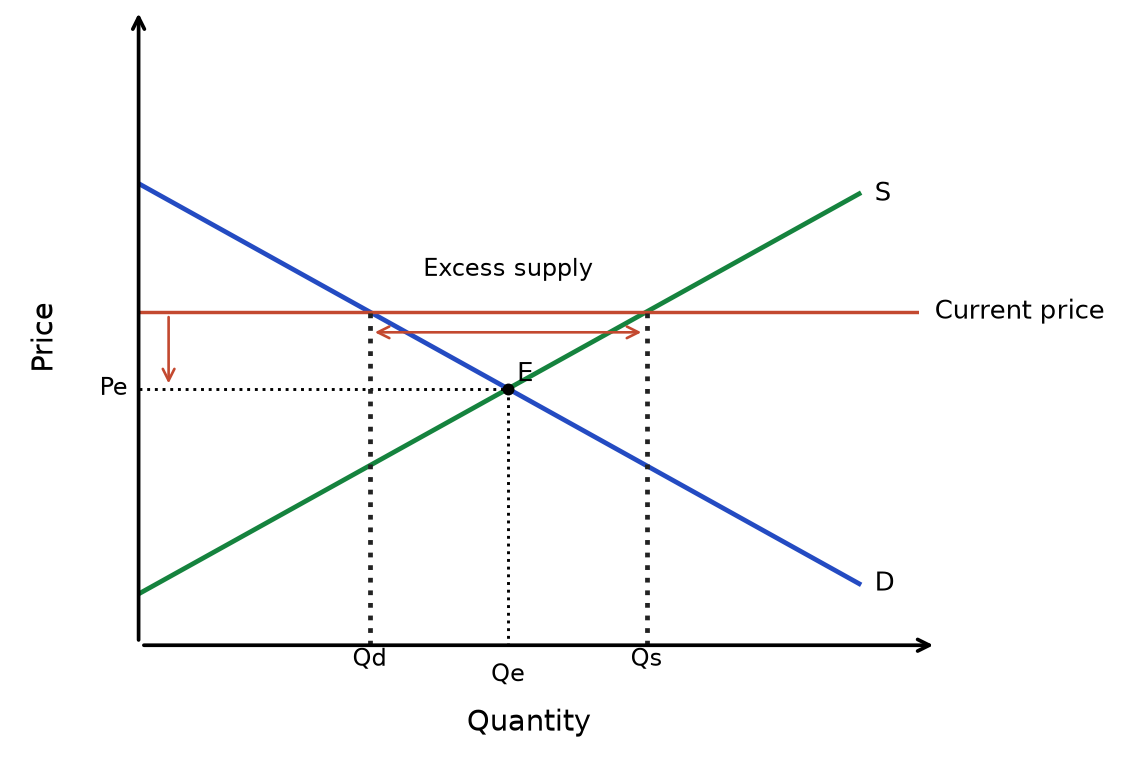
Read the diagram: At a price above equilibrium, quantity supplied exceeds quantity demanded. Unsold output puts downward pressure on price. With no price control, movement along the existing curves restores equilibrium; the curves do not need to shift.
Figure 1.31 Demand shift and price adjustment
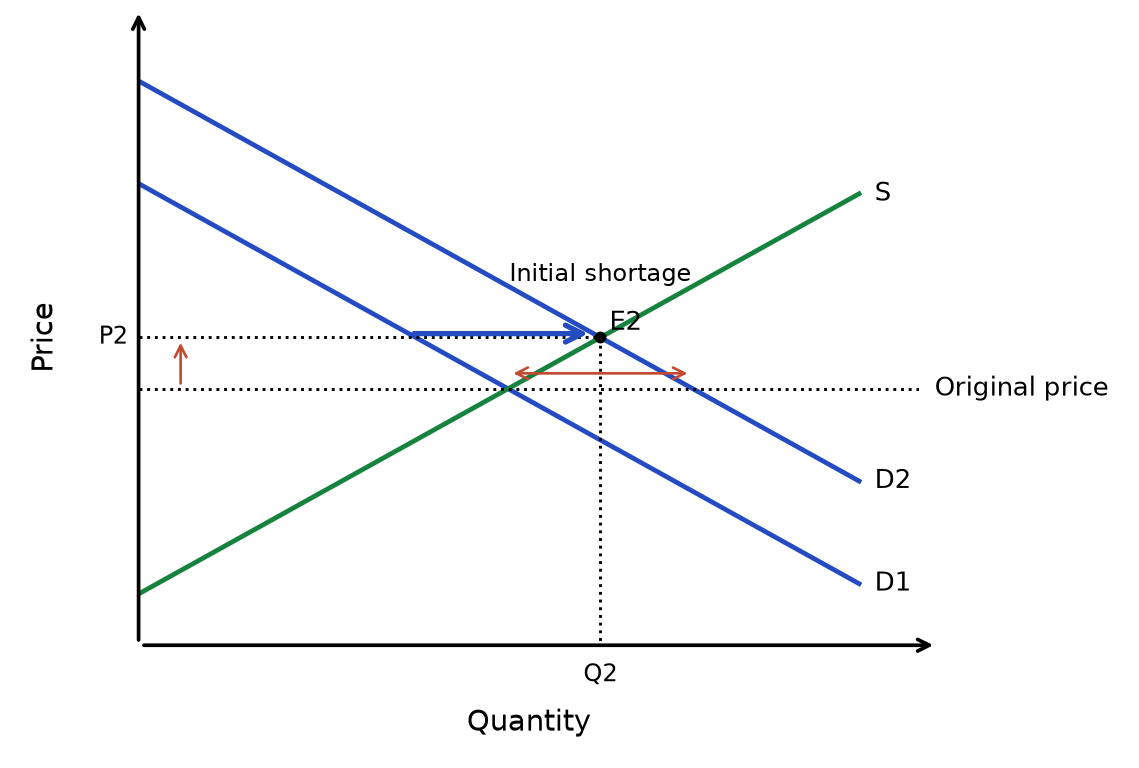
Read the diagram: Demand shifts right. At the original price, quantity demanded is greater than quantity supplied. Price then rises; movement along supply and the new demand curve restores equilibrium. Distinguish the initial shift from the subsequent adjustment.
Figure 1.32 Demand shift and price adjustment
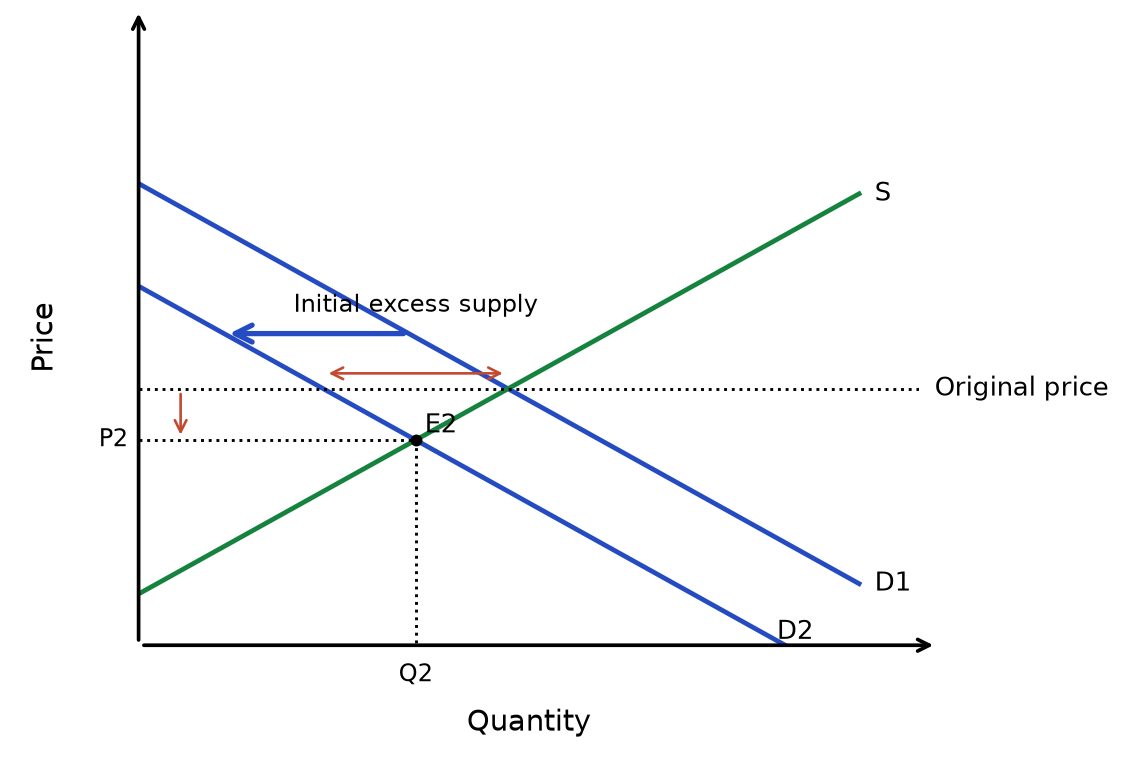
Read the diagram: Demand shifts left. At the original price, quantity demanded is less than quantity supplied. Price then falls; movement along supply and the new demand curve restores equilibrium. Distinguish the initial shift from the subsequent adjustment.
The price mechanism in the context of different types of markets
The price mechanism should be considered in a variety of contexts, including local, national, and global markets.
- The wider the market, the more buyers and sellers influence the price.
- A global market price (e.g. oil) is set by worldwide demand and supply, not by any one country.
| Market type | Definition | Example |
|---|---|---|
| Local market | Serves a small geographic area; closer to consumers | Local market for rice |
| National market | Operates across a whole country | National market for houses |
| Global market | Operates internationally across many countries | Global market for oil |
The price mechanism can also be considered in the context of mass markets (the largest group of consumers for a product, e.g. restaurants) and niche markets (a smaller, specific segment, e.g. a particular cuisine like Italian). A niche market may respond closely to particular consumer preferences. It is not necessarily more efficient than a mass market: resource allocation also depends on competition, information, production costs and externalities.
The price mechanism adjusts less through quantity when supply is inelastic. It can clear a market while leaving essential goods unaffordable for some households, so efficiency and access require separate judgements.
Rapid recap
Prices signal relative scarcity, incentivise responses and ration goods by willingness and ability to pay. These functions can operate together.
Diagram cue: show how a shortage or surplus creates pressure for price adjustment.
Related chapters: Unit 1 chapter 12 (p. 53) · Unit 1 chapter 15 (p. 69)