Supply shows how much firms are willing and able to sell at different prices.
Must know
- Own price causes a movement along supply.
- Input costs technology taxes and subsidies can shift supply.
- A supply increase means more supplied at each price.
Must know definitions
Supply: the amount producers are willing and able to sell at a given price, in a given time period.
Supply curve: shows the relationship between price and quantity supplied; slopes upward.
Law of supply: as price rises, quantity supplied rises (positive relationship).
Expansion of supply: a movement along the supply curve caused by a rise in price.
Contraction of supply: a movement along the supply curve caused by a fall in price.
Shift of supply: a change in quantity supplied at every price level, caused by a non-price factor.
Profit motive: firms are driven by the desire to maximise profits, explaining why higher prices lead to more supply.
PINTSWC: mnemonic for factors shifting supply — Productivity, Indirect taxes, Number of firms, Technology, Subsidies, Weather, Costs of production.
Explain and apply
Mechanism in brief: A fall in input costs makes additional units profitable at existing prices. Firms supply more at each price, shifting supply right; the resulting market price depends on demand as well.
Distinguish: A fall in price contracts supply along the curve; it does not itself shift supply left.
Use the extract: Look for input costs, technology, taxes or producer numbers; separate these from a change in the product's own price.
The concept of supply
Supply is the amount that producers are willing and able to sell at any given price, in a given period of time.
- A supply curve shows the relationship between price and quantity supplied, with price on the vertical axis and quantity on the horizontal axis.
- It slopes upwards from left to right because, as price rises, rational profit-maximising producers supply more since profits should rise.
- This positive relationship between price and quantity supplied is the basis of the "law of supply".
Supply curves are upward sloping because:
- Higher price → more profitable → firms supply more
- Higher prices can attract new firms in the longer run → market supply shifts right; this is separate from movement along an existing supply curve.
- Larger outputs mean higher costs → firms need a higher price to cover them
The distinction between movements along a supply curve and shifts of a supply curve
A movement along the supply curve is caused only by a change in the price of the good itself, while a shift of the whole curve is caused by a change in a non-price factor (conditions of supply).
- This is based on the profit motive — firms are driven by the desire to make large profits.
- A rise in price causes an expansion of supply (more supplied).
- A fall in price causes a contraction of supply (less supplied).
an indirect tax or a cost change shifts the curve; only the good's own price moves you along it.
| Cause | Effect | Terminology | |
|---|---|---|---|
| Movement along the curve | Change in the price of the good itself | Rise in price → quantity supplied rises; fall in price → quantity supplied falls | Expansion / contraction of supply |
| Shift of the curve | Change in a non-price factor (e.g. costs, technology) | More or less supplied at every price level | Increase in supply: rightward shift. Decrease in supply: leftward shift. |
Figure 1.13 Movement along S
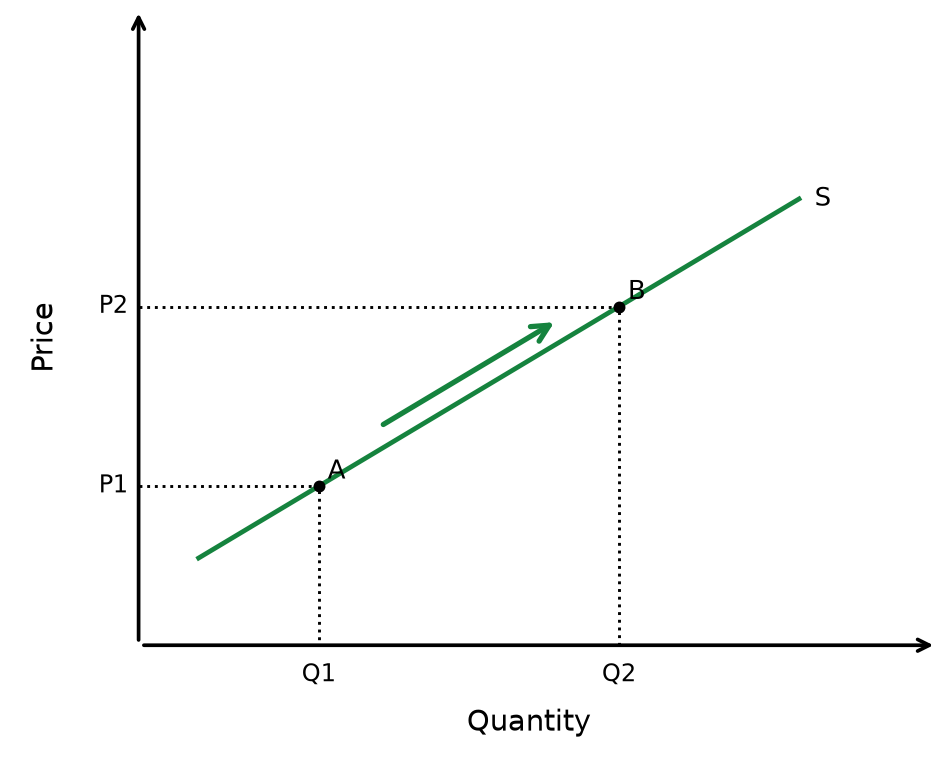
Read the diagram: The good’s own price changes and other determinants are held constant. The arrow shows movement from A to B along the same curve. Quantity changes; the curve does not shift.
Figure 1.14 Shifts of S — Increase
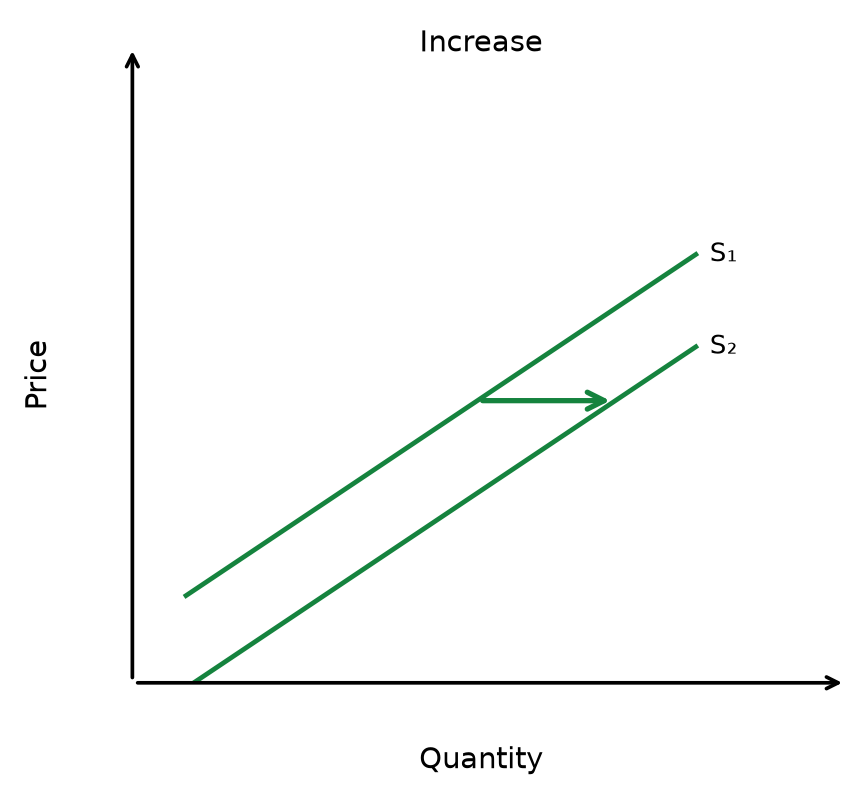
Figure 1.15 Shifts of S — Decrease
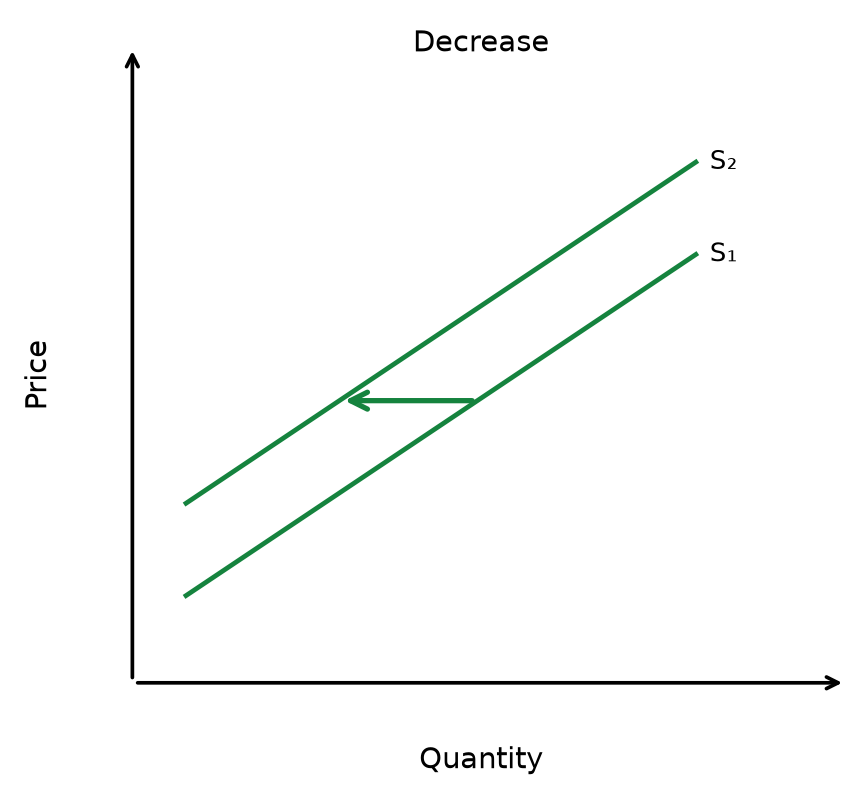
Read the diagram: Each panel shows a change in a non-price determinant, holding other influences fixed. The arrow runs from curve 1 to curve 2: an increase is a rightward shift; a decrease is a leftward shift. Compare quantities at the same vertical-axis value.
Factors that may cause a shift in the supply curve
Any change in a non-price determinant of supply shifts the entire curve outward (more supplied at every price) or inward (less supplied at every price).
- These factors are commonly remembered using the PINTSWC mnemonic.
Most work through costs of production
anything that lowers costs shifts supply outward.
| Factor | Explanation | Effect on supply |
|---|---|---|
| P – Productivity | Higher productivity lowers average costs for the firm | Productivity ↑ → supply ↑ (outward shift) |
| I – Indirect taxes | Taxes on production raise costs | Indirect tax ↑ → supply ↓ (inward shift) |
| N – Number of firms | More firms in the market means more total output | Number of firms ↑ → supply ↑ (outward shift) |
| T – Technology | More advanced technology makes production more efficient | Technology improves → supply ↑ (outward shift) |
| S – Subsidies | Government subsidies reduce costs | Subsidies ↑ → supply ↑ (outward shift) |
| W – Weather | Particularly relevant for agricultural produce | Favourable weather → supply ↑; bad weather → supply ↓ |
| C – Costs of production | Lower costs allow firms to supply more; higher costs reduce supply | Costs ↓ → supply ↑ (outward shift); costs ↑ → supply ↓ (inward shift) |
Additionally, depreciation in the exchange rate increases the cost of imported raw materials, causing an inward shift in supply.
A cost saving may produce little immediate output growth if equipment, staff or transport are constrained. Distinguish the initial production incentive from the feasible response and the time needed to expand capacity.
Rapid recap
Own-price changes move quantity supplied along S. Input costs, technology and other production conditions shift S by changing willingness or ability to supply at each price.
Diagram cue: distinguish movement along S from a shift of S, with arrows.
Related chapters: Unit 1 chapter 11 (p. 46) · Unit 1 chapter 12 (p. 53)