4.5 Exchange rates
The exchange rate is the value of one currency expressed in terms of another currency. For example, US$ 1 = AU$ 0.96 means an individual needs 0.96 Australian dollar to buy 1 US dollar, or one needs US$ 1.04 to buy AU$ 1. If the price of currency A is expressed in terms of currency B as d, then the price of currency B is expressed in terms of A as \("\frac{1}{d}"\).
Floating exchange rate system
A floating exchange rate system (also known as the flexible exchange rate system) is an exchange rate system where the value of the currency is determined by market forces, which is the demand and supply of a currency.
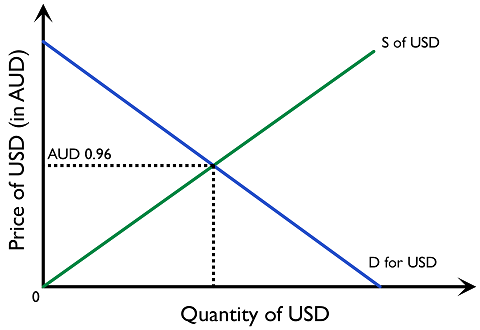
In Figure 4.5.1, the price of US$ in terms of AU$ is determined by the demand and supply of US$. The equilibrium price for US$1 is AU$ 0.96.
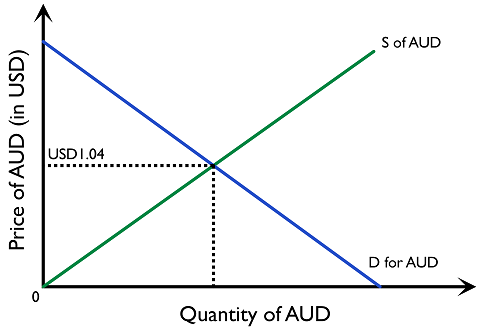
In Figure 4.5.2, the price of AU$ in terms of US$ is determined by the demand and supply of AU$ and the equilibrium price for AU$ 1 is US$ 1.04.
Appreciation of a currency is an increase in the value of one currency in terms of another currency in a floating exchange rate system.
Depreciation of a currency is a decrease in the value of one currency in terms of another currency in a floating exchange rate system.
Changes in the demand and supply for a currency
1) Foreign demand for a country’s exports
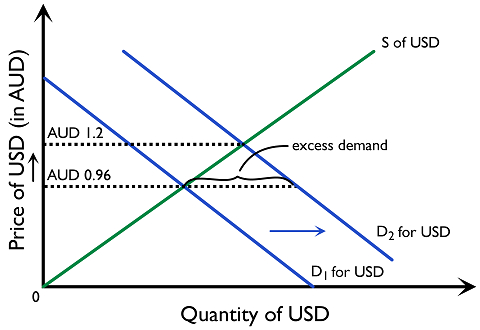
An increase in foreign demand for a country’s export will lead to an increased demand for a country’s currency. For example, when Australia increases the demand for US exports, the demand for US$ will increase and shift from \(D_1\) to \(D_2\) as shown in Figure 4.5.3. At the original exchange rate US$ 1 = AU$ 0.96, there is an excess demand of US$. The excess demand will force the price of US$ to rise. The US$ will appreciate to US$ 1 = AU$ 1.2.
2) Domestic demand for imports
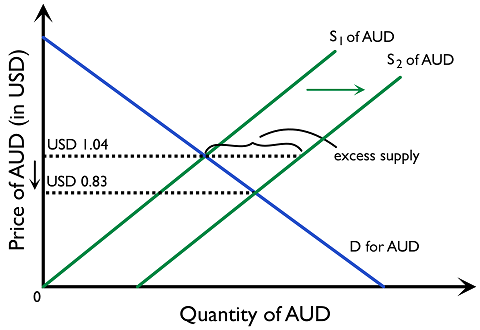
In the previous example, when Australia demands more US exports, the demand for US$ increases. At the same time, the supply for AU$ also increases in order to exchange for more US$ to finance the increased expenditure. In Figure 4.5.4, the supply for AU$ increases from \(S_1\) to \(S_2\). At the original exchange rate AU$ 1 = US$ 1.04, there is an excess supply of AU$. The excess supply will force the price of AU$ to fall. The AU$ will depreciate to AU$ 1 = US$ 0.83.
An increase in demand for one currency means an increase in supply for another currency.
An appreciation of currency X in terms of currency Y means a depreciation of currency Y in terms of currency X.
3) Relative interest rates
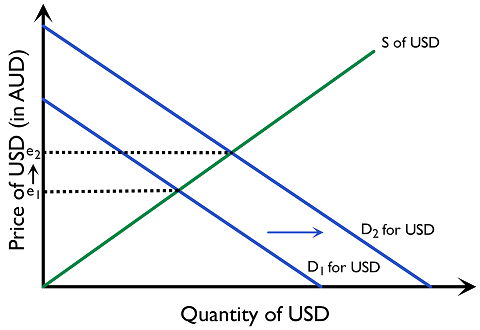
Suppose there is a rise in interest rates in a country, the return of saving deposits and bonds become more attractive to investors. There is a capital inflow to the country. In Figure 4.5.5, when the interest rate rises in the US compared to Australia, given that the US$ is rather stable and a sudden fall in US$ is not expected, Australians may convert their AU$ to US$ in order to enjoy a higher return in saving deposits. The demand for US$ will increase from \(D_1\) to \(D_2\). US$ appreciates from \(e_1\) to \(e_2\).
4) Relative inflation rate
A higher inflation rate in the country represents an increase in the general price level within the country, compared to its trading partners. This will lower the demand for domestic exports and so the demand for its currency decreases. At the same time, the country may find foreign imports cheaper, and demand for imports increases. Hence the supply of domestic currency increases.
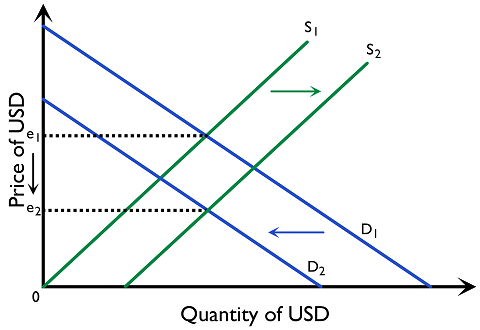
Figure 4.5.6 shows the effect of a higher inflation rate in the US relative to Australia. US exports become less competitive and the demand for US$ decreases from \(D_1\) to \(D_2\). Imports from other countries are more competitive and US citizens will supply more US$ in exchange for imports, shifting the supply of US$ from \(S_1\) to \(S_2\). The US$ tends to depreciate from \(e_1\) to \(e_2\).
Relative economic growth rates
A change in income affects demand for imports. The effect on the exchange rate therefore depends partly on the growth of domestic income relative to income in trading partners.
1) Faster growth in domestic income
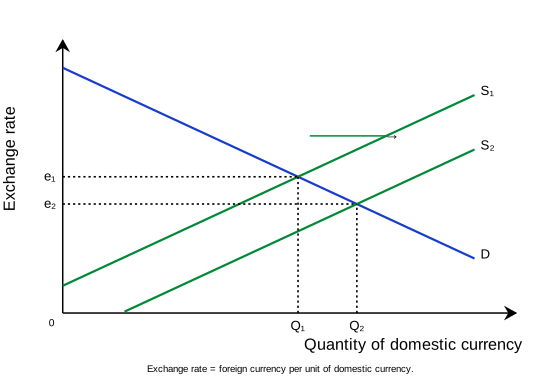
Assume that imports are normal goods. As domestic income rises, households and firms buy more imports. To pay foreign suppliers, they supply more domestic currency in exchange for foreign currency. Holding other determinants constant, the supply of domestic currency shifts from S₁ to S₂ in Figure 4.5A. The exchange rate falls from e₁ to e₂: the domestic currency depreciates.
2) Faster growth in trading partners
Higher incomes abroad can increase demand for the country's exports. Foreign buyers demand more domestic currency to pay for them. Holding other determinants constant, this creates upward pressure on the exchange rate.
The relative growth rates help explain which of these pressures is stronger. Import demand also depends on income elasticity: a given rise in income generates a larger rise in imports where demand for imports is more income elastic.
Faster domestic growth does not necessarily cause depreciation overall. If improved growth prospects attract investment from abroad, the resulting demand for the currency may offset the pressure from higher imports.
5) Investment from overseas (in the form of foreign direct investment and portfolio investment)
When the future of an economy becomes more prosperous, foreign investors tend to increase their investment in the country including investing in corporations or buying stocks as better returns can be expected. This increases the demand for the domestic currency and the currency will tend to appreciate.
Outward investment and the exchange rate
Outward foreign direct investment occurs when residents invest in an enterprise abroad and establish a lasting interest with significant influence over its management. Outward portfolio investment includes residents purchasing foreign financial assets, such as shares or bonds, without establishing a direct-investment relationship.
When residents exchange domestic currency to finance these investments, the supply of domestic currency increases. In Figure 4.5A, this is also represented by a shift from S₁ to S₂. Other things being equal, the domestic currency depreciates.
Inward investment financed by buying domestic currency creates the opposite pressure: demand for the currency rises. Foreign investors selling domestic assets and converting the proceeds into foreign currency can instead create downward pressure.
The size of the exchange-rate effect depends on how the transaction is financed. A resident who uses foreign currency already held abroad does not need to supply additional domestic currency immediately. Investment flows should therefore be linked to the currency transaction rather than treated as an automatic one-for-one change in currency demand or supply.
6) Speculative activities
When people expect a currency to rise in the future, they will buy it now and the demand for the currency increases; the currency tends to appreciate.
7) Remittances
Remittances are funds sent by migrants back to their home country. Remittances provide the recipient economy with foreign currency and help finance imports; they may therefore cause the recipient country’s currency to appreciate.
8) Central bank intervention
The government can influence the exchange rate by changing the interest rate. If the government increases the interest rate, the domestic interest rate will be relatively higher than interest rates abroad. This will lead to ‘hot money’, in the form of financial investment, flowing into the country. In order to make financial investments in the domestic economy, foreign investors will have to buy the domestic currency. This will increase the demand for the domestic currency and cause it to appreciate.
The government can also influence the exchange rate using its reserves of foreign currency. It can increase the value of its currency by buying its own currency on the foreign exchange market using reserves of foreign currency; this increases the demand for the domestic currency and causes it to appreciate.
Calculations of the exchange rate
i) How to calculate the value of one currency in terms of another currency?
Given than US$ 1: € 0.77, what is the price of € 1 in terms of US$?
\( \text{€} \; 1= \frac{1}{0.77} = 1.30, \text{€}1 =\text{\$}1.30 \)
ii) How to calculate the price of a good in different currencies?
Assume that a watch is sold in the UK for £100. Assume that £ 1 = AU$ 1.5. The price of the watch in AU$ will be:
£ 100×1.5 = AU$ 150
Suppose the item is sold at AU$ 180 in Australia, calculate the price of the watch in £:
First, calculate the price of the AU$ in terms of £:
\(\mathrm{AUD}\;1=\frac{1}{1.5}\;\mathrm{GBP}=\frac{2}{3}\;\mathrm{GBP}\approx0.67\;\mathrm{GBP}\)
The price in pounds is AU$180 ÷ 1.5 = £120. Use the unrounded reciprocal, 2/3, when multiplying; 0.67 is only an approximation.
Calculations of the changes of the exchange rate
Suppose the exchange rate of US$ and Indian Rupees (INR) are shown as follows.
| September | US$ 1 = INR 5400 |
|---|---|
| December | US$ 1 = INR 5800 |
i) What is the change in the price of US$ in terms of INR?
Recall the formula of calculating percentage change as
\( \frac{Price \; (New) - Price \; (Old)}{Price \; (Old)} \times 100 \%\)
\( \% \Delta \; in \; US$ = \frac{5800-5400}{5400} \times 100\% = +7.4\% \)
US$ has appreciated by 7.4% against the INR from September to December.
ii) What is the change in price of Rupees in terms of US$?
First, we need to convert the exchange rate to the price of INR in terms of US$.
| September | \(\mathrm{INR}\;1=\mathrm{US}\$\frac{1}{5400}=\mathrm{US}\$0.000185185\ldots\) |
|---|---|
| December | \(\mathrm{INR}\;1=\mathrm{US}\$\frac{1}{5800}=\mathrm{US}\$0.000172413\ldots\) |
\(\%\Delta\text{ in INR}=\left(\frac{1/5800}{1/5400}-1\right)\times100\%=\left(\frac{5400}{5800}-1\right)\times100\%\approx-6.90\%\)
The INR has depreciated by approximately 6.90% against the US dollar from September to December. The US dollar appreciation is approximately 7.41%. The percentages differ because the currencies have different starting values.
Watch Out: From this example, students should be aware that a 7.4% appreciation in US$ does not represent a 7.4% depreciation in INR; students have to calculate the relative percentage change.
Consequences of changes in the exchange rate on economic indicators
1) Change in the inflation rate
Suppose the domestic currency depreciates, imports are more expensive in terms of domestic currency. Firms have to pay a higher price for imported raw materials and the cost of production increases. This will lead to an import-oriented inflation and the inflation rate may increase.
In Figure 4.5.8, depreciation raises the domestic-currency cost of imported inputs, other things equal. Higher production costs shift SRAS to the left (upwards), creating cost-push inflationary pressure. This is separate from any rightward shift of AD caused by an increase in net exports.
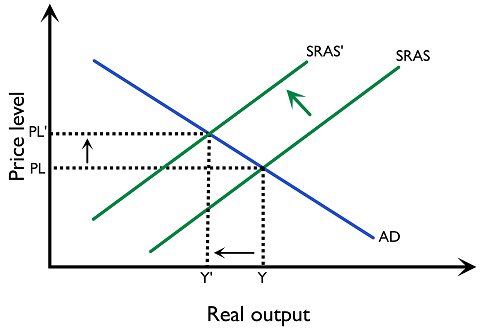
Furthermore, if the domestic currency depreciates, exports become relatively cheaper for foreign consumers while imports become relatively more expensive for domestic consumers. This means that net exports (X - M) are likely to increase, shifting AD out and leading to inflation.
2) Employment
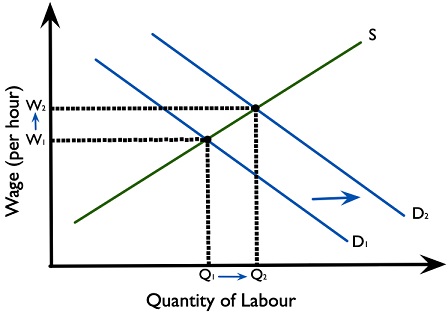
A depreciation of domestic currency will lower the price of domestic exports in terms of foreign currency and increase the quantity of exports. At the same time, imports become more expensive and domestic products become more competitive. This may increase the demand for labour in the exports sector and also import-competing sectors. Therefore, there is an improvement in the domestic employment level.
This can be seen in Figure 4.5.9. The increase in the demand for labour from D1 to D2 caused by the depreciation of the domestic currency leads to an increase in the quantity of labour employed from Q1 to Q2.
3) Economic growth
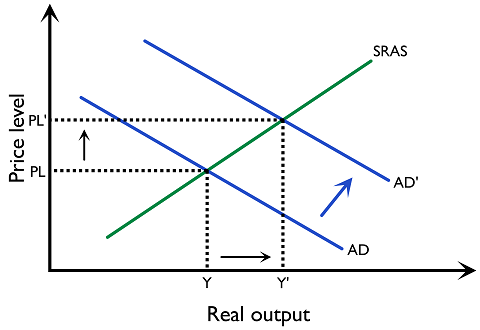
The depreciation of the domestic currency will help increase exports and lower imports. As net exports is a component of the GDP, the value of GDP is improved, thus enhancing economic growth.
This can be seen in figure 4.5.10. The increase in net exports (X - M) leads to a shift out of the AD curve, and thus economic growth.
4) Current account balance
The trade balance is the value of exports of goods and services minus imports of goods and services; it is one component of the current account. Depreciation may improve it if export and import quantities respond sufficiently to relative price changes. The outcome depends on demand elasticities, time lags and price pass-through. Import expenditure measured in domestic currency may initially rise. A trade-balance improvement therefore cannot be assumed, nor does depreciation automatically prevent a loss of reserves.
5) Living standards
Consider an appreciation of the exchange rate. When the exchange rate appreciates, imports become cheaper for domestic consumers. This means that domestic consumers are able to buy more imports, and their living standards might improve.
Fixed exchange rate system
A fixed exchange rate system (also known as the pegged exchange rate system) is a currency system in which the government tries to set its domestic currency at some constant level against another currency. The central bank maintains the exchange rate by buying and selling its currency.
In a fixed exchange rate system, we use the terms devaluation and revaluation to describe the change in the price of a currency in terms of another currency.
Revaluation of a currency is an increase in the value of one currency in terms of another currency in a fixed exchange rate system.
Devaluation of a currency is a decrease in the value of one currency in terms of another currency in a fixed exchange rate system.
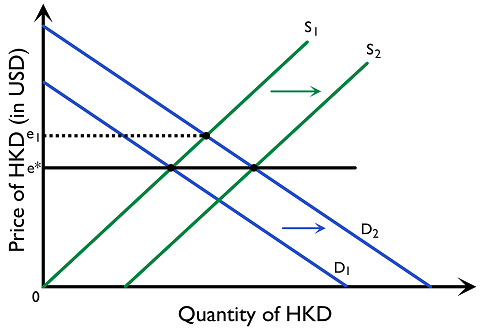
In Figure 4.5.11 it is assumed that the Hong Kong Dollar (HK$) is pegged against US$ at a rate US$ 1 = HKD 7.8, (or HK$ 1 = US$ 0.128) at \(e^*\) and the equilibrium exchange rate is also at \(e^*\); there is no role for government intervention. Suppose that there is an increase in the demand for Hong Kong’s exports, the demand for HK$ increases from \(D_1\) to \(D_2\). At \(e^*\), there is an excess demand for HK$, and pressure for the HK$ to appreciate to \(e_1\). In order to maintain the exchange rate at \(e^*\), the central bank will sell HK$ in the market and buy US$ to increase the supply of HK$ from \(S_1\) to \(S_2\) as shown in Figure 4.5.11. The exchange rate of HK$ in US$ can be maintained at \(e^*\).
Managed exchange rate system
In a managed floating exchange rate system, market forces influence the exchange rate, but the central bank intervenes to influence its level or reduce fluctuations. Intervention may involve buying or selling currency. A target band is one possible arrangement, but managed floating does not require a fixed or publicly announced band. The following diagram illustrates intervention within a band.
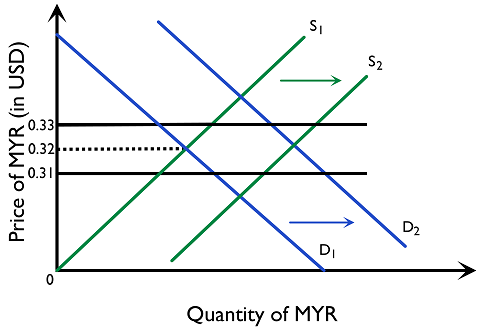
Suppose that Malaysia adopts a managed exchange rate system and that the Malaysian central bank wants to maintain the value of Malaysian Ringgit (MYR) close to MYR 1 = US$ 0.32. The central bank allows the exchange rate to float in small fluctuations (from MYR 1 to US$ 0.31 to 0.33) without intervention.
However, if the demand for MYR increases from \(D_1\) to \(D_2\) in Figure 4.5.12 and MYR has pressure to appreciate above the upper band set by the central bank, the central bank will sell its currency and increase the supply of MYR from \(S_1\)
to \(S_2\) so that the price of MYR falls back into the band.
Consequences of overvalued and undervalued currencies
Maintaining an overvalued currency
The price of imports is lowered with an overvalued domestic currency. Firms are able to import cheaper raw materials and machinery. This lowers the production cost and increases the competitiveness of import-competing industries.
Consequences of maintaining an overvalued currency
An overvaluation of the domestic currency will increase export prices and the export sectors suffer. However, the prices of imports are lowered, thus also lowering the production cost of domestic firms in export sectors. The exporting firms are able to produce cheaper goods. This may offset the price effect brought by an overvaluation of a currency.
Maintaining an undervalued currency
Governments maintain an undervalued currency for export promotion strategy. The prices of exports are lowered with an undervalued domestic currency. Domestic exports become more competitive in the global market. The export is improved and this leads to economic growth.
Consequences of maintaining an undervalued currency
An undervalued currency means imports become more expensive. The cost of living of the population is higher and may lead to import-oriented inflation.
Fixed versus floating exchange rate systems
| Floating |
Higher uncertainty and exchange rate riskSince the exchange rate is determined by market forces, exporters, importers and investors face exchange rate risk. They may face higher uncertainty in terms of the change in the price level and total revenue. This will lower the volume of international trade. |
|---|---|
| Fixed |
Less uncertainty and exchange rate riskA fixed exchange rate system increases certainty for returns in investment. Investors will not be exposed to exchange rate risk. The volume of international trade is higher.
|
| Floating |
No requirement for foreign reservesThere is no need for the central bank to hold large foreign reserves to intervene with the exchange rate.
|
|---|---|
| Fixed |
Large foreign reserves neededIn order to maintain the fixed exchange rate system, large foreign reserves are needed for buying domestic and foreign currencies to manipulate the exchange rate level.
|
| Floating |
Possible adjustment of trade imbalancesA trade deficit can put downward pressure on the exchange rate, other things equal, but capital flows and other foreign-exchange transactions also affect it. Depreciation may help reduce the deficit if export and import demand are sufficiently responsive. Adjustment can take time, and the trade balance may initially worsen. A floating rate does not guarantee that a trade imbalance will disappear. |
|---|---|
| Fixed |
Trade disequilibrium will not be automatically adjustedAs the currency will not be automatically depreciated in times of trade deficit, the negative trade balance will not be automatically adjusted. There is a need for government intervention to implement contractionary demand-side policies to improve the trade balance.
|
| Floating |
Smooth exchange rate adjustmentAn overvaluation or undervaluation of a currency caused by the change in demand and supply will automatically cease through depreciation and appreciation of the currency. The process is smooth and continuous.
|
|---|---|
| Fixed |
Destructive exchange rate adjustmentIf the fixed exchange system is abandoned, the sudden depreciation or appreciation of the exchange rate can be disastrous.
|
| Floating |
Flexible use of monetary policyPolicy makers have the autonomy to use monetary policy when there is a need to boost the economy by reducing interest rates. The exchange rate is free to depreciate to encourage exports and achieve economic growth.
|
|---|---|
| Fixed |
Loss of monetary autonomyPolicymakers lose the tools of using the monetary policy to achieve economic goals. It is because interest rates and money supply adjustments will lead to a change in the exchange rate which causes the exchange rate to deviate from the fixed rate.
|