4.4 Economic integration
Preferential trade agreements
Preferential trade agreements give preferential access to certain products from participating countries by reducing or eliminating trade barriers. This is the first stage of economic integration.
Bilateral
Bilateral trade agreements are agreements made between two sides, where each side could be a country, a trading bloc or an informal group of a country.
For example, China has a bilateral agreement with Hong Kong for a Closer Economic Partnership Arrangement (CEPA). China has another bilateral agreement with the Association of Southeast Asian Nations (ASEAN) for the ASEAN-China Free Trade Area.
Regional
Regional trade agreements are agreements made between all the countries within a particular region.
For example, the North American Free Trade Agreement (NAFTA) is a regional trade agreement between the USA, Canada, and Mexico.
NAFTA is used here as a historical free-trade agreement: it operated from 1994 until its replacement by USMCA on 1 July 2020.
Multilateral
Multilateral trade agreement is an agreement made by more than two countries at one time. It tries to lower trade barriers between participating countries without discrimination. WTO agreements are multilateral trade agreements.
Trading blocs
Trading blocs are a type of intergovernmental agreement that is formed by groups of countries. Countries within the same bloc will enjoy free trade and trade barriers are removed.
A free trade area is an agreement that free trade is enhanced among member countries, but each member can maintain its own trade policies with non-member countries. One example is the North American Free Trade Agreement (NAFTA) made between Canada, the US and Mexico.
A customs union is a trading bloc whose member countries enjoy free trade with each other and a common external trade policy, e.g. a common tariff is imposed on non-member countries. One example is the Southern African Customs Union (SACU).
A common market combines free trade between members and a common external tariff, as in a customs union, with free movement of factors of production, including labour and capital. The EU single market illustrates these features. EFTA is a free-trade association, not a customs union: its members do not share a common external tariff. Iceland, Liechtenstein and Norway participate in the EU single market through the EEA; Switzerland does not belong to the EEA.
Advantages and disadvantages of trading blocs
Advantages
1) Greater access to markets offer potential for economies of scale
As domestic producers are able to sell their product to a larger market and therefore increase their scale of production, they might benefit from economies of scale. However, some domestic producers might find it difficult to compete.
2) With freedom of labour, there are greater employment opportunities
If the trading bloc includes free movement of labour, individuals looking for work in one of the member countries could also move to another member country to find employment.
3) Membership in a trading bloc might allow for stronger bargaining power in multilateral negotiations
That is, a trading bloc negotiating on behalf of all its member states may be more effective than each member state negotiating on its own.
4) Greater political stability and cooperation
Membership of a trading bloc encourages countries to cooperate with each other politically as well as regarding trade. The international structure of the bloc may also encourage political stability in each of the member countries.
5) Trade creation (HL only)
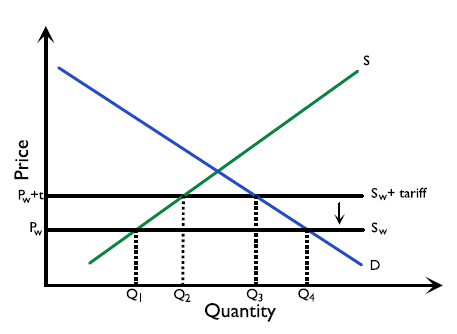
Trade creation occurs when trade is diverted from a less efficient domestic producer towards a more efficient exporter. Suppose that a trading bloc is formed between two countries and both countries remove their tariffs imposed on each other. The world supply curve that country A faces reduces from Sw + tariff to Sw. Country A's domestic production reduces from Q2 to Q1 and import levels increase from Q2Q3 to Q1Q4. Country A hence diverts its production from a less efficient domestic producer towards a more efficient exporter. Country A can now enjoy cheaper imports.
Member countries who gain access to more markets in the bloc can enjoy economies of scale; this may lower their average production costs.
For example, consider the case of the UK joining the EU. Assume that when the UK joined the EU, it had a comparative advantage in the production of luxury cars. However, prior to the UK’s entry, the EU had imposed import tariffs on the UK’s cars. Because of these import tariffs, the EU was producing some cars, and importing some from the UK. When the import tariff is removed, EU production falls, and imports rise; trade has been created. This is reflected in the increase in quantity demanded to Q4 and the decrease in quantity supplied domestically ot Q1 in Figure 4.4.1. There is also movement from high-cost to low-cost producers, as luxury cars are now being made by more efficient UK producers rather than by EU producers.
Disadvantages
1) Loss of sovereignty
With greater integration, countries might lose some of their economic and political sovereignty. This is because in a trading bloc decisions on how to trade with countries outside the union are made centrally, not by individual countries.
2) Challenge to multilateral trading negotiations
Trading blocs favour increased trade among their members, but might discriminate against non-members; this is damaging to the achievements of the WTO, and might mitigate our ability to achieve the potential gains from more liberalised world trade.
3) Trade diversion (HL)
Trade diversion occurs when trade is diverted from a more efficient exporter outside the bloc towards a less efficient one within the bloc. Suppose that country A faces supply from both country B and C, where country B has a higher cost of production than C. Suppose that country A and B enter into a customs union where they would impose common trade protection on the outside bloc countries. Country A therefore might impose a tariff on country C. After the tariff is imposed, country B’s price level shall be lower than country C’s. Therefore, trade is diverted because the more efficient exporter has to bear the protectionist measures imposed, which increase its production costs and reduce its export competitiveness. Being in the bloc, the importing country misses out on cheaper import opportunities outside the bloc.
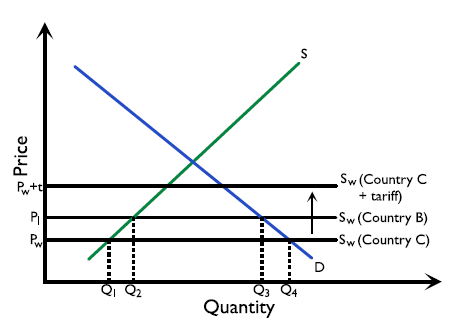
Consider again the case of the UK joining the EU. Before the UK joined, it might have been producing clothing itself, and importing clothing from India, which had a comparative advantage in the production of clothing. However, once it joined the EU, it had to impose a tariff on Indian clothing. This would lead to a fall in the quantity demanded and a loss of consumer surplus; this is illustrated in Figure 4.4.2 by the fall in quantity demanded from Q4 to Q3. There is also a shift from low-cost to high-cost producers, as the production has transferred from efficient Indian producers to inefficient EU producers.
Monetary union
Monetary union is a common market with a common currency and a common central bank. The Eurozone members of the European Union (EU) is one example. The majority of the countries in the EU adopted a common currency, the euro.
Advantages and disadvantages of monetary union (HL)
Advantages to members within the monetary union
1) Closer cooperation between members
Members in the EU share resources, common standards and law. They have created policies to protect the environment. This encourages a closer cooperation between members and lowers the possibility of war.
2) Lower transaction costs for trade
With individual currencies, there is a charge associated with trade when currencies are exchanged; this will not happen with the existence of a single currency.
3) Strengthen individual countries
A group of countries with a common currency will enjoy greater influence in world affairs.
4) Less exchange rate fluctuation
Since the countries now have a common currency, any fluctuations that used to exist between the countries’ exchange rates will disappear, eliminating exchange-rate uncertainty and increasing investment and trade.
5) More credible currency
A currency which is used in a large currency zone will be more credible, and therefore more stable against speculation.
6) Improved confidence
There will be less risk involved in trading among the countries, leading to improved business confidence.
7) More transparent prices
A common currency makes differences in price between countries more obvious, so should over time lead to the equalisation of prices.
Disadvantages to members within the monetary union
1) Reduce sovereignty of countries
Members in the EU cannot adopt their own monetary policies or exchange rate policies as they have to follow instructions from the European Central Bank (ECB). Thus, the economic sovereignty is lost.
For example, if one country in the EU were experiencing inflation and other countries were not, the ECB would not increase interest rates in the EU, so the country would have to take other measures.
2) Inflexibility of implementation of fiscal policy
Although individual governments may have different fiscal budget plans, according to the EU guidelines, each country’s budget deficit and debt level have to be below the agreed level (expressed as % of GDP). The European central bank has the authority to maintain financial stability among the countries. Hence, governments have to maintain budget prudence and limited extent of fiscal policies that can be implemented by individual governments under huge deficits.
3) High financial costs
Each member pays an administration fee to the EU. For example, the EU membership costs EU countries £65 billion every year.
Furthermore, the initial costs of converting the currencies to the common currency are very large; they include taking the old currency off the market, printing and distributing the new currency, and re-pricing all goods and services in each country’s economy.
The World Trade Organisation (WTO)
The World Trade Organisation (WTO) is an international organisation which sets rules for global trading and resolves disputes between its member countries. It was established in 1995 and by June 2020 had 164 members and 23 ‘observer countries’ which are seeking membership.
All member countries are required to give each other ‘most favoured nation’ status, meaning that they grant each other trade concessions.
Aims of the WTO
The WTO aims to promote free trade by abolishing tariffs and other trade barriers and resolving trade disputes.
Its principles are non-discrimination betwen the products that countries produce and goods on foreign markets; more open trade; predictability and transparency of trade; encouraging ‘fair’ competition; ensuring benefit for developing countries, and protecting the environment.
Functions and activities of the WTO
- To reduce trade barriers relating to matters such as anti-dumping, subsidies and product standards
- To settle trade disputes between governments and organise trade negotiations, with the WTO as the final judge
- To administer and monitor the application of the WTO’s rules for trade
- To monitor and review the trade policies of members and ensure that trade agreements are clear
- To be a forum for trade negotiation
Factors affecting the influence of the WTO
1) Unequal bargaining power of member countries
Some particularly powerful economies, such as the USA and the EU, have undue influence on the WTO and its negotiations, despite the fact that all countries are meant to have an equal vote. This means that the views of developing countries may not be heard.
2) Difficulty reaching agreement in the most recent round of negotiations
In the Doha round, negotiations broke down due to an inability to agree on two issues:
- The EU and USA reducing their agricultural subsidies to improve market access for developing countries’ exports;
- More-developed countries want larger developing countries like Brazil and India to lower their barriers to the import of manufactured goods.
Difficulties reaching agreement on services
Trade in services often depends on rules within a country rather than a tariff charged at its border. Foreign suppliers may need permission to establish a business, employ staff or have their qualifications recognised. Negotiations therefore involve the conditions under which services can be supplied.
1) Different regulatory requirements
Governments regulate services to protect consumers and maintain standards. Countries may disagree over whether a requirement is necessary for this purpose or whether it gives domestic suppliers an unfair advantage. Opening a market therefore involves deciding which restrictions can be reduced while preserving legitimate protection.
2) Different commercial interests
Countries seek better access for the services in which their suppliers are competitive, but may be reluctant to open sectors where domestic firms face stronger foreign competition. An offer that benefits one country's exporters may impose adjustment costs on another country's producers and workers.
3) Movement of people and government control
Some services require the supplier to be physically present in the customer's country. Commitments allowing this can raise concerns about employment and the administration of entry rules. Governments may also be unwilling to make commitments that they believe would restrict future regulation.
These differences make it difficult to agree on a package of concessions acceptable to all participants. Agreement on general support for freer trade does not necessarily produce agreement on the particular sectors or restrictions to be opened.