2.4 Critique of the maximising behaviour of consumers and producers
Rational consumer choice
When creating economic models, assumptions have to be made in order to test and validate the hypotheses that generate economic theories.
Assumptions of rational consumer choice
Assumptions are made about the way that consumers, as economic ‘agents’, make choices.
1) It is assumed that consumers behave rationally
In this case, a ‘rational’ response to an economic decision involves considering all the possible options and working out which will give the most utility.
2) Consumers are utility maximisers
When making decisions, consumers act only in their own self-interest, and seek to maximise their utility.
3) Consumers have perfect information when making decisions
Behavioural economics - limitations of the assumptions of rational consumer choice
In real life, humans do not satisfy these assumptions of rational consumer choice due to the following:
1) Biases
- Availability bias
- Anchoring bias
- Framing bias
- Rule of thumb
Availability bias occurs when people judge the likelihood or importance of an event by how easily examples come to mind. Recent, vivid or frequently encountered information can therefore receive too much weight. For example, if we become aware of a case of salmonella in another part of the country, we might make different food choices in response even if there is no risk in our area.
Anchoring bias occurs when we use the value of one good as a reference point to influence future choices. We tend to rely too heavily on the first piece of information offered to us to make subsequent judgements. For example, we might ‘anchor’ the price of a good in the supermarket in our minds, and feel like we are getting a very good deal when there is a sale and therefore buy more than we need.
Framing bias means the way that information is presented influences choices. When information about a good is presented in a positive manner, we are likely to have a more positive view about the product.
A rule of thumb is a rough and practical method that can easily be applied when making decisions. It might lead to irrational decision making. For example, we might decide to only buy something if it is on special offer without realising that the ‘special offer’ price is not cheaper than the average price of the good over a period of time.
2) Bounded rationality
Bounded rationality refers to the fact that our rationality is limited by the information that we have, the time that we have, and the cognitive ability that we have to weigh up different options. For example, when buying a bicycle online we are likely to be unable or to lack the time to weigh up the pros and cons of all the different options accurately, and therefore fall back on biases such as the rule of thumb or framing bias to help us make decisions.
3) Bounded self-control
Bounded self-control refers to the fact that we cannot always exercise perfect will-power; we sometimes give in to temptation. For example, I might know that it is in my self-interest to eat fruit as a healthy snack, but actually give in to temptation and eat sweets instead.
4) Bounded selfishness
Bounded selfishness refers to the fact that humans do not always act in their own self-interest; we care about the well-being of others. For example, the rational consumer model assumes that people would not spend time volunteering for charity.
5) Imperfect information
Imperfect information means we do not always have access to all levels of information, and are limited in terms of how we can process the information available to us. For example, we may be uncertain about the costs and benefits of a particular product, such as potential side effects of taking a pain-killing medication.
Behavioural economics in action
Given these biases, consumers often make poor choices. Changing their choice architecture and using nudge theory are two ways to improve their decision-making.
Choice architecture
Choice architecture is the idea that the way that choices are presented to us influences the decision that we make.
- A default choice is a choice that is pre-selected if the decision-maker does nothing, or the choice that is always followed unless a deliberate decision is made to change it. For example, Google is the default search engine on many browsers - you do not have to actively open it, but just type a query into the URL bar and it automatically comes up. A choice may also be default because of habit, for example always taking the same route to school.
- A restricted choice means when consumers have a choice but limited options, their choice is restricted. For example, the choice between junk food and healthier food is restricted.
- A mandated choice is a choice that consumers are required by law to make. For example, in many countries individuals are required to sign up as organ donors when they apply for a driving license.
Nudge theory
Nudge theory argues that choice architecture can be designed to ‘nudge’/’encourage’ people to voluntarily choose the option that is better for them.
This ensures that consumers maintain their right to choose (their consumer sovereignty) while still making better decisions.
An example is placing healthy foods at the entrance of a school cafeteria. Students are not forced to choose the healthy option, but are ‘nudged’ subconsciously to do so.
In their book Nudge: Improving Decisions About Health, Wealth, and Happiness, Richard Thaler and Cass Sunstein define a ‘nudge’ as:
“... any aspect of the choice architecture that alters people’s behaviour in a predictable way without forbidding any options or significantly changing their economic incentives. To count as a mere nudge, the intervention must be easy and cheap to avoid. Nudges are not mandates. Putting fruit at eye level counts as a nudge. Banning junk food does not.”
Nudges therefore make it more likely that an individual will make the choice that the choice architect wants them to make; usually, this choice will be for a merit good, something that is in the individual’s best interest but which without intervention would be under-demanded.
In 2010, the then UK government set up the Behavioural Insights Team, which is known colloquially as the ‘Nudge Unit’. The Nudge Unit aims to apply behavioural economic insights, including nudge theory, to inform policy and improve public services.
In 2013, the Behavioural Insights Team worked with the Department of Health, the NHS, the Driver and Vehicle Licensing Agency (DVLA) and the Government Digital Service to encourage organ-donor registration. The shortage remained substantial: at the end of February 2020, 6,138 people were on the UK active transplant waiting list.
When renewing car tax online, customers are asked if they want to join the organ donor register. The Nudge Unit ran a randomised controlled trial for a month where eight different messages were used to encourage people to sign up, with visitors to the site being randomly allocated to each of those eight messages. The most successful message was: “If you needed an organ transplant, would you have one? If so, please help others.” This message was successful because it drew on the idea of reciprocity and fairness. The Nudge Unit estimates that if this were to be used for the whole year, it would lead to approximately 96,000 extra registrations.
England introduced an opt-out organ-donation system on 20 May 2020. Consent may be deemed for eligible adults who have not recorded a decision against donation. It does not cover everyone: exceptions include people under 18, people who lack the capacity to understand the arrangements, and people who have not been ordinarily resident in England for at least 12 months. The policy illustrates a change in the default; it does not mean that every adult automatically donates organs.
Business objectives
Profit maximisation
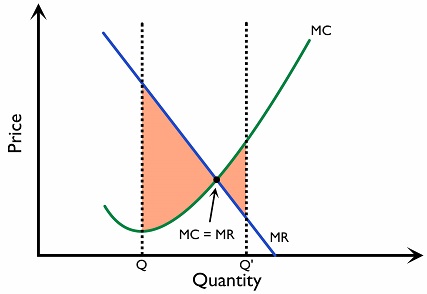
Profit-maximising condition is where marginal revenue (MR)= marginal cost (MC). In all subsequent models, it is assumed that firms attempt to maximise their profits, and their decisions will be guided by the profit motive. In Figure 2.4.1, the firm was originally producing at quantity Q. If the firm produces one extra unit of output, the MR the firm would gain is higher than the MC it needs to pay. Therefore, the firm would produce more than at quantity Q. On the other hand, suppose the firm was originally producing at quantity Q’. If the firm produces one less unit of output, the MC the firm would save is higher than the MR it gains. Therefore, the firm would produce at a quantity below quantity Q’.
Alternative goals
In the real world, firms might also have alternative goals, apart from purely maximising profit. Some of the alternative goals are:
1) Market share maximisation
The firm may seek to maintain or increase its market share over its rivals. To achieve this end, it may sell at the lower than profit-maximising price in order to attract more consumers. A firm that has a greater market share may be able to better take advantage of its size.
2) Growth maximisation
Firms may also try to maximise growth, especially for firms at the start-up stage, or where there are significant network effects (i.e. where the firm is more likely to get more users and business the greater its size is, for instance Wikipedia, or social networking websites).
3) Satisficing
Satisficing is a goal of “good enough”, where a firm tries to take actions that satisfy conflicting objectives, rather than to maximise profit. For example, a coffee shop owner strongly values the creation of the “happy customer”, and he would rather hire one more person to make coffee so that he can spend more time talking with the customer. Hiring a person to make coffee might not align with the profit maximisation principle, but it does allow the owner to fulfil his belief.
4) Corporate social responsibility
Besides maximising profit, firms might want to pursue interests that align with society, e.g. introducing a greener work environment, encouraging employers to do voluntary work, providing work opportunities to the less privileged groups in society etc.