2.2 Supply
Supply
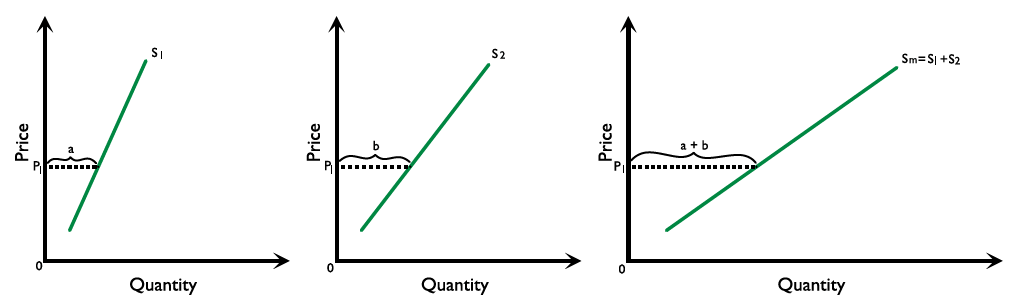
Supply means the willingness and ability of producers to produce a quantity of a good or service at a certain price over a period of time. Individual supply for a good or service is the quantity of goods and services that a producer is willing and able to sell at various price levels over a period of time. A market supply of a good or service can be obtained by simply adding up the quantity supplied that each producer is willing and able to sell at different prices.
The law of supply - the relationship between price and quantity supplied
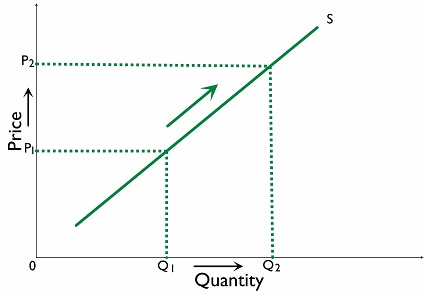
The law of supply states that within a period of time, an increase in price would lead to an increase in quantity supplied, ceteris paribus.
The law of diminishing marginal returns
The marginal return to a factor of production is the additional amount that is produced for every unit of that factor that is added. For example, if a farm hires an additional worker to harvest apples, the marginal return will be the additional number of apples that that worker harvests.
The law of diminishing marginal returns states that, beyond a certain point, adding units of a variable factor to fixed factors of production leads to a fall in marginal product, with technology unchanged. If the farm has a fixed number of ladders, each additional worker will be able to harvest a smaller number of apples as there aren’t enough ladders to go around.
Increasing marginal costs
Marginal cost is the additional cost of producing one more unit of output. Once diminishing marginal returns set in, marginal cost rises if the price of the variable input is unchanged: each additional unit of the input produces less extra output.
Why are the supply curves upward sloping?
Profit effect: A higher price represents a higher profit-margin; the producer has an incentive to produce more in order to earn more.
Cost effect: Per unit cost will increase with the rise in quantity supplied; producers will only produce them when the per-unit price is higher.
Price determinants of supply (movement along the supply curve)
When there is a change in the price of good A, the quantity supplied of good A will change. This results in a movement along the same supply curve. (Figure 2.2.2)
The non-price determinants of supply (Shift of supply curve)
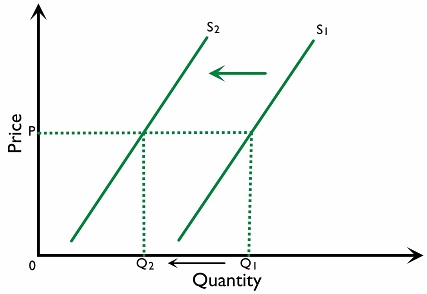
The shift of the supply curve means quantity supplied changes at every price level. Hence a shift of the supply curve shall be caused by non-price factors of the good.
1) Change in costs of factors of production
When the costs of factors of production (labour, land, capital and entrepreneurship) increases, firms enjoy a lower profit. At every single price, the firm is willing to supply less. This can be represented by a shift of supply curve to the left from \(S_1\) to \(S_2\) as shown in Figure 2.2.3.
2) Change in technology
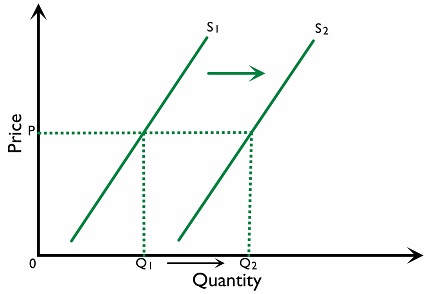
Improved technology can help firms increase production efficiency and lower their production cost. Firms are able to produce more units at the same price. This increases the supply and shifts the supply curve to the right.
3) Change in prices of related good
A change in the price of a good that is jointly supplied will affect the supply of another good.
Joint Supply means that the goods are supplied together. For example, a producer who produces beef jointly supplies cow leather. When the price of beef rises, the producer is willing to supply more beef, so the quantity supplied of beef increases. At the same time, as beef and cow leather are supplied together, the supply of cow leather will also increase and the cow leather supply curve shifts to the right as shown in Figure 2.2.4
On the other hand, a change in the price of a good that is competitively supplied will also affect the supply of another good.
Competitive supply means two goods are competing for the same resources used in production. Take the example of a producer who has a fixed area of rearing cows and sheep. When the price of cows rises, the producer has a higher incentive to supply more cows; the area left for rearing sheep will be lowered and hence lower the supply of sheep.
4) Change in expectation of prices
If producers expect the price to be higher in future, they will cut back the supply now and supply more in the future. The supply curve will shift to the left for the current time period.
5) Change in the number of firms
When more firms enter a market, the market supply will increase and the supply curve will be shifted to the right.
6) Imposition of indirect taxes and subsidies
An increase in indirect tax will increase the production cost and shift the supply curve to the left. An increase in subsidy helps reduce the production cost and shift the supply curve to the right. The topic of indirect tax and subsidy shall be covered in greater detail under topic 2.7.