2.1 Demand
A market exists when buyers and sellers interact to exchange goods and services. Their interaction determines the market price of a good or service and thus how they are produced and whom they are produced for.
The market does not need to be confined to a physical location. The online trade business is classified as a market. There are different types of markets. The product market involves the exchange of goods and services. The factor market involves the exchange of factors of production, such as labour and capital. The financial market involves the trade of monetary items such as shares of companies and foreign exchange.
Demand
Demand means the willingness and ability to purchase a quantity of a good or service at a certain price over a period of time. Individual demand for a good or service is the quantity of a good or service that a person is willing and able to buy at various price levels over a period of time. The market demand of a good or service can be obtained simply by adding up the individual quantity demanded at different prices.
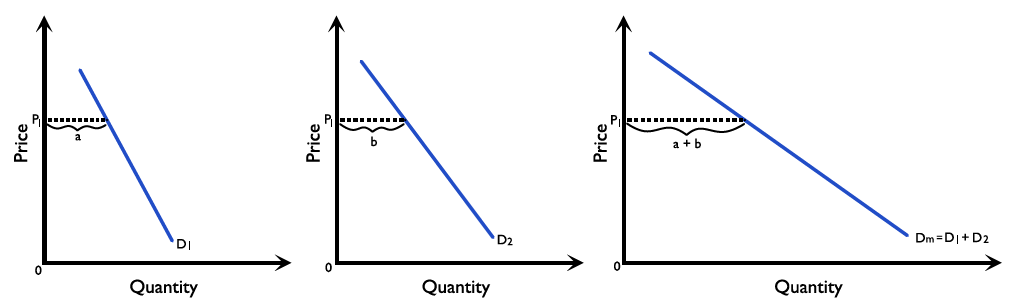
The law of demand - the relationship between price and quantity demanded
The law of demand states that within a period of time, an increase in price would lead to a decrease in quantity demanded, ceteris paribus.
The income and substitution effects
The substitution effect: when the price of good X increases, other goods are relatively cheaper. Consumers will substitute other goods for good X, thus lowering the quantity of good X bought.
The income effect: when the price of good X increases, consumers’ real income is lowered so the quantity of good X they can afford is lowered.
The law of diminishing marginal utility
Marginal utility refers to the additional utility, or satisfaction, that you gain from consuming an extra unit of a good. The law of diminishing marginal utility is the idea that the additional utility of each additional unit consumed is decreasing.
For example, if you are very hungry and sit down for dinner, your first plate of food is likely to give you more utility than your second, which is in turn likely to give you more utility than your third.
Price determinants of demand (Movement along the demand curve)
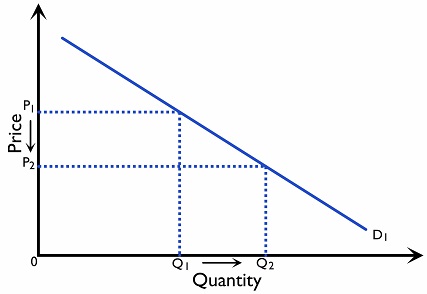
When there is a change in the price of good A, the quantity demanded of good A will change. This results in a movement along the same demand curve.
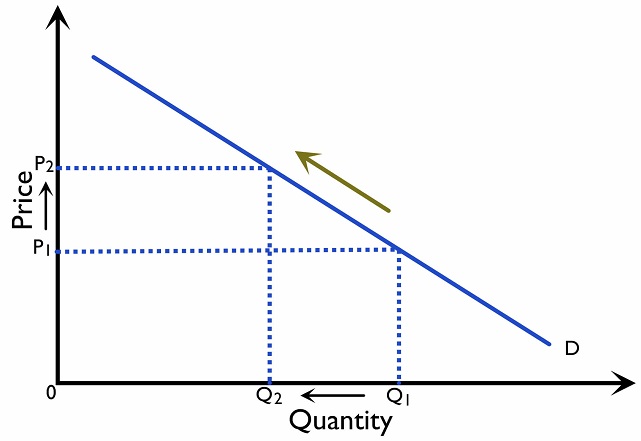
A price change of good B will NOT incur movement along good A’s demand curve. It will only cause movement along good B’s demand curve. However, it may cause a shift in demand for good A.
The non-price determinants of demand (Shift of demand curve)
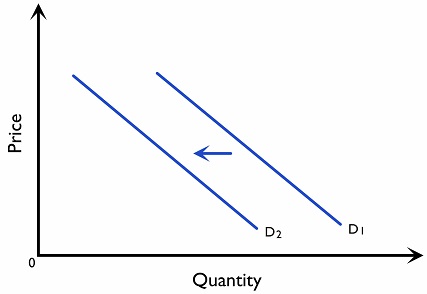
The shift of demand curve means the quantity demanded changes at every price level. Hence, factors resulting in a shift of the demand curve shall be non-price factors of the good.
1) Change in income
Normal goods:
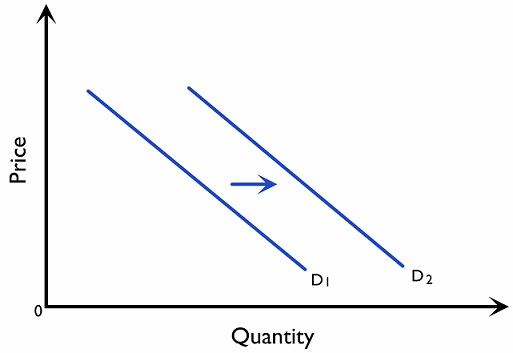
When income increases, the demand for normal goods will increase, e.g. luxurious goods. This shifts the demand curve to the right, and vice versa. (Figure 2.1.3)
Inferior goods:
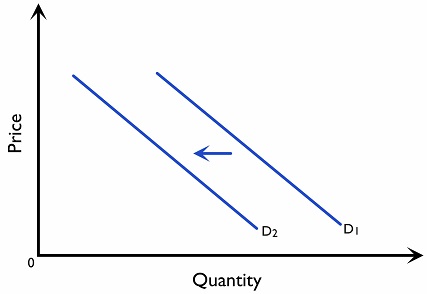
When income increases, the demand for inferior goods will decrease, e.g. lower-quality goods or old fashioned goods. This shifts the demand curve to the left. (Figure 2.1.4)
2) Price of substitutes
Two or more goods are defined as substitutes if they are interchangeable in fulfilling a consumer’s need, in which they are of competitive consumption. An example would be American fast-food
chains McDonald's and Burger King. When there is a price cut at McDonald's, we can expect more people to consume at McDonald's and so the quantity demanded for McDonald’s food increases as shown in Figure 2.1.5. As McDonald's and Burger King
are substitutes, the demand for Burger King’s food will decrease as shown in Figure 2.1.6.
3) Price of complements
Complements are goods that are often used together. Examples are coffee and milk. Since people usually drink coffee with milk, when there is a price cut in coffee, we can expect more people will consume coffee and so the quantity demanded for coffee increases. As coffee and milk are complements, the demand for milk will also increase.
4) Preferences
Changes in taste and preferences affect demand. Preference can be affected by consideration of health, weather, fashion trends, advertising etc. For instance, an increase in awareness of overweight problems will likely lower the demand for junk food.
5) Demographic factors
Changes in sex ratios and age distribution affect demand. One problem many developed countries face is the deteriorating birth rate, which lowers the demand for children’s clothing and primary schooling.
6) The expectation of changes in market prices
If consumers expect future prices to rise, it is more likely for consumers to make purchases now, hence increasing the current demand of a good.