Macroeconomic policy choices depend on the shock, available instruments and the economy's constraints.
Must know
- Demand policies influence spending.
- Supply policies influence capacity and costs.
- Objectives can conflict over different time horizons.
Must know definitions
Quantitative easing (QE): a central bank creating new money electronically to purchase financial assets, used to lower long-term borrowing costs and stimulate the economy when interest rates are already very low.
Discretionary fiscal policy: deliberate changes to government spending or taxation, rather than automatic responses to the economic cycle. Measures may be temporary or lasting.
Transfer pricing: the pricing set for transactions between different parts of the same multinational corporate group, which can be manipulated to shift profit into lower-tax jurisdictions.
Footloose TNC: a transnational company able to relocate its operations or registered assets between countries relatively easily and at low cost, limiting any single government's control over it.
Explain and apply
Mechanism in brief: A negative demand shock can justify spending support, while a cost shock creates a harder output–inflation trade-off. A policy mix can address immediate weakness and longer-run constraints through separate channels.
Distinguish: The same policy does not have the same effect in every economy; short-run success can create long-run costs.
Use the extract: Diagnose a demand or supply shock and identify fiscal, monetary and exchange-rate constraints.
How governments use fiscal policy, monetary policy, exchange-rate policy, supply-side policies and direct controls
- Governments and central banks draw on five broad policy tools to pursue four recurring objectives: reducing fiscal deficits and national debt, controlling inflation, responding to external shocks, and reducing poverty and inequality.
- Fiscal policy — using government spending and taxation to influence aggregate demand.
To reduce deficits/debt
cutting spending or raising taxes narrows the deficit directly, but risks slowing growth, which can itself reduce tax revenue and partly offset the improvement; promoting growth instead (without raising rates) can raise tax revenue passively, though this does little to fix a structural deficit.
To reduce poverty and inequality
progressive taxation combined with higher transfer payments (benefits, pensions) redistributes income from higher to lower earners.
fiscal tightening (G ↓ or T ↑) → AD ↓ → growth ↓ → tax revenue ↓ → the improvement in the deficit is partly offset, ceteris paribus
Monetary policy — using interest rates and the money supply, typically set by a central bank.
To control inflation
raising interest rates raises borrowing costs → consumption and investment ↓ → AD ↓ → demand-pull inflationary pressure eases, ceteris paribus.
To respond to external shocks/support growth
cutting interest rates lowers borrowing costs and encourages spending and investment; once rates are already near zero, central banks may turn to quantitative easing (QE) — creating new money electronically to buy financial assets (typically government bonds) — which lowers longer-term borrowing costs and increases the amount of cash in the financial system, encouraging further lending, spending and investment.
A common slip in exams: QE is not simply "printing money to give to people" — it works by purchasing financial assets to push down long-term interest rates. A risk of QE is that it can fuel inflation if the extra spending outpaces the economy's productive capacity.
Exchange-rate policy — influencing the value of the currency to affect competitiveness and trade.
Under a pure float, the authority does not promise to defend a parity, so it cannot announce a devaluation of a fixed rate. However, interest-rate changes, asset purchases or discretionary currency intervention may influence a floating rate; the outcome is uncertain and not fully controlled.
A weaker currency can also import inflation, since imported goods become more expensive in domestic currency terms.
Supply-side policies — measures that raise an economy's productive potential and shift long-run aggregate supply.
Investment in education, training and healthcare raises the quality and productivity of the workforce (human capital), supporting sustained growth and helping reduce poverty over the long run by raising people's earning potential.
Encouraging entrepreneurship, reducing discrimination in labour markets, and deregulating markets can improve efficiency and boost long-run growth, though these policies generally act with a long time lag rather than being an immediate response tool.
Direct controls — government intervention that works outside the normal market price mechanism.
Examples include maximum price controls (e.g. capping food prices in some developing countries), minimum guaranteed prices (including a national minimum wage), and wage controls.
A minimum wage sets a floor on the wage rate for covered workers; it does not guarantee a job, working hours or total income. Price controls can suppress particular recorded prices, but may create shortages and do not by themselves remove the underlying causes of inflation.
Figure 4.13 AD and AS equilibrium
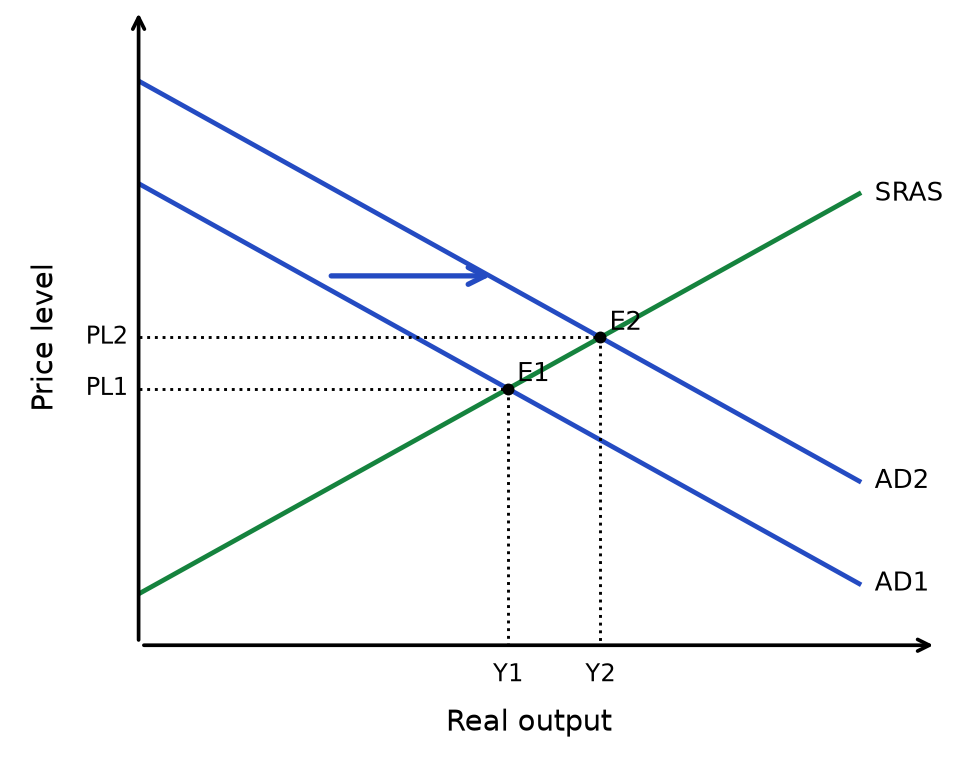
Read the diagram: Identify a non-price determinant that changes AD → shift AD right, holding the other curve fixed → find the new intersection → price level rises and real output rises. The price-level change is a movement along the unchanged curve. This result assumes upward-sloping SRAS; spare capacity and the curve’s slope determine the real-output response. A higher price level is not the same as a permanently higher inflation rate.
| Objective | Policy tools typically used |
|---|---|
| Reduce fiscal deficits/national debt | fiscal policy (spending cuts, tax rises); promoting growth to raise tax revenue passively |
| Control inflation | monetary policy (interest rates, QE in reverse/tightening); direct price controls in some cases |
| Respond to external shocks | monetary policy (rate cuts, QE); fiscal stimulus; exchange-rate adjustment where applicable |
| Reduce poverty and inequality | fiscal policy (progressive tax and transfer payments); supply-side policy (education, training); direct controls (minimum wage) |
Use of demand-side policies in response to the global financial crisis of 2008
- After a long period in which fiscal policy in many advanced economies had been largely passive (left to automatic stabilisers), the 2008 global financial crisis prompted many governments to use discretionary fiscal policy as an active Keynesian tool — increasing government spending and/or cutting taxes to directly boost aggregate demand and prevent a deeper recession, financed by higher government borrowing.
Alongside this, central banks used monetary policy aggressively
interest rates were cut to historic lows (in several economies effectively as close to zero as practically possible), and once conventional rate cuts were exhausted, central banks turned to quantitative easing to inject money into the financial system, encourage lending, and support aggregate demand.
2008 financial crisis → bank lending collapses, confidence falls → AD ↓ sharply → governments raise spending/cut taxes (discretionary fiscal stimulus) and central banks cut interest rates towards zero, then use QE → AD supported, recession depth reduced
Measures to control TNCs
Reducing tax avoidance
transnational companies (TNCs) can shift profits to low-tax countries — particularly easy for firms whose value comes from intangible assets like software, brands or intellectual property, which can simply be registered in a low-tax jurisdiction so that the associated profit is taxed there rather than where the underlying economic activity actually occurs. Governments have proposed rules requiring TNCs to pay some tax on profits earned within a country regardless of where the related intellectual property is formally registered, and tax authorities can also investigate and challenge firms that under-report the profit properly attributable to their operations in a country.
Regulation of transfer pricing
transfer pricing is the pricing TNCs set for transactions between different parts of the same corporate group (e.g. one subsidiary "selling" goods or services to another). Since corporate tax rates vary considerably between countries, a TNC can manipulate these internal prices to shift recorded profit into lower-tax subsidiaries, reducing its overall global tax bill. Because this happens within a single firm rather than between independent parties, an exact comparable market price may be difficult to establish, so effective control mainly relies on international agreements and cooperation between tax authorities to enforce consistent transfer-pricing rules.
Limits to government ability to control TNCs
TNCs are often "footloose" — able to relocate operations, headquarters, or registered intellectual property to another country relatively easily and at limited cost — which constrains any single government's ability to tax or regulate them without risking the TNC simply moving elsewhere. Enforcement is also costly and complex: identifying under-reported profit requires detailed investigation, and tax rules governing multinational profit allocation are technically difficult to apply. International cooperation (e.g. WTO agreements restricting certain investment-related requirements) offers only partial control, since agreement across many countries with different national interests is hard to secure and enforce.
TNC registers intellectual property/profits in a low-tax country → most global profit taxed at a low rate despite economic activity occurring elsewhere → government tax revenue in higher-tax countries ↓ → governments pursue international agreements and stricter reporting rules to counter this, constrained by TNCs' ability to relocate ("footloose" capital)
The impact of policy changes on local, national and the global economy
A single macroeconomic policy decision can have effects at multiple levels simultaneously:
| Level | Example impact |
|---|---|
| Local economy | a regional infrastructure project or a local minimum wage change affects employment and incomes in that specific area first and most strongly |
| National economy | a change in interest rates or a fiscal stimulus affects aggregate demand, inflation, employment and growth across the whole country |
| Global economy | because economies are increasingly interconnected through trade and financial flows, a major economy's policy choices (e.g. a large interest rate change or a large stimulus) can affect trading partners' exports, capital flows, and exchange rates well beyond its own borders |
Problems facing policymakers when applying policies
Inaccurate information
policy decisions rely on economic data (GDP, unemployment, the balance of payments) that may be incomplete, outdated, or subject to later revision, so policymakers may act on a picture of the economy that is not fully accurate at the time.
Risks and uncertainties
households and firms do not always respond to policy in the way theory predicts — for example, the impact of quantitative easing on spending, or how a country's exit from a trading bloc will affect business confidence, is difficult to predict with precision, adding uncertainty to policy design.
Inability to control external shocks
in an increasingly globalised world, individual governments have limited power to insulate their economy from shocks originating elsewhere — a global financial crisis, a commodity price shock, or a slowdown in a major trading partner can undermine a domestic policy's intended effect regardless of how well-designed the policy itself is.
Compare speed, scale and side effects. Demand expansion near capacity risks inflation; supply measures take time. The strongest judgement identifies the binding constraint and explains why the chosen combination fits it.
Rapid recap
Diagnose: a demand shortfall, cost shock and capacity constraint need different responses. Identify the initial AD/AS change before selecting policy.
Trace: demand measures affect C, I, G or net exports; supply measures affect costs or capacity. Distinguish the immediate effect from the longer-run response.
Judge: combine capacity, timing, distribution, external balance and fiscal/monetary constraints. Explain which trade-off matters most in the stated economy.
Diagram cue: show the diagnosed AD or AS shock and the proposed policy response.
Related chapters: Unit 2 chapter 4 · Unit 4 chapter 7 (p. 35)