Tax design affects revenue, incentives and the distribution of disposable income.
Must know
- Direct and indirect taxes have different bases.
- Progressivity concerns the average tax rate as income rises.
- The Laffer curve illustrates a possible revenue response.
Must know definitions
Direct tax: a tax on income, wealth, or profit paid directly to the tax authority by the taxpayer.
Indirect tax: a tax on spending on goods and services, usually collected by the seller.
Progressive tax: a tax where the average rate rises as income rises.
Proportional tax: a tax where the average rate stays constant regardless of income.
Regressive tax: a tax where the average rate falls as income rises.
Laffer curve: a curve showing the relationship between the tax rate and total tax revenue, illustrating that revenue can fall if tax rates rise beyond an optimal point.
Explain and apply
Mechanism in brief: A higher tax rate raises revenue per unit of an unchanged base. Behavioural responses can shrink the taxable base through reduced activity, avoidance or evasion, changing the overall revenue effect.
Distinguish: A proportional tax can collect more money from richer people; a Laffer diagram does not locate the actual economy.
Use the extract: Distinguish marginal and average rates; identify the taxable base and likely behavioural response.
The distinction between, and examples of, direct and indirect taxes
- A direct tax is a tax levied on income, wealth, or profit and paid directly by the individual or firm to the tax authority — examples include income tax, corporation tax, and capital gains tax.
- An indirect tax is a tax on spending, charged on goods and services and typically collected by the seller on the government's behalf — examples include VAT, excise duties (e.g. on fuel or tobacco), and stamp duty.
| Direct taxes | Indirect taxes |
|---|---|
| Income tax, corporation tax, capital gains tax, inheritance tax | VAT, excise duty, stamp duty, tariffs |
| Levied on income/wealth/profit | Levied on spending on goods and services |
| Paid directly by the taxpayer | Usually collected by the seller; the economic burden depends on demand and supply elasticities. |
The distinction between progressive, proportional and regressive taxes
Progressive tax
the average rate of tax rises as income rises, so higher earners pay a larger proportion of their income in tax — income tax with rising tax bands is the standard example. Direct taxes are generally more progressive.
Proportional tax
the average rate of tax stays constant regardless of income level — sometimes called a flat tax.
Regressive tax
the average rate of tax falls as income rises, so lower earners pay a larger proportion of their income in tax even though the tax itself is not linked to income — indirect taxes such as VAT on necessities tend to be regressive, since lower-income households spend a larger share of their income on taxed goods. Indirect taxes are generally more regressive.
Figure 4.11 Tax structures
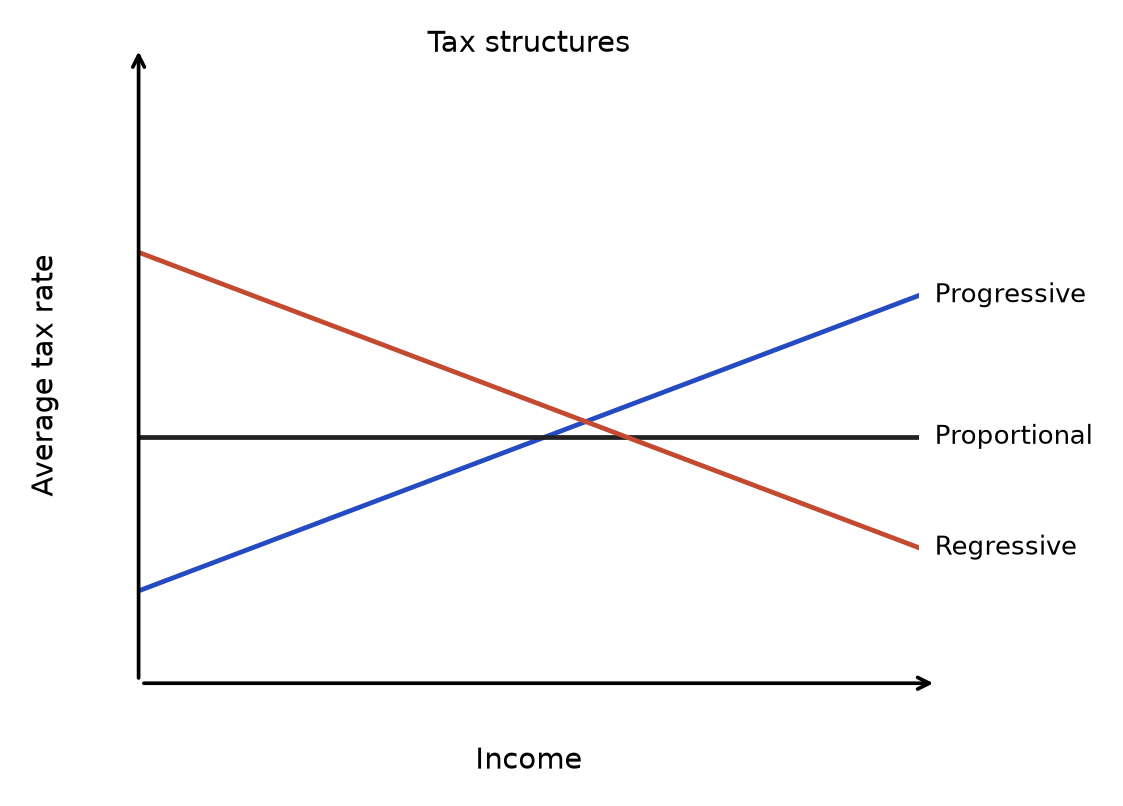
Read the diagram: Progressivity describes the average tax rate as income changes. It does not simply describe the amount of tax paid: higher-income people can pay more money even under a proportional tax.
The economic effects of changes in direct and indirect tax rates
Incentives to work
higher marginal income tax rates can reduce the incentive to work longer hours, take promotions, or seek employment at all, since less of each extra pound of income is retained.
Tax revenues (Laffer curve)
tax revenue does not necessarily rise indefinitely with the tax rate — beyond an optimal rate, higher rates discourage work effort and encourage avoidance/evasion, so revenue can fall even as the rate rises.
Income distribution
raising direct (progressive) tax rates on higher earners, and using the revenue to fund benefits for lower earners, narrows income inequality; relying more heavily on indirect (regressive) taxes tends to widen it.
Real output and employment
higher taxes are a leakage from the circular flow of income → disposable income ↓ → consumption ↓ → AD ↓ → real output and employment ↓, ceteris paribus.
The price level
a rise in indirect tax raises firms' costs → if firms pass this on, prices ↑ → can trigger a wage-price spiral if workers demand higher wages to compensate, feeding a further round of cost-push inflation.
The trade balance
a tariff (a tax on imports) raises import prices → import volumes ↓ → trade balance may improve, though trading partners may retaliate with tariffs of their own, reducing export demand and offsetting the gain.
FDI flows
a higher corporation tax rate raises the cost of investing in a country relative to lower-tax rivals → FDI inflows ↓, ceteris paribus; a stable, predictable, and internationally competitive tax regime tends to attract more FDI.
The Laffer curve plots tax revenue against the tax rate. Revenue rises with the tax rate up to an optimal rate, after which further rate increases cause revenue to fall as rising disincentives to work, increased tax avoidance and evasion, and a growing number of taxpayers relocating abroad outweigh the higher rate itself.
Figure 4.12 Laffer curve illustration
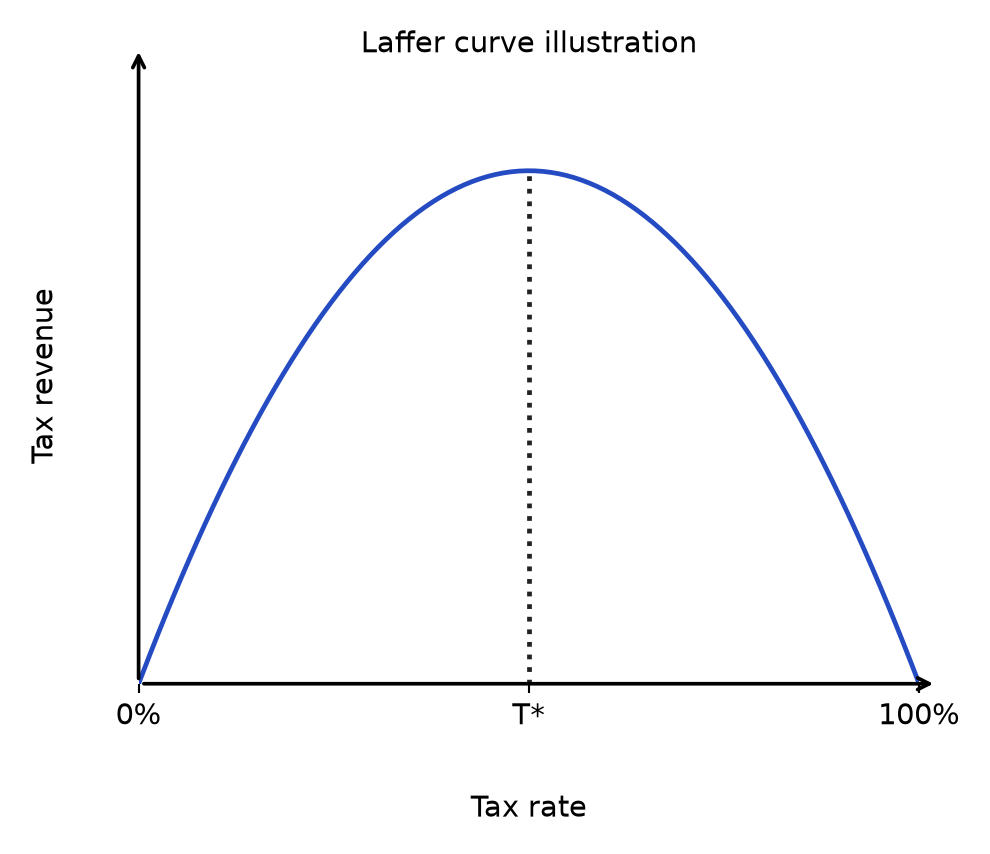
Read the diagram: The stylised curve illustrates how a higher rate may eventually shrink the tax base enough to reduce revenue. T* maximises revenue in this illustration; its real-world location is unknown and is not necessarily the welfare-maximising rate. The endpoint assumptions are stylised.
A tax cut raises revenue only if the base expands enough to offset the lower rate. Judge responsiveness and enforcement rather than inferring this from the curve alone; revenue maximisation is not necessarily the policy objective.
Rapid recap
Rates: average tax rate = tax/income; marginal tax rate applies to extra income. Progressivity means the average burden rises with income.
Mechanisms: tax changes affect disposable income, incentives and revenue. Incidence depends on behaviour and market conditions, not only who legally pays.
Judge: a tax cut raises revenue only if the base expands sufficiently. The Laffer curve does not identify the economy’s position; assess responsiveness, avoidance, enforcement and the policy objective.
Diagram cue: distinguish tax-rate patterns; explain why a Laffer curve does not locate the actual economy.
Related chapters: Unit 1 chapter 16 · Unit 4 chapter 10 (p. 47)