Protection changes domestic prices, production, consumption and the distribution of welfare.
Must know
- Tariffs can generate revenue.
- Quotas create rents whose recipient depends on allocation.
- Production subsidies differ from border restrictions.
Must know definitions
Protectionism: government measures that restrict free trade to shield domestic industries from foreign competition.
Tariff: a tax imposed on imported goods.
Quota: a physical limit on the quantity of a good that may be imported over a given period.
Dumping: exporting below normal value, usually the comparable domestic-market price. Below-cost pricing can be relevant, but it is not the sole definition.
Infant industry: a newly established industry with high start-up costs that may need temporary protection to become internationally competitive.
Voluntary export restraint (VER): an agreement between two countries to limit the volume of exports from one to the other.
Must know relationship: Tariff revenue = tariff per unit × imports after the tariff.
Calculation: post-tariff imports equal domestic quantity demanded minus domestic quantity supplied. Multiply that quantity by the tariff in money per unit; use the same time period.
Explain and apply
Mechanism in brief: The higher price expands domestic output and reduces consumption, narrowing imports. Consumers lose surplus; producers and government can gain, while distorted production and consumption create welfare losses under standard assumptions.
Distinguish: Quota quantity is the import gap, not total consumption; quota rents need not go to government.
Use the extract: Identify tariff size or the import limit, domestic supply and demand, and who receives the revenue or rent.
Reasons for restrictions on free trade
Protectionism is the act of shielding a country's domestic industries from foreign competition by restricting free trade.
| Reason | Explanation |
|---|---|
| Protect infant industries | New industries with high start-up costs may need temporary support until they become internationally competitive |
| Protect geriatric/sunset industries | Declining industries are shielded to slow job losses and allow orderly restructuring |
| Protect domestic industries and employment | Reduces import competition so domestic firms and jobs are not lost to cheaper foreign producers, including protection from jobs being offshored |
| Protect national security | Maintains domestic capacity in strategically important sectors, e.g. defence or food production, so the country is not reliant on other nations |
| Prevent dumping | Counters imports sold below normal value, usually their comparable home-market price; dumping does not require an intention to eliminate domestic competition. |
| Correct a current account deficit | Import restrictions reduce import spending, narrowing a deficit on the current account of the balance of payments |
| Raise government revenue | Tariffs act as a tax on imports, generating income for the government |
| Retaliation | Some countries impose restrictions purely in response to trade barriers already imposed on their own exporters by trading partners |
domestic industry faces cheap/dumped imports → output ↓, unemployment ↑ in that industry → government imposes protectionist measures → import competition ↓ → domestic output and employment protected, ceteris paribus
Types of restrictions on free trade
- Tariffs — a tax on imported goods, raising their price to consumers. Quantity demanded of imports falls while quantity demanded of domestic output rises, and the government gains tax revenue, but exporters may face retaliation from the country whose imports were taxed.
Figure 4.3 A tariff in a small-country market
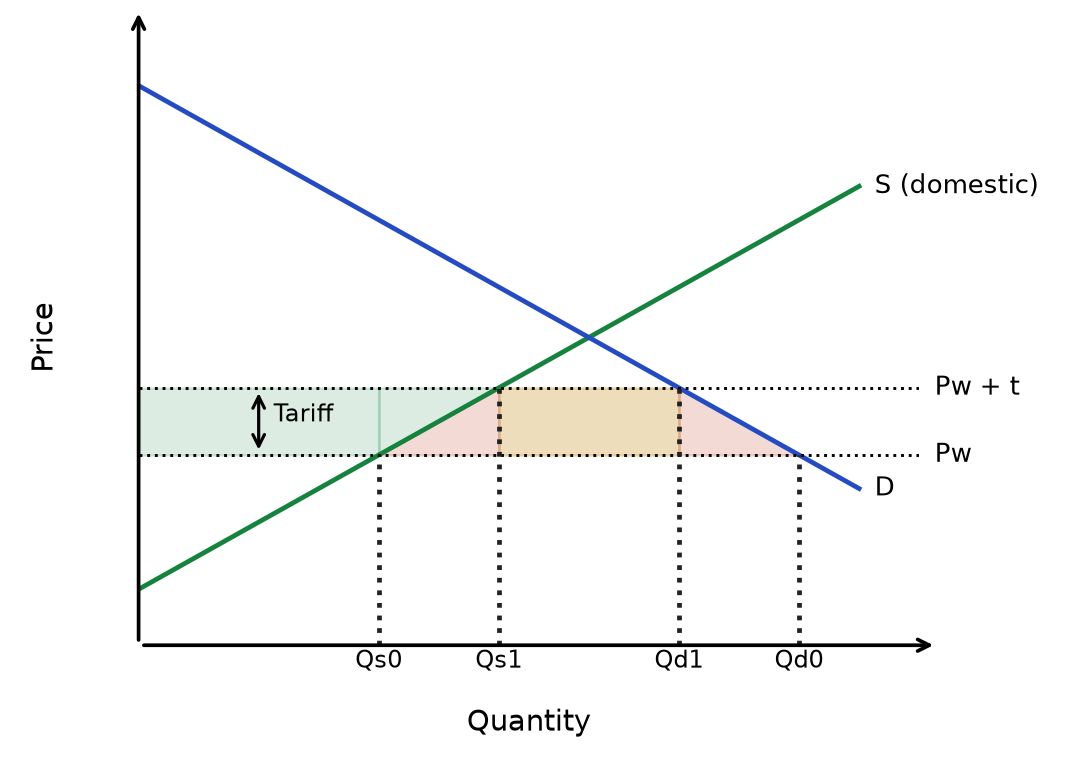
Read the diagram: Domestic output rises and consumption falls. The rectangle between Qs1 and Qd1, from Pw to the higher price, is tariff revenue (or quota rent). The adjacent triangles are efficiency losses; the area above supply between the two prices is the producer-surplus gain. Assumes a fixed world price and no externalities.
- Quotas limit import quantity and can raise the domestic price. Quota rents accrue to licence holders; the government may receive revenue if it auctions import licences. Without an auction, rents need not accrue to the government.
Figure 4.4 A binding import quota
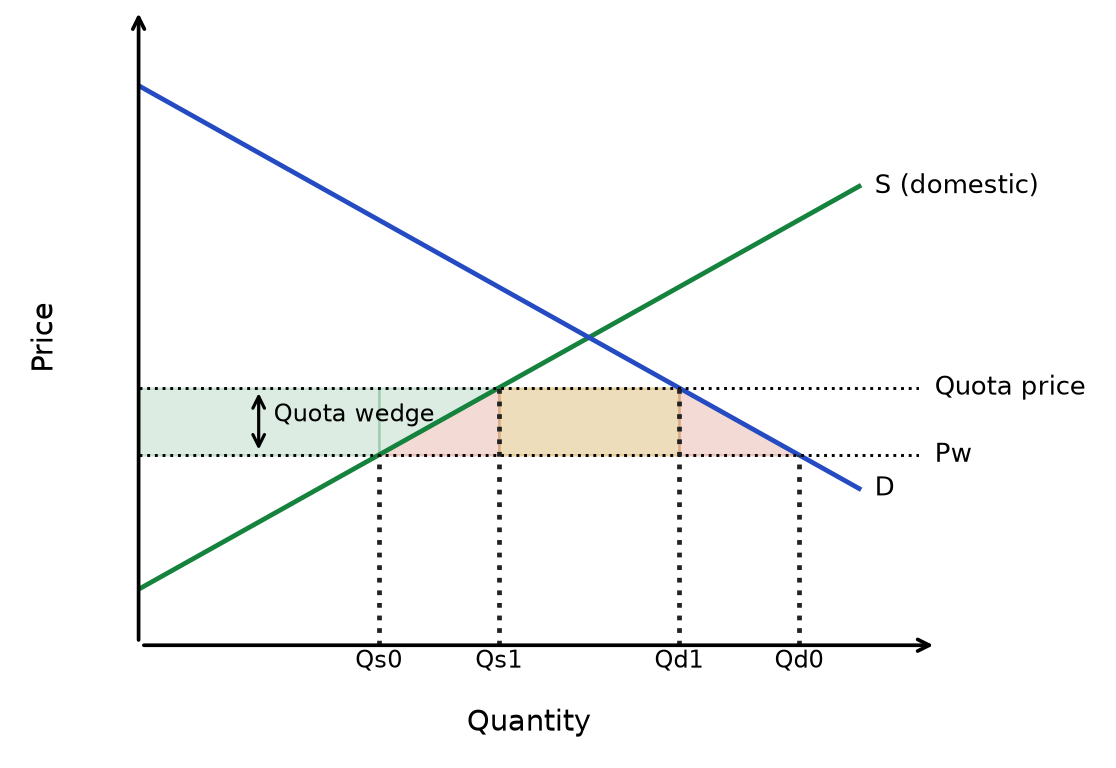
Read the diagram: Domestic output rises and consumption falls. The rectangle between Qs1 and Qd1, from Pw to the higher price, is tariff revenue (or quota rent). The adjacent triangles are efficiency losses; the area above supply between the two prices is the producer-surplus gain. Assumes a fixed world price and no externalities.
- Non-tariff barriers are trade restrictions other than tariffs. Quantitative restrictions include quotas, voluntary export restraints and embargoes. Other barriers include discriminatory product rules or excessive administrative requirements. Legitimate health, safety or environmental standards are not automatically protectionist.
- These raise the cost or difficulty of trading without an explicit tax, discouraging imports.
- Subsidies to domestic producers lower their effective costs and encourage domestic production. In a small-country import market with free trade and a fixed world price, the consumer price can remain at the world price: domestic output rises and imports fall. Government expenditure equals the subsidy per unit multiplied by subsidised domestic output.
Figure 4.5 A domestic production subsidy
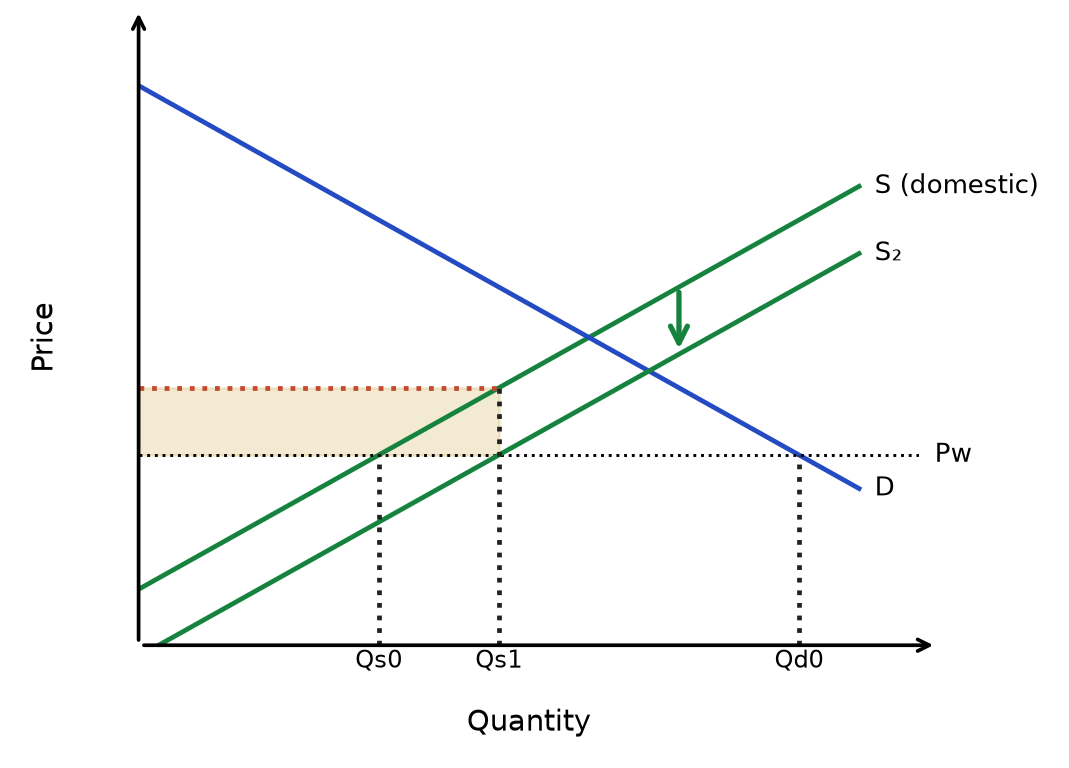
Read the diagram: Consumers continue paying Pw, so consumption is unchanged. Domestic production rises from Qs0 to Qs1 and imports fall. Producers receive Pw plus the subsidy; the shaded rectangle is government spending on all subsidised domestic output.
Impact of protectionist policies
Tariffs
Pros: Raises government revenue that can fund public services or redistribute income to the poor; protects domestic output and jobs in the taxed industry; can help correct a current account deficit
Cons: Regressive — hits low and fixed-income consumers hardest, worsening inequality; causes a deadweight welfare loss (the triangles in the tariff diagram); risk of retaliation, which could reduce exports and damage the wider economy
Quotas
Pros: A binding quota caps permitted imports and can support domestic output and employment. It does not guarantee domestic producers a fixed market share.
Cons: A binding quota generally raises the domestic price. Quota rents depend on licence allocation; auctioning licences can raise revenue. Price adjustment can clear the market, so a persistent shortage is not inevitable. Protection may weaken incentives to cut costs.
Non-tariff barriers
Pros: Protects domestic industries (e.g. from unsafe or low-quality imports) without an explicit tax that consumers can easily see
Cons: Raises the cost/difficulty of trade in a way that is hard to detect and challenge, so it can quietly damage relations with trading partners; particularly harmful to developing-country exporters trying to access the market, worsening global inequality
Subsidies to domestic producers
Pros: A production subsidy reduces domestic firms’ effective costs and can help them compete with cheaper imports. In the small-country diagram, the consumer price remains at the world price while domestic output increases; the subsidy can support strategically important sectors (e.g. the primary sector under the EU’s Common Agricultural Policy).
Cons: Direct cost to public finances (opportunity cost of the government spending elsewhere); may encourage firms to produce a wasteful surplus; distorts resource allocation away from the free-market efficient outcome
Across all four policies, protectionism tends to distort the free-market allocation of resources: by insulating firms from international competition, it weakens the market's normal pressure to innovate and minimise costs (a loss of dynamic efficiency), reduces allocative efficiency, and risks retaliation or government failure if protection is granted for political rather than sound economic reasons — costs that tend to outweigh the gains captured by protected producers and the government.
A common slip in exams: tariffs and quotas need not have identical effects. A tariff generates tax revenue; quota rents depend on licence allocation and may accrue to government if licences are auctioned. With a fixed quota, stronger demand may raise domestic prices further.
Temporary protection may support learning if costs genuinely fall, but retaliation and weak incentives can prolong inefficiency. Judge the learning mechanism, duration and exit conditions rather than treating infant-industry protection as automatically beneficial.
Rapid recap
Tariff: in the small-country model, domestic price rises → domestic supply expands and demand contracts → imports fall. Government revenue = tariff per unit × imports after the tariff.
Quota: restrict the import quantity; higher domestic prices create rents that need not go to government. Identify who holds the import rights.
Judge: compare consumers, producers and government; include production/consumption distortions, retaliation and any justified external or learning benefits. Protection is not automatically successful industrial policy.
Diagram cue: show the trade restriction, domestic quantities and revenue or rent and welfare areas.
Related chapters: Unit 1 chapter 13 · Unit 4 chapter 4 (p. 19)
Why this connects: Tariff welfare uses the same surplus logic as Unit 1, with imports and tariff revenue added. Domestic output is not the same as domestic consumption.