Trading blocs reduce barriers between members but can alter trade with non-members.
Must know
- Free trade areas remove internal barriers.
- Customs unions add a common external tariff.
- Trade creation and diversion have different efficiency effects.
Must know definitions
Trade liberalisation: the reduction or removal of barriers to trade, such as tariffs and quotas.
World Trade Organization (WTO): the international body that promotes trade liberalisation, settles trade disputes, and organises trade negotiations between member countries.
Trade creation: lower-cost imports from a member replace higher-cost domestic production after trade barriers fall.
Trade diversion: imports switch from a lower-cost non-member to a higher-cost member because of preferential trade arrangements.
Common external tariff: a single, shared tariff rate applied by all members of a customs union (or more integrated bloc) to imports from non-member countries.
Optimal currency zone: a group of economies for which sharing a single currency is likely to work well, because they respond similarly to shocks and have flexible labour/product markets to adjust without an independent monetary policy.
Explain and apply
Mechanism in brief: Removing internal tariffs changes relative buyer prices. Imports may switch to an efficient partner or away from a more efficient outsider, so increased intra-bloc trade can arise through different welfare mechanisms.
Distinguish: More intra-bloc trade does not prove trade creation; deeper integration is not an inevitable sequence.
Use the extract: Compare the original and new suppliers and their resource costs; identify the preference causing the switch.
The role of the World Trade Organization (WTO) in trade liberalisation
The World Trade Organization (WTO) is the international body responsible for promoting trade liberalisation — the reduction or removal of barriers to trade — between its member countries.
| WTO function | What it involves |
|---|---|
| Negotiator | Organises rounds of trade negotiations between member countries to lower tariffs, quotas, and other trade barriers |
| Enforcer/police | Monitors members' trade policies to check they comply with agreed WTO rules and trade agreements |
| Judge | Settles trade disputes between members when one country believes another has broken the rules, and can authorise trade sanctions against rule-breakers |
| Regulator of scope | Covers not just trade in goods, but also trade in services and intellectual property rights |
trade barriers ↓ (via WTO-negotiated agreements) → cost of importing/exporting ↓ → volume of world trade ↑ → gains from comparative advantage more fully realised
Types of trading blocs
The forms below involve increasingly extensive commitments. They are a comparison of features, not an inevitable sequence: actual agreements differ and countries need not move through every form.
- Free trade area (e.g. the European Free Trade Association (EFTA); NAFTA is a historical example, replaced by USMCA in 2020):
- Members abolish trade barriers (tariffs, quotas) between themselves.
- Each member keeps its own trade policy (including its own external tariffs) with non-member countries.
- Allows members to exploit their comparative advantages with each other, raising efficiency.
- Customs union (e.g. the European Union (EU)) — has all the features of a free trade area, plus:
- A common external trade policy towards the rest of the world (e.g. a shared common external tariff), replacing each member's individual trade policy.
- Common market (the EU was originally established as one) — has all the features of a customs union, plus:
- Free movement of capital and labour across member borders, not just goods.
Free movement of labour
workers can live and take up employment in any member state without needing a work visa or permit — e.g. an EU citizen can move to another EU country and work there under the same rights as a local citizen. This lets labour flow towards where it is most in demand, helping fill skills shortages and raising labour market efficiency across the bloc.
Free movement of capital
restrictions on moving money, savings, and investment between member states are removed — firms and individuals can invest, save, or transfer funds across borders without capital controls or extra charges. This allows capital (financial and physical investment) to flow to wherever it earns the highest return within the bloc, improving the allocation of investment.
Economic and monetary union (e.g. the Eurozone) — has all the features of a common market, plus:
Members adopt a single shared currency, administered by a common central monetary policy (one shared interest rate) — the Euro was introduced in 1999 to form the Eurozone.
To join, countries must meet convergence criteria
Euro entry involves price stability, sustainable public finances, exchange-rate stability and long-term interest-rate convergence. Inflation may be at most 1.5 percentage points above the reference group of the three best-performing EU states in price stability; long-term rates may be at most 2 points above that group. ERM II participation is required for at least two years without severe tensions or unilateral devaluation. Fiscal reference values are 3% of GDP for the deficit and 60% for government debt, with Treaty qualifications and an assessment of excessive deficits. Source: ECB convergence criteria, checked September 2026.
Works best as an optimal currency zone — members respond similarly to external shocks, and have flexible labour/product markets (geographical and occupational mobility of labour, wage and price flexibility) and fiscal transfers to smooth out regional imbalances when a single monetary policy can no longer be tailored to any one member.
Figure 4.2 Forms of trading-bloc integration
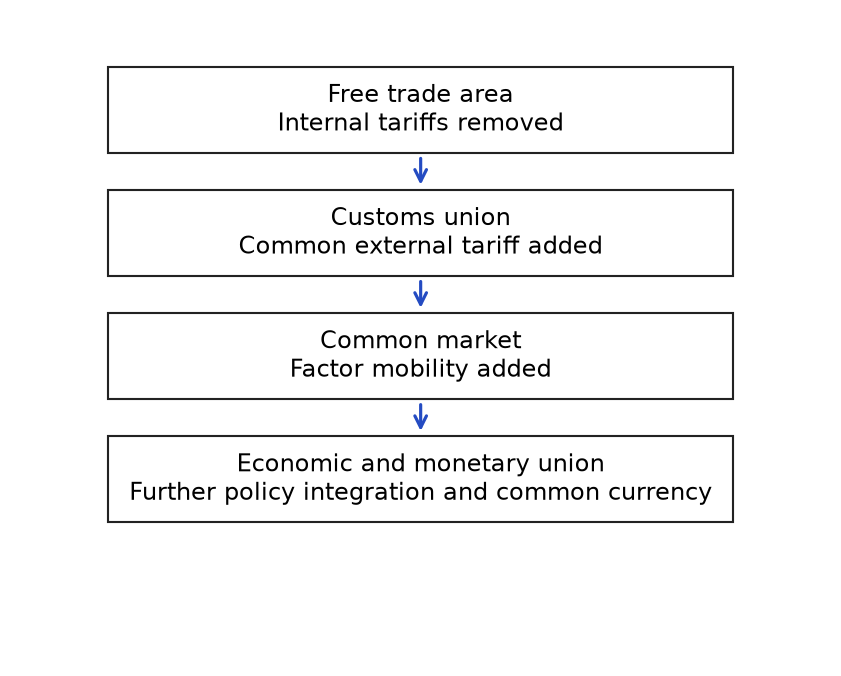
Read the diagram: The diagram organises increasingly extensive features of integration. Actual agreements differ and countries need not progress through every stage. Assess the commitments of the specific bloc rather than assuming its label settles every rule.
Costs and benefits of membership of a trading bloc
Benefits
| Benefit | Explanation | Applies to |
|---|---|---|
| Trade creation | Lower-cost imports from a member replace higher-cost domestic production after internal barriers fall, improving resource allocation. | All bloc types (free trade area and above) |
| Reduced transaction costs | Removing border controls and trade barriers makes trading simpler and cheaper | All bloc types |
| Economies of scale | Firms gain access to a much larger market (e.g. consumers across the EU single market), allowing specialisation and exploitation of comparative advantage, and the reaping of efficiency/technology gains | All bloc types, but effect grows with market size/integration |
| Enhanced competition | Firms face more competitors in the larger market, forcing greater efficiency, better resource allocation, and potential long-run dynamic efficiency gains — though these gains are not always spread evenly across members | All bloc types |
| Fills labour shortages | Free movement of labour lets workers move to where they are needed, helping fill domestic skills/labour shortages | Common market and above (requires free movement of labour) |
| Elimination of currency conversion costs | A single shared currency removes the transaction costs and exchange-rate uncertainty of converting between currencies for trade and investment | Economic and monetary union only |
Costs
| Cost | Explanation | Applies to |
|---|---|---|
| Trade diversion | Preferential treatment redirects imports from a lower-cost non-member to a higher-cost member, reducing productive efficiency. | Can occur in free-trade areas as well as customs unions; a common external tariff is not necessary. |
| "Brain drain" | Free movement of labour can cause a country's most skilled workers to emigrate to other member states, weakening the sending country's own labour force | Common market and above (requires free movement of labour) |
| Loss of independent trade policy | A common external tariff removes a member's freedom to set its own tariffs and trade policy with non-members | Customs union and above |
| Loss of independent monetary policy | A shared currency means giving up an independent interest rate and requires fiscal discipline (e.g. the 3%-of-GDP deficit rule), even when a member's economic conditions differ from the bloc average | Economic and monetary union only |
Possible conflicts between trading blocs and the WTO
Trading blocs can sit in tension with the WTO's core principle that all trading partners should be treated equally, since a common external tariff — used by customs unions and more integrated blocs — grants free trade to members while imposing protectionist barriers on non-members.
- This can distort world trade, contribute to an inefficient allocation of resources (e.g. the EU's Common Agricultural Policy), and risks triggering retaliatory protectionism if conflicts between blocs escalate.
- Critics also argue the WTO itself is too powerful or overlooks developing countries, since developed economies do not always trade completely freely with them, limiting their growth.
- In practice, trading blocs and the WTO can also be complementary: the WTO aims to ensure non-members can still trade freely and easily with bloc members, even as blocs deepen integration internally. A common slip in exams: do not assume trading blocs are simply a step towards free trade for everyone — externally, a bloc's common tariff can itself be a protectionist barrier against non-members.
Compare resource costs and the previous supplier before judging integration. Dynamic gains from competition and investment may matter, but higher intra-bloc trade alone does not prove that trade creation dominates diversion.
Rapid recap
Trade creation replaces higher-cost domestic output with lower-cost partner output. Trade diversion replaces a lower-cost external supplier because tariff preferences favour a partner.
Diagram cue: compare integration features; do not present deeper integration as inevitable.
Related chapters: Unit 4 chapter 2 (p. 10) · Unit 4 chapter 5 (p. 25)