Comparative advantage explains gains from specialisation using relative opportunity costs.
Must know
- Absolute advantage concerns productivity.
- Comparative advantage concerns lower opportunity cost.
- Mutually beneficial terms of exchange lie between opportunity costs.
Must know definitions
Specialisation: concentrating on producing the goods/services a country (or firm/individual) is relatively most efficient at producing.
Absolute advantage: the ability to produce more output of a good than another country using the same quantity of inputs.
Comparative advantage: the ability to produce a good at a lower opportunity cost than another country.
Opportunity cost: the next best alternative foregone when a choice is made.
Dumping: exporting a good below its normal value, usually the comparable domestic-market price. Production cost may be used to help establish normal value when a suitable domestic price is unavailable.
Explain and apply
Mechanism in brief: Specialising towards the good with lower opportunity cost increases combined feasible output. Trade then allows consumption beyond each country's own production frontier, provided exchange terms cover what each sacrifices.
Distinguish: Absolute advantage in both goods does not eliminate gains from trade; gradients reveal opportunity costs.
Use the extract: Use the output data to calculate opportunity costs before choosing specialisation; compare any trading price with both costs.
Benefits and costs of specialisation and trade in the international context
Specialisation occurs when a country concentrates on producing the goods and services in which it is relatively most efficient, then trades for the rest. International trade allows countries to specialise beyond their own borders, exchanging output based on comparative advantage.
| Benefits | Costs |
|---|---|
| Lower prices and more choice for consumers | Trade deficit may arise if a country's goods/services become uncompetitive |
| Larger markets → economies of scale for firms | Danger of dumping by foreign firms — exporting below normal value |
| Higher economic growth and living standards (based on the law of comparative advantage) | Increased unemployment resulting from import competition/uncompetitiveness |
| — | Increased economic integration → greater exposure to external shocks |
| — | Unbalanced development — only industries with comparative advantage grow, leaving others undeveloped → sectoral imbalance may restrict overall growth |
| — | Global monopolies as transnational companies grow larger |
| — | Developing/emerging economies: infant industries may be unable to compete and fail; monopsony power of global buyers may force low prices for commodity exporters |
The theory of comparative advantage
Absolute advantage exists when a country can produce a greater total output of a good than another country using the same quantity of inputs, meaning it can manufacture the product at a lower absolute cost. Comparative advantage, in contrast, exists when a country can produce a good at a lower opportunity cost than another country — i.e. it is relatively more efficient, even if it does not hold the absolute advantage.
| Absolute advantage | Comparative advantage |
|---|---|
| Can produce more output of a good from the same resources than another country | Can produce a good at a lower opportunity cost than another country |
Worked example. Assume a world of two countries, A and B, producing two goods, oranges and smartphones, with the same quantity of resources:
| Oranges (max output) | Smartphones (max output) | |
|---|---|---|
| Country A | 100 | 50 |
| Country B | 40 | 40 |
Country A has an absolute advantage in both goods, since it can produce more oranges and more smartphones than Country B. However, absolute advantage does not tell us who should specialise in what — comparative advantage does, based on opportunity cost.
Country A gives up 2 oranges for every smartphone produced → Country B gives up only 1 orange per smartphone → Country B has the lower opportunity cost in smartphones → Country B has a comparative advantage in smartphones, and Country A has a comparative advantage in oranges.
Put in ratio form: the opportunity cost of one smartphone is 2 oranges in Country A but only 1 orange in Country B. Equivalently, the opportunity cost of one orange is 0.5 of a smartphone in Country A but 1 smartphone in Country B.
- Since B sacrifices fewer oranges per smartphone than A, B should specialise in smartphones; since A sacrifices fewer smartphones per orange than B, A should specialise in oranges.
- Both countries gain from trading according to this pattern, even though A is absolutely better at producing everything.
Figure 4.1 Comparative advantage
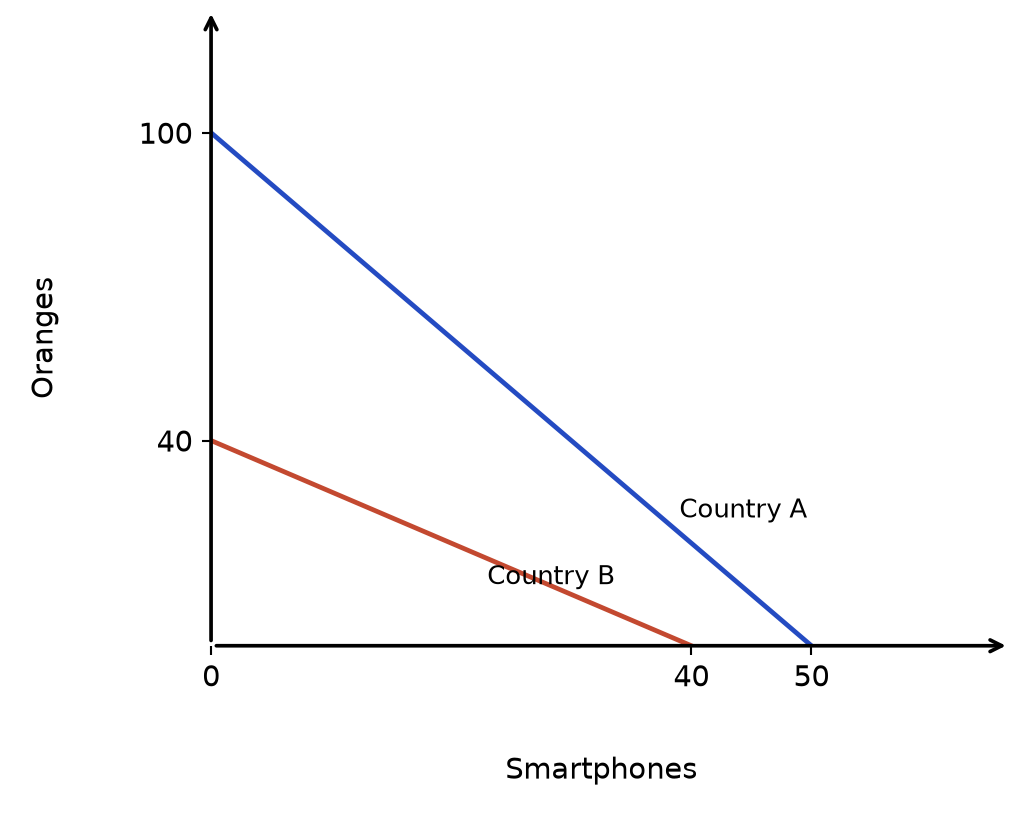
Read the diagram: Read each PPF’s intercepts → calculate output forgone per additional unit → compare opportunity costs. A gives up 2 oranges per smartphone; B gives up 1. B has comparative advantage in smartphones and A in oranges, although A has absolute advantage in both.
Assumptions: these straight PPFs imply constant opportunity costs. Gains require a trading price between the countries’ opportunity costs and resources that can move between domestic industries.
Assumptions underlying the theory:
- Constant costs of production (economies of scale are ignored).
- Transport costs are zero.
- There is perfect knowledge of prices and techniques across countries.
- There are no barriers to trade (no tariffs, quotas, etc.).
- Factors of production can be switched easily and costlessly between producing one good and another.
Limitations of the theory — many of the assumptions above rarely hold in the real world:
No completely free trade
barriers such as tariffs and quotas persist between countries, so the gains from specialisation predicted by the model are rarely fully realised.
External costs ignored
the model takes no account of costs such as environmental degradation from increased production and transport.
Exchange rates ignored
exchange-rate changes can alter exporters’ prices and money profitability, while transport costs and trade barriers can also affect observed specialisation. These do not by themselves change comparative advantage, which depends on relative opportunity costs.
Unrealistic two-country, two-good simplification
real-world trade involves many countries and goods, so the model understates the true complexity of global specialisation.
Little true specialisation in practice
modern technology allows countries to produce a wide range of goods, so specialisation need not be complete. Vietnam’s coffee industry expanded substantially from the early 1990s, and a UNEP case study published in 2020 described it as the world’s second-largest coffee exporter. This illustrates the development of an export industry over time; export growth alone does not measure comparative advantage. Norway’s oil endowment similarly illustrates how natural resources can shape production and trade.
Immobile factors of production
where factors cannot in fact move easily between sectors, the shift towards specialisation risks the same structural unemployment cost identified in sub-point a, as workers in declining industries struggle to relocate into the sectors where the country is specialising.
A common slip in exams: comparative advantage is about the lower opportunity cost, not simply who can produce more — a country can have an absolute advantage in everything and still not have a comparative advantage in everything.
Transport costs and adjustment barriers can reduce the gain. Workers may not move easily between sectors, and comparative advantage can change through investment; weigh transition costs against lasting consumption possibilities.
Rapid recap
Comparative advantage means lower opportunity cost; absolute advantage means greater productivity. Mutually beneficial trading prices lie between opportunity costs under the simple model.
Diagram cue: use frontier intercepts to calculate opportunity costs and identify gains from trade.
Related chapters: Unit 1 chapter 4 · Unit 4 chapter 3 (p. 14)