Monopoly power allows a firm to influence price but does not remove demand or cost constraints.
Must know
- Profit-maximising output uses MC equals MR.
- Price is read from AR.
- Third-degree discrimination requires separable markets and limited resale.
Must know definitions
Monopoly: a market with a single firm supplying the entire industry output, protected by high barriers to entry.
Price maker: a firm able to choose the price or output it sets, rather than accepting a market price.
Natural monopoly: a market where continuously falling long-run average costs mean a single firm can supply the market more efficiently than several competing firms.
Price discrimination: charging different prices to different groups of consumers for the same good or service, for reasons unrelated to cost.
Third-degree price discrimination: charging identifiable groups different prices for the same product, unrelated to cost differences, for example age-based cinema discounts.
X-inefficiency: producing at a higher average cost than the lowest technically achievable, due to weak competitive pressure.
Explain and apply
Mechanism in brief: A monopolist restricts output relative to the basic P = MC benchmark when it maximises profit. With third-degree discrimination, it allocates output so each market's MR equals common MC and charges the less elastic market more.
Distinguish: Monopoly does not guarantee profit; different prices caused solely by different costs are not necessarily price discrimination.
Use the extract: Identify entry barriers and cost conditions; for discrimination, look for separable groups, different elasticities and restricted resale.
Assumptions of monopoly
A monopoly is assumed to be the only firm in the industry, to face high barriers to entry that prevent new firms from entering, and to be a short-run profit maximiser.
- Because the monopolist is the only firm in the market, its own cost and revenue curves are the same as the industry's.
- It faces a downward-sloping demand curve and, unlike a price taker, can choose the level of price or output it sets, making it a price maker.
sole firm in the industry → firm's demand curve = industry demand curve → downward-sloping AR → firm can set price or output (price maker), not just react to the market price
Barriers to entry and exit
The same high barriers to entry that define an oligopoly are even more pronounced in a monopoly, since they must be strong enough to block out all potential rivals rather than merely limit their number. These include:
- Economies of scale — an incumbent's cost advantage over any new, smaller entrant.
- Legal barriers — patents, licences, exclusive rights.
- Limit pricing — setting price low enough that entry would be unprofitable.
- Ownership of a key resource.
- High sunk costs.
- Strong brand loyalty.
Profit-maximising equilibrium
The monopolist profit maximises where MC = MR, producing at output Q and charging price P.
- Because AR lies above ATC at this output, the firm earns supernormal profit, shown as the shaded rectangle between AR and ATC.
- Since barriers to entry block new firms from competing this profit away, a monopolist can earn supernormal profit in both the short run and the long run — unlike a perfectly or monopolistically competitive firm.
Figure 3.18 Firm output price and profit
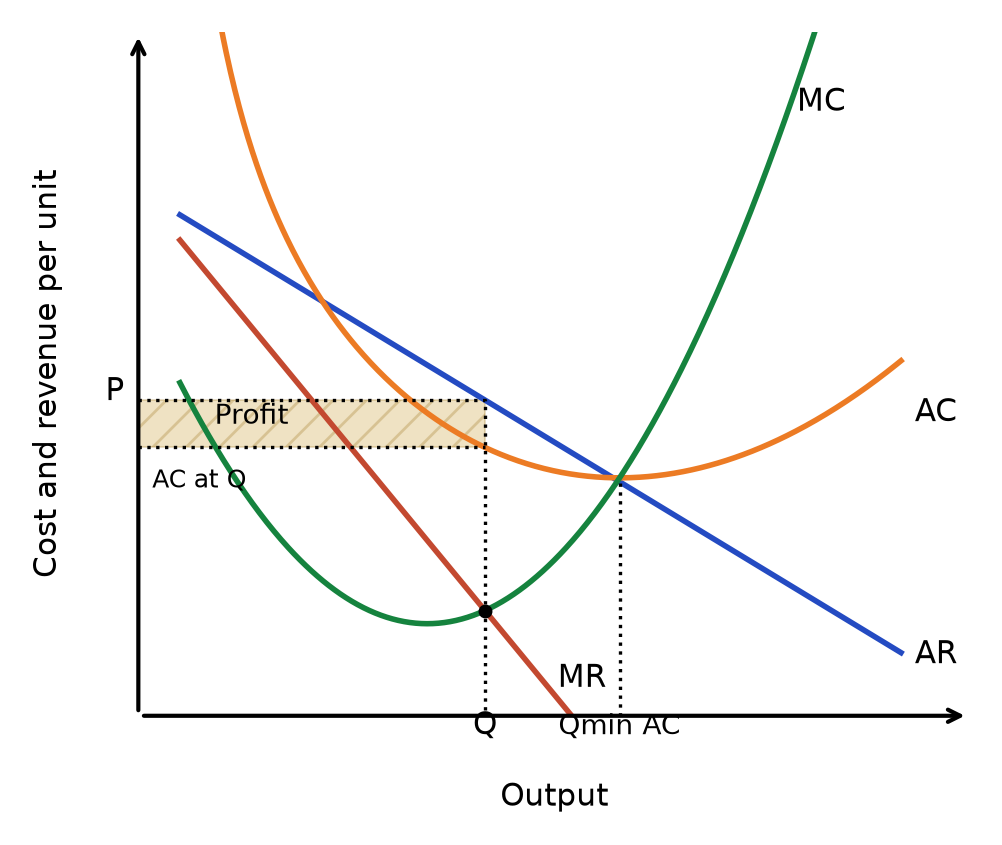
Read the diagram: Find Q where rising MC crosses MR → read P vertically above Q on AR → read AC at the same Q → profit is (P − AC) × Q, shown by the rectangle. Higher AC could turn this profit into a loss; downward-sloping demand alone does not guarantee profit.
MC = MR → profit-maximising output Q, price P → AR > ATC at Q → supernormal profit
high barriers to entry → no new entrants to compete profit away → supernormal profit persists into the long run
Costs and benefits of monopoly to firms and consumers
| Benefits of monopoly | Costs of monopoly |
|---|---|
| Supernormal profit provides finance for investment and R&D, and a reserve against short-term difficulties | Weak competitive pressure gives less incentive to be efficient or develop new products |
| Monopolists can exploit economies of scale, so average cost may still be lower than a small competitive firm's | Monopolies misallocate resources by setting price above marginal cost (allocative inefficiency) |
| Cross-subsidisation can widen the range of goods/services available to consumers | Output may differ from minimum AC; weak competitive pressure can also permit avoidable cost (X-inefficiency). |
| Avoids undesirable duplication of services, which would itself misallocate resources | Monopoly power means higher prices and lower output for domestic consumers |
The concept of 'natural monopoly' and its implications
A natural monopoly exists where economies of scale are so large that long-run average cost keeps falling over the entire relevant range of output, so a single large firm can supply the whole market more cheaply than several smaller competing firms could.
- Since a new entrant could not match the incumbent's costs and prices, competition in such a market is unlikely to emerge or survive.
- Duplicating the infrastructure (e.g. two separate national water pipe networks) would itself be wasteful.
- Utilities such as water and rail infrastructure are classic examples.
economies of scale so large relative to market size → LRAC keeps falling over the relevant output range → one firm can supply the market more cheaply than several smaller firms could → competition is unlikely to emerge or survive
Conditions necessary for third-degree price discrimination
Price discrimination occurs when a monopolist charges different groups of consumers different prices for the same good or service, for reasons unrelated to cost.
- Third-degree price discrimination — the only form required — charges identifiable groups different prices, for example adult and student cinema tickets for the same screening, when the difference is unrelated to cost.
Three conditions must hold for it to work
the firm must have market power to set its own price; it must have enough information to distinguish groups with different willingness to pay; and it must be able to prevent resale between groups, since otherwise low-price buyers would simply resell to high-price buyers.
The market is split into sub-markets with different price elasticities of demand.
The monopolist charges a higher price in the market with lower absolute PED at the chosen price, and a lower price in the more elastic market. With a common marginal cost, profit maximisation requires equal MR across markets and MR = MC. Lower elasticity here is relative: with positive MC, both markets can still be on elastic portions of demand.
With unchanged costs and no extra segmentation costs, optimal price discrimination cannot earn less profit than the best uniform price, because the firm can still choose the same price in both markets. It earns strictly more when different optimal prices improve the outcome.
Market power + separable groups + prevention of resale → compare price elasticities at the chosen prices → charge more in the market with lower absolute PED. With positive common MC, both chosen points are on elastic portions of demand.
Figure 3.19 Price discrimination and the uniform-price alternative
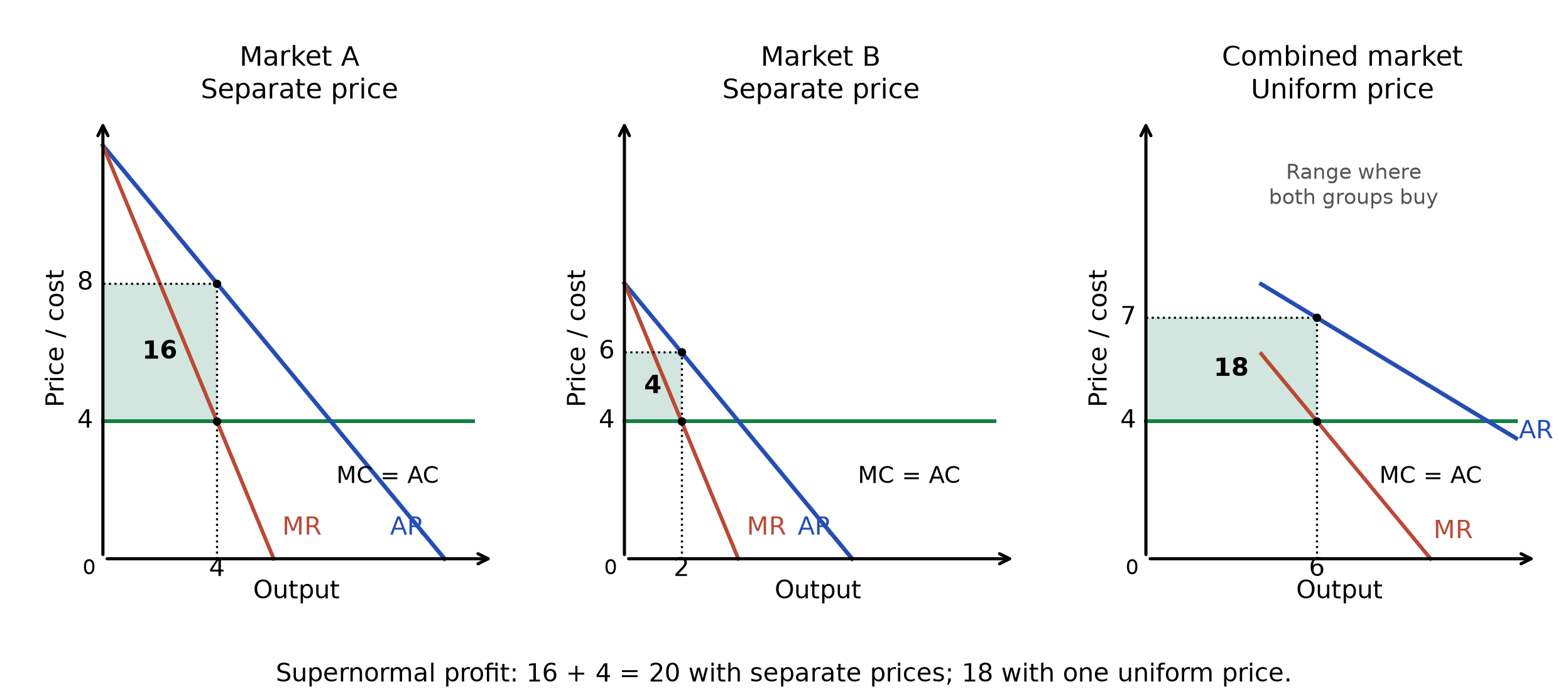
Read the diagram: In each separate market, choose output where MR = MC, then read price from AR. Market A: Q = 4 and P = 8, so profit = (8 − 4) × 4 = 16. Market B: Q = 2 and P = 6, so profit = (6 − 4) × 2 = 4. Total discriminatory profit is 20. With one uniform price in the combined market, MR = MC at Q = 6 and AR gives P = 7, so profit = (7 − 4) × 6 = 18. Discrimination raises profit by 2 here; total output is unchanged.
Assumptions: P = 12 − QA and P = 8 − QB; constant MC = AC = 4, no fixed or segmentation costs, and no resale. The combined panel shows only the relevant range where both groups buy: AR gives P = 10 − Q/2 and MR = 10 − Q. Higher-price portions are omitted. Read output at MR = MC, then price from AR in every panel.
Costs and benefits of price discrimination to firms and consumers
| Stakeholder | Costs | Benefits |
|---|---|---|
| Consumers | Some groups pay more and lose consumer surplus; others pay less or gain access. Compare total output and surplus with uniform pricing. P > MC can persist, but discrimination does not always reduce total welfare. | Cross-subsidisation can produce a net welfare gain if some consumers pay a lower price; some previously priced-out consumers (e.g. lower-income patients charged less for the same drug) gain access at all |
| Producers | May draw regulatory scrutiny if used as a form of predatory pricing; splitting the market itself carries a cost | Raises total revenue, which can support survival of a product; higher profit can fund quality improvements or new-product development; better use of spare capacity; profit from one sub-market can cross-subsidise a loss-making but socially valuable one |
Efficiency assessment
| Efficiency type | Achieved? | Reasoning |
|---|---|---|
| Allocative efficiency | No | With downward-sloping demand and an interior profit maximum, AR exceeds MR = MC, so P > MC in the basic model without externalities. |
| Productive efficiency | Not guaranteed | The chosen output may differ from minimum AC. Check the illustrated cost and demand conditions; market power alone does not prove that minimum AC can never be reached. |
| Dynamic efficiency | Limited/Yes | Retained supernormal profit, protected by high barriers to entry, can fund R&D and long-run investment in new technology that lowers future average cost — though the same lack of competition can also reduce the urgency to innovate |
| Economies of scale | Possible | Large scale may lower unit costs; this alone does not establish P = MC or output at minimum AC. |
Impact on stakeholders
| Stakeholder | Pros | Cons |
|---|---|---|
| Consumers | Economies of scale may keep average costs (and potentially prices) lower than under smaller competing firms; price discrimination can extend access to previously priced-out groups through lower prices in those markets | Higher prices and lower output than under competition (allocative inefficiency); less choice than in a more competitive market; price discrimination redistributes consumer surplus; its aggregate effect depends on demand and output |
| Producers | Retained supernormal profit can fund investment, R&D, and resilience to short-term shocks; the firm may exploit economies of scale. Price discrimination can raise profit where differences in demand can be exploited and implementation costs do not outweigh the gains. | Weak competitive pressure reduces the urgency to cut costs or innovate (X-inefficiency); may face regulatory scrutiny over anti-competitive practices |
| Government | High monopoly profits can be a source of tax revenue | Must monitor and regulate monopoly power to prevent consumer exploitation and anti-competitive behaviour |
| Society | Avoids wasteful duplication of infrastructure, especially in a natural monopoly; dynamic efficiency gains from funded R&D can generate positive externalities; export revenue from globally dominant firms | Price above marginal cost implies allocative inefficiency in the basic model. Productive inefficiency depends on cost conditions; market power alone does not establish that output can never be at minimum AC. |
Separate cost conditions from market power. Economies of scale may lower costs, but consumer gains depend on prices and quality. Under discrimination, compare each group and total output with the uniform-price alternative; a redistribution of surplus is not itself a net welfare gain.
Rapid recap
Monopoly: choose Q at MR = MC, read P from AR, then compare P with AC to find profit. Market power does not guarantee positive profit.
Discrimination: market power, identifiable groups and restricted resale permit different prices. With common MC, allocate output so MR is equal across markets and equals MC.
Compare: read each price from its own AR and add profits. Compare consumer groups, total output and costs with the best uniform price; higher profit is not proof of higher social welfare.
Diagram cue: show monopoly price and profit; for discrimination align markets at the common MC.
Related chapters: Unit 3 chapter 8 (p. 38) · Unit 3 chapter 19 (p. 88)