Monopolistic competition combines product differentiation with entry and exit.
Must know
- Firms face downward-sloping demand.
- Short-run supernormal profit can attract entry.
- Long-run normal profit coexists with excess capacity in the model.
Must know definitions
Monopolistic competition: a market with many small firms selling differentiated products, with low barriers to entry and exit.
Product differentiation: making a product distinct from competitors' through physical features, marketing, or distribution.
Excess capacity: producing below the output at which average cost is minimised, since AR is tangent to ATC rather than touching it at its lowest point.
Explain and apply
Mechanism in brief: Profit attracts entrants offering substitutes, reducing demand for incumbents. At long-run equilibrium, each firm covers economic cost but produces below the output that minimises its average cost.
Distinguish: Normal profit does not imply productive efficiency; differentiation does not eliminate competition.
Use the extract: Identify product differentiation, entry and advertising; explain why a firm retains downward-sloping demand.
Assumptions of monopolistic competition
- Monopolistic competition describes a market with a large number of relatively small firms, low barriers to entry and exit, and — unlike perfect competition — firms produce similar but differentiated products.
- Because products are differentiated rather than homogeneous, each firm has some degree of market power and faces a downward-sloping demand curve, though this market power is weak given how many competitors and close substitutes exist.
- Hairdressers and local restaurants are typical real-world examples.
many small firms + low barriers to entry/exit + differentiated products → each firm has weak market power → downward-sloping (but highly elastic) demand curve
Types of product differentiation
- Firms differentiate their products in three main ways.
- Physical differentiation involves genuine differences in product features, quality, or design.
- Marketing differentiation involves advertising, branding, and packaging that shape how consumers perceive an otherwise similar product.
- Distribution differentiation involves the channel through which the product is sold — for example, in-store, online, or by telephone — which can make an otherwise similar product feel distinct to consumers.
| Type of differentiation | Example |
|---|---|
| Physical | Different product features, ingredients, or design |
| Marketing | Advertising, branding, packaging |
| Distribution | Shop, online, telephone, delivery service |
Profit-maximising equilibrium in the short run and long run
- Because of product differentiation, the firm's demand (AR) curve slopes downward — the firm can raise price without losing all of its customers, since some buyers value the differentiated features enough to stay.
- The firm profit maximises where MC = MR, producing at output Q and charging price P.
- In the short run, if AR lies above ATC at this output, the firm earns supernormal profit.
Figure 3.15 Firm output price and profit
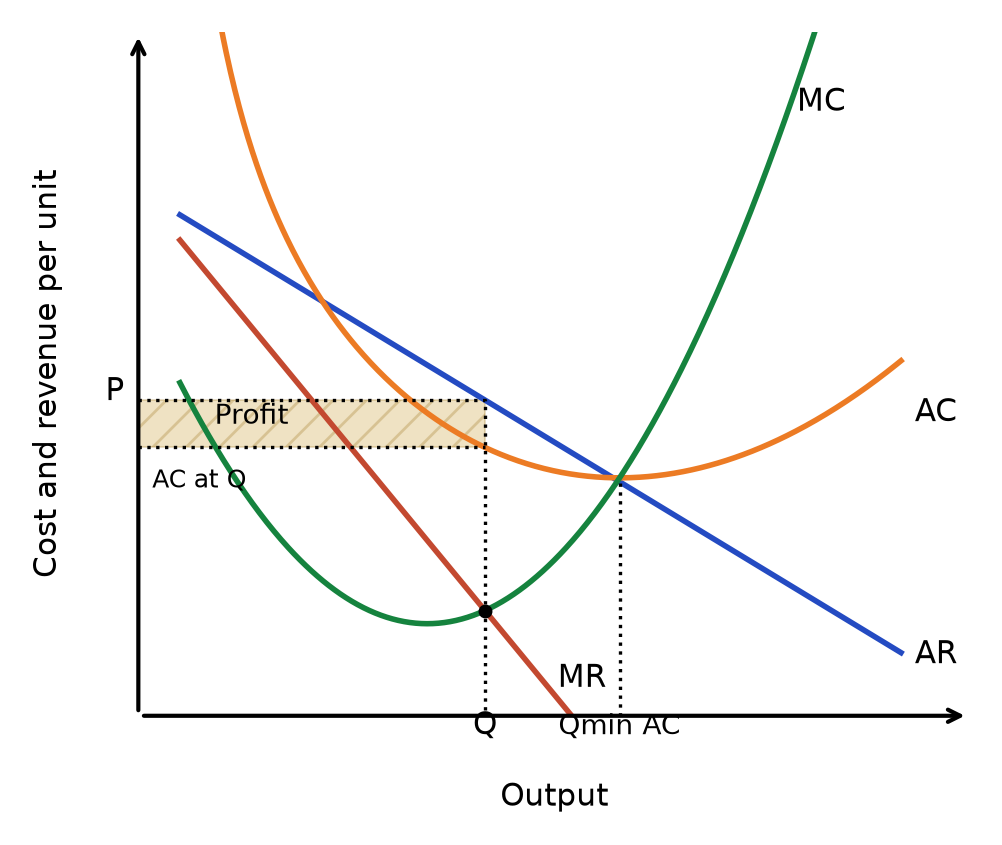
Read the diagram: Find Q where rising MC crosses MR → read P vertically above Q on AR → read AC at the same Q → profit is (P − AC) × Q, shown by the rectangle. Higher AC could turn this profit into a loss; downward-sloping demand alone does not guarantee profit.
- In the long run, the low barriers to entry allow new firms to enter, attracted by the supernormal profit. As more competitors enter offering close substitutes, demand for the existing firm's product becomes more price elastic and the AR curve shifts leftward/inward, continuing until AR is tangent to ATC and only normal profit remains.
- Symmetrically, firms making losses would exit, shifting AR back outward until normal profit is restored.
- Firms often try to delay this erosion by continuously differentiating their product or innovating to keep some market power.
supernormal profit exists → new firms enter (low barriers) → more substitutes available → AR curve shifts inward (more elastic) → AR falls to ATC → only normal profit remains in the long run
Figure 3.16 Firm output price and profit
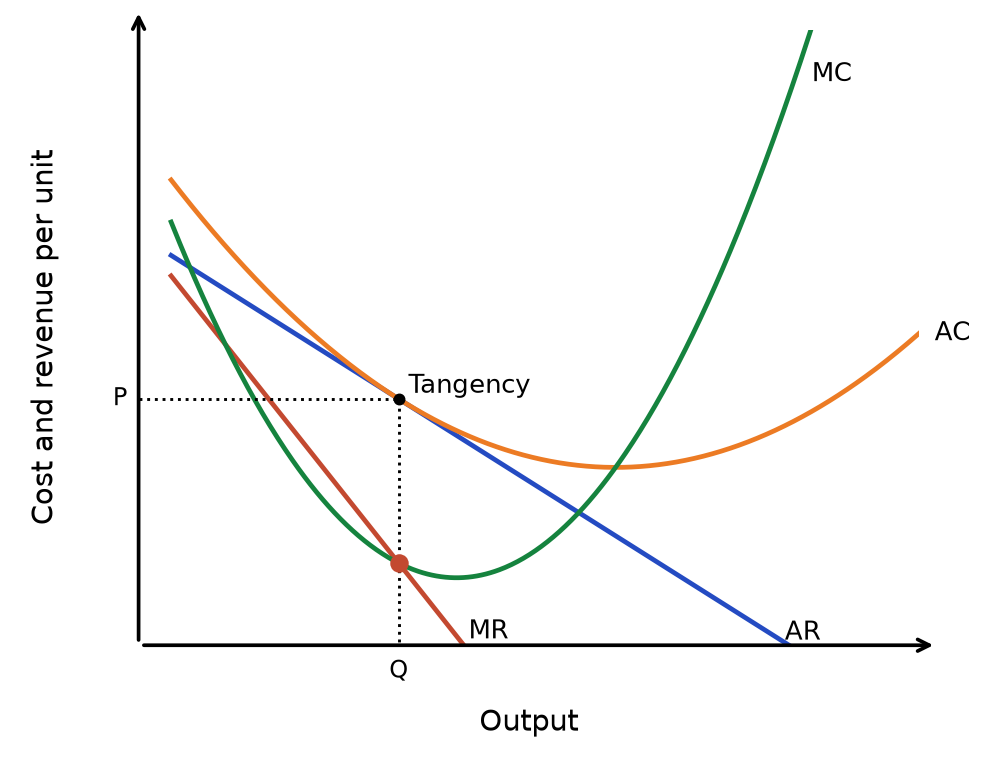
Read the diagram: Find Q where MC = MR → move up to the AR–AC tangency to read P → P = AC means normal profit → compare Q with the output at minimum AC to identify excess capacity.
Assumptions: entry removes supernormal profit while products remain differentiated. Tangency at the chosen output is not the minimum of AC.
Productive and allocative efficiency in the short run and long run
- In the standard profit-maximising model with downward-sloping demand, P exceeds MC. In long-run monopolistic competition, AR–AC tangency implies excess capacity; short-run productive efficiency is not ruled out in every possible configuration.
- At an interior profit-maximising output, MR = MC and downward-sloping AR lies above MR, so P > MC. This is allocative inefficiency under the model’s no-externality assumptions.
- In the standard long-run model, downward-sloping AR is tangent to AC to the left of minimum AC. The firm has excess capacity and is productively inefficient at that equilibrium.
Long-run AR–AC tangency before minimum AC → excess capacity → productive inefficiency. Short-run productive efficiency depends on the actual position of the chosen output relative to minimum AC.
Efficiency assessment
| Efficiency type | Achieved? | Reasoning |
|---|---|---|
| Allocative efficiency | No in the standard profit-maximising model | With downward-sloping demand and an interior MR = MC choice, P > MC; assume no externalities when interpreting allocative efficiency. |
| Productive efficiency | No in the standard long run; not guaranteed in the short run | Long-run tangency occurs to the left of minimum AC, creating excess capacity. Short-run output could coincide with minimum AC for particular demand and cost conditions. |
| Dynamic efficiency | Not guaranteed | Only normal profit is earned in the standard long run, but firms still have incentives to differentiate and innovate to gain a temporary advantage. Limited retained profit may constrain funding; the strength of innovation depends on finance, rivalry and the scope for differentiation. |
| Economies of scale | Limited/absent | Firms remain relatively small with a limited market share, so they generally do not reach the minimum efficient scale |
Impact on stakeholders
| Stakeholder | Pros | Cons |
|---|---|---|
| Consumers | Wide product variety and choice, since firms differentiate to compete; some short-run innovation incentive can improve product quality | P > MC in the standard model, indicating allocative inefficiency in the absence of externalities; weaker competitive pressure may allow X-inefficiency. A direct price comparison with perfect competition also depends on costs and product characteristics. |
| Producers | Retain some pricing power from product differentiation, and can earn supernormal profit in the short run | Only normal profit in the long run; excess capacity means costs are higher than the technically achievable minimum |
| Government | — | May need to monitor misleading advertising or marketing claims used to differentiate otherwise similar products |
| Society | Greater product variety serves diverse consumer preferences better than a single homogeneous good | In the standard long run, P > MC and output is below minimum AC: neither allocative nor productive efficiency is achieved. These model results should be weighed against the benefits of product variety. |
A common slip in exams: don't describe monopolistic competition's long-run outcome as identical to perfect competition's — both settle at normal profit only, but a monopolistically competitive firm's AR curve is tangent to ATC above its minimum point (excess capacity, P > MC), whereas a perfectly competitive firm's AR curve touches ATC exactly at its minimum (P = MC).
Excess capacity indicates a cost disadvantage relative to the productive-efficiency benchmark. Consumers may value variety and location, so compare that benefit with higher unit costs instead of treating differentiation as pure waste.
Rapid recap
Differentiation gives each firm downward-sloping demand. Entry erodes supernormal profit; long-run AR is tangent to AC, generally to the left of minimum AC.
Diagram cue: show long-run AR–AC tangency and explain excess capacity.
Related chapters: Unit 3 chapter 8 (p. 38) · Unit 3 chapter 9 (p. 40)