Perfect competition provides a benchmark with price-taking firms and free entry and exit.
Must know
- AR equals MR equals market price.
- A producing firm maximises profit where MC equals MR.
- Entry and exit remove supernormal profit in long-run equilibrium.
Must know definitions
Perfect competition: a market structure with many small price-taking firms, free entry/exit, perfect knowledge, and homogeneous goods.
Price taker: a firm that must accept the market price, facing a horizontal AR = MR = D curve.
Long-run equilibrium (perfect competition): the point where entry/exit has competed away supernormal profit, leaving only normal profit at AR = ATC.
Explain and apply
Mechanism in brief: Supernormal profit attracts entry, expanding market supply and reducing price. Each firm adjusts output at the new price until the entry incentive disappears, assuming free entry and the model's cost conditions.
Distinguish: The firm chooses output at the market price; free entry is a long-run adjustment mechanism.
Use the extract: Check price-taking, product similarity and entry conditions; distinguish the firm from the whole market.
Assumptions of perfect competition
- Perfect competition is a theoretical market structure where competition is at its most intense, resting on a set of strict assumptions:
- there are many buyers and sellers, each too small individually to influence the market price;
- firms are price takers;
- there is free entry to and exit from the market, with no barriers;
- buyers and sellers have perfect knowledge of prices and products;
- the good produced is homogeneous (identical across firms);
- factors of production are perfectly mobile.
- Very few real-world markets meet all of these conditions fully — the foreign exchange market is often cited as the closest real-world approximation — but the model is a useful benchmark against which other market structures can be compared.
many small firms + free entry/exit + perfect knowledge + homogeneous goods → no single firm can influence price → firms are price takers
Profit-maximising equilibrium in the short run and long run
- Because a perfectly competitive firm is a price taker, its average revenue (AR) curve is horizontal at the market price, and since every extra unit sells at that same price, AR = MR = D.
- The firm profit maximises where MC = MR.
- In the short run, if average revenue lies above average total cost at this output, the firm earns supernormal profit — shown as the rectangle between AR and ATC at the profit-maximising output.
Figure 3.12 Firm output price and profit
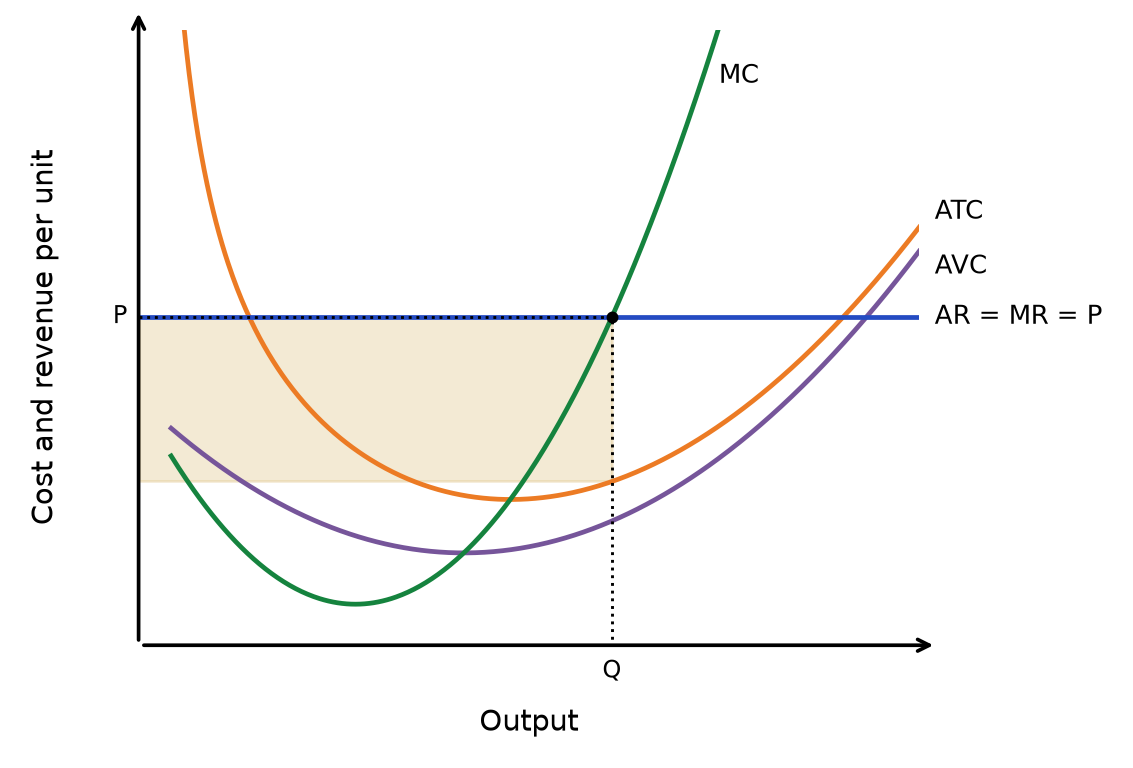
Read the diagram: Find Q where rising MC = MR → read the horizontal price P → compare P with ATC at Q → the shaded rectangle is (P − ATC) × Q, or supernormal profit. Entry may remove this profit in the long run.
Assumptions: the firm is a price taker, so P = AR = MR. This short-run profit need not persist once entry changes the market price.
- In the long run, the supernormal profit earned in the short run attracts new firms into the industry, since there are no barriers to entry. New entrants raise total market supply, shifting the industry supply curve rightward and lowering the market price, which shifts each individual firm's horizontal AR curve downward.
- Entry continues until price falls to the point where AR = ATC and only normal profit remains — at this point there is no further incentive to enter, so the market settles at long-run equilibrium.
- Symmetrically, if firms were making losses, exit would reduce supply, raise price, and restore normal profit in the long run.
supernormal profit exists → new firms enter (no barriers) → market supply ↑ → price ↓ → supernormal profit competed away until only normal profit remains
Figure 3.13 Market equilibrium
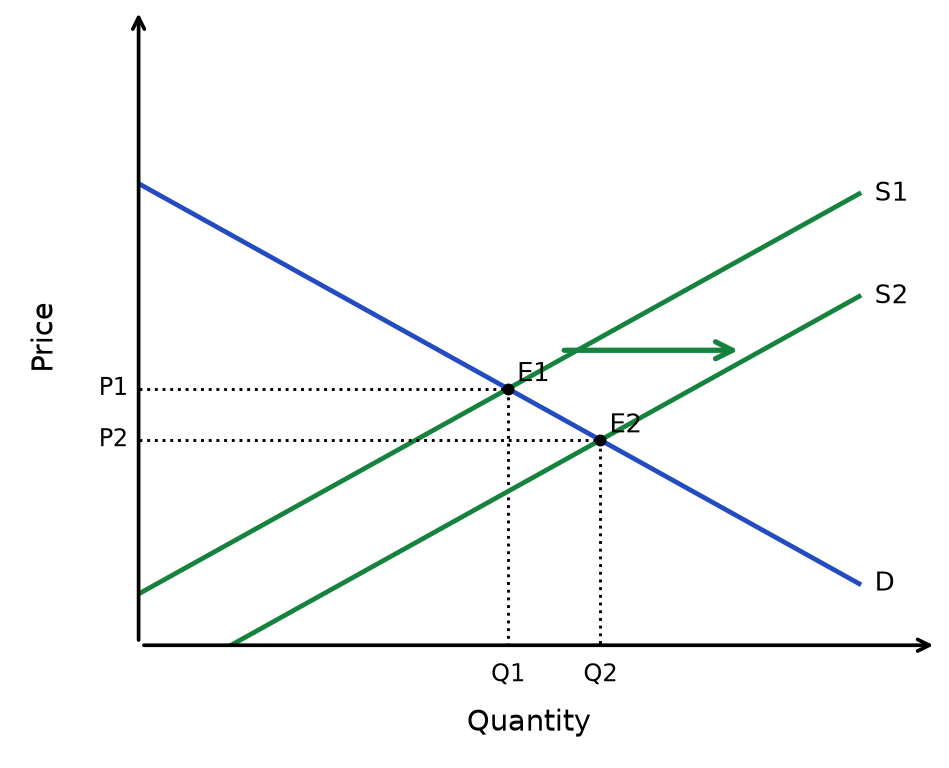
Read the diagram: Identify a non-price determinant that changes supply → shift supply right, holding the other curve fixed → find the new intersection → price falls and quantity rises. The price change causes movement along the unchanged curve. Elasticities determine the size of the response.
Figure 3.14 Firm output price and profit
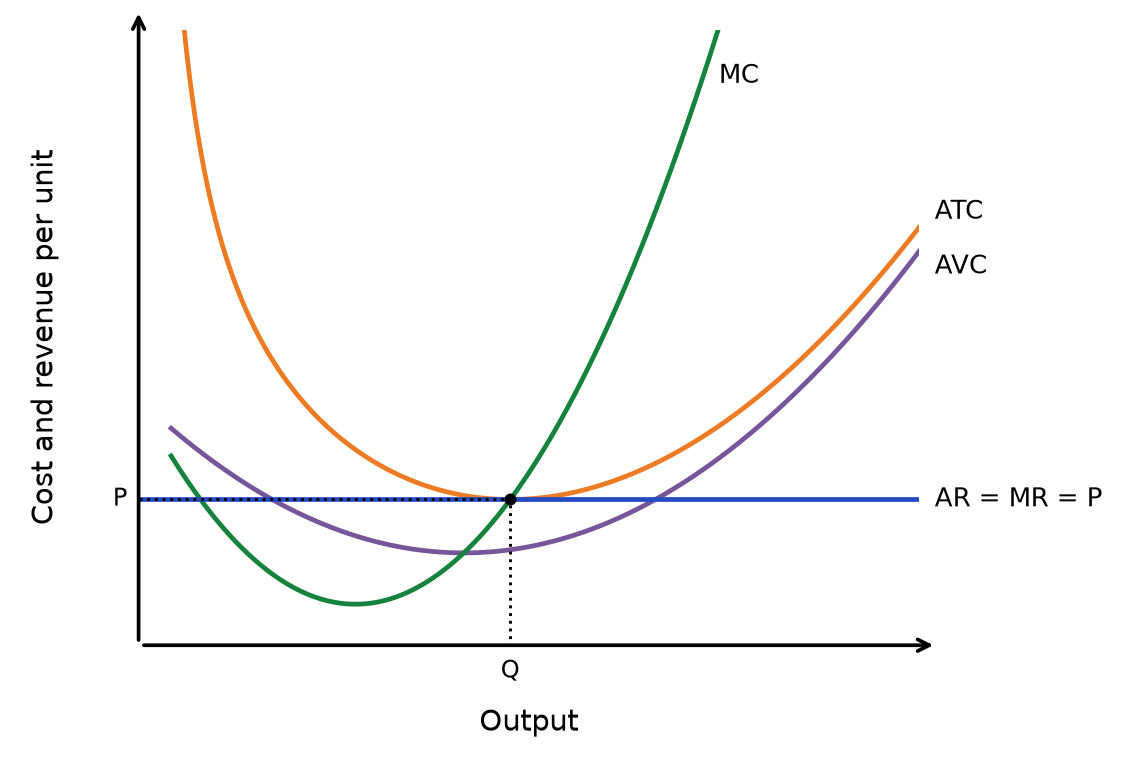
Read the diagram: Find the common point where P = MR = MC = minimum ATC → read Q → P = ATC gives normal profit and minimum ATC shows productive efficiency. This is the standard long-run competitive model.
Assumptions: free entry and exit and adjustment to long-run equilibrium. The minimum-AC result belongs to this model, not every competitive-looking market.
The short-run shutdown point
- For a competitive firm, the short-run shutdown threshold is P = minimum AVC. Above it, the best operating output contributes towards fixed costs; at equality the firm is indifferent; below it, no positive output covers variable cost and the firm shuts down in the model.
Productive and allocative efficiency in the short run and long run
- Perfectly competitive firms are allocatively efficient both in the short run and the long run, because profit maximisation at MC = MR combined with AR = MR means the firm always produces where price equals marginal cost (P = MC).
- The standard long-run competitive equilibrium is productively efficient at minimum AC. Short-run output need not be at minimum AC, although it can coincide with it; short-run profit or loss must be read from the actual curves.
MC = MR and AR = MR → P = MC → allocative efficiency in the standard model without externalities.
Long-run entry and exit → P = minimum ATC → productive efficiency in long-run equilibrium.
Efficiency assessment
Allocative efficiency
Achieved?: Yes, short run and long run
Reasoning: At an interior profit-maximising output, P = MR = MC. Allocative efficiency also assumes no external costs or benefits.
Productive efficiency
Achieved?: Guaranteed in the standard long-run equilibrium; not guaranteed in the short run
Reasoning: Entry and exit lead to minimum ATC in the standard long-run equilibrium. A short-run output can coincide with minimum ATC, but need not do so.
Dynamic efficiency
Achieved?: Not guaranteed
Reasoning: Free entry and rapid imitation can limit lasting supernormal profit and weaken incentives for costly R&D. However, normal profit includes the required return to enterprise and capital; competitive pressure can encourage cost-saving innovation. Do not infer that innovation is impossible.
Economies of scale
Achieved?: Depends on efficient scale relative to market demand
Reasoning: A firm can have a small market share and still reach minimum efficient scale when that scale is small relative to industry demand. Long-run competitive equilibrium is at minimum average cost in the standard model; small size alone does not prove unexploited economies of scale.
Impact on stakeholders
| Stakeholder | Pros | Cons |
|---|---|---|
| Consumers | Low prices, since competition drives price down to minimum ATC; allocative efficiency means output matches what consumers value; homogeneous goods mean no branding premium | Rapid imitation may weaken incentives for costly product innovation, but competition can encourage cost reductions; innovation and quality gains are not ruled out. |
| Producers | — | Entry limits persistent supernormal profit; funding R&D may be harder, although firms can still innovate and reach efficient scale. |
| Government | A self-regulating, competitive market needs little intervention to prevent consumer exploitation, since no single firm holds market power | — |
| Society | Efficient resource allocation (P = MC) and low prices benefit society as a whole | Rapid imitation may weaken incentives for costly innovation; the actual effect depends on finance and competitive pressure. |
Common slip: perfect competition is a benchmark for static efficiency under its assumptions. Free entry can reduce persistent profit available for research, but firms may still innovate to lower costs, gain temporary returns or use external finance.
Use the model as a benchmark, then test its assumptions. Barriers or slow adjustment can sustain departures from long-run equilibrium; normal profit includes a return to enterprise and does not mean innovation is impossible.
Rapid recap
Firm: price taking gives P = AR = MR; choose output where rising MC = MR, subject to shutdown.
Industry adjustment: supernormal profit attracts entry → market supply rises → price falls; losses encourage exit. The standard long-run equilibrium has P = MC = minimum AC.
Judge: these conclusions rely on entry, information and other model assumptions. Distinguish the individual firm’s horizontal demand from downward-sloping market demand.
Diagram cue: link market entry to the firm’s long-run price and minimum AC.
Related chapters: Unit 3 chapter 5 (p. 23) · Unit 3 chapter 8 (p. 38)