4.9 Barriers to economic growth and/or economic development
Poverty traps/poverty cycles
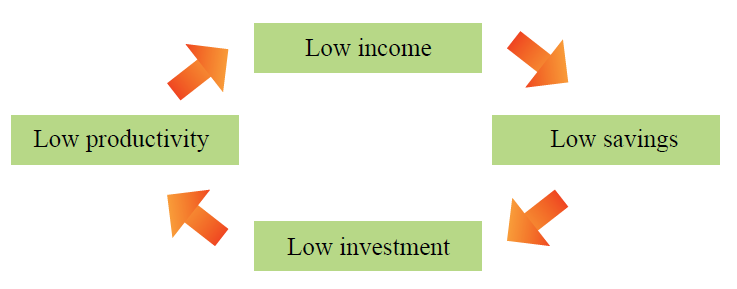
Poverty trap refers to the vicious cycle where poverty perpetuates through generations due to the prevailing low-income level leading to a low savings level, hence low level of investment and productivity, and back to a low level of income.
The UN’s Least Developed Countries Report 2016 found that global poverty is becoming increasingly concentrated among a group of 48 countries which are falling further behind the rest of the world in terms of development. Since 1990, the proportion of the global poor in those countries has more than doubled, as has the share of those without access to water. The same countries also have the majority of the over 1 billion people worldwide who do not have access to electricity.
These factors leave many of those 48 countries stuck in a poverty trap. The UN considers a country to have ‘graduated’ from the Least Developed Country (LDC) category when they satisfy a set of economic and social criteria, but only four countries have achieved this in the last 45 years. Between 2011 and 2016, only Samoa had graduated.
Economic barriers
Below are the economic barriers that hinder development in an economy.
Rising economic inequality
High income inequality is a barrier to growth and development in several ways:
- Where there are high levels of inequality, there tend to be lower levels of saving, as the poor have a very low marginal propensity to save. Low levels of saving means that investment is limited.
- The rich tends to dominate political and economic life, meaning that policies tend to be made in their favour.
- Capital flight is the movement of financial wealth abroad, often in response to economic or political risk. It can reduce funds available for domestic investment. Purchases of imported consumer goods are imports, not capital flight.
Lack of access to infrastructure and appropriate technology
Lack of access to infrastructure
Infrastructure includes essential facilities and services such as roads, airports, and sewage treatment that add to the capital stock of the economy and are necessary for economic activities. Improvements in infrastructure lead to higher levels of economic development; for example, better roads mean that producers can transport their goods to more parts of the country.
Lack of access to appropriate technology
In development economics, appropriate technology refers to the use of technology that makes use of existing local resources. For LEDCs, this often means technology that makes use of labour (due to the relative abundance of labour as opposed to capital) and locally available raw materials, and can be operated easily by the local populace.
An example of this is the Universal Nut Sheller originally used in Mali, which is a simple and inexpensive hand-operated machine for shelling varying sizes of peanuts.
Low levels of human capital
The presence of human capital determines the level of labour productivity, which in turn determines the level of economic output produced per person. Higher labour productivity is important in increasing per-person income levels that contribute to a higher standard of living.
The availability of education
Education is a positive externality; when the workforce is more educated, the economy is more efficient. Education also makes people more able to read and communicate, and therefore makes it more likely that attitudes about the role of women in society will improve. More educated people are also likely to be healthier, as they are more informed about health issues and how to avoid them.
Education therefore improves efficiency and productivity, thus helping the economy to achieve higher levels of growth and development.
The availability of healthcare
Better availability of healthcare is also likely to improve economic development; there is a strong correlation between healthcare and life expectancy. Healthcare might also improve economic growth, as the availability of healthcare means that workers have to take less time off work due to ill health.
Dependence on primary sector production
Countries which are dependent on a narrow range of goods, such as primary products, may suffer if the prices for those goods change on international markets, or if substitutes for those goods become available.
The price elasticity of demand and supply for commodities on the world market tend to be inelastic. This means that any change in demand or supply will lead to large fluctuations in price; this will in turn have a large impact on the export revenue of countries dependent on the sale of those commodities.
This price volatility also makes it hard for individuals, firms, and governments in developing countries to plan ahead; this limits investment and government planning for healthcare, education, and infrastructure, and thus also limits development.
Lack of access to international markets
Protectionist measures taken by developed countries may hinder the ability of developing countries to achieve economic growth; if developed countries adopt protectionist policies, developing countries will be prevented from using their comparative advantage and exporting to developed countries.
Protectionism is particularly harmful in primary product markets. For example, the US subsidises domestic cotton production heavily, damaging developing country producers. Such products are sold at lower prices than they would be without subsidies, so are ‘dumped’ in foreign markets.
There are other reasons why countries may have limited access to international markets:
- Landlocked countries and countries with poor infrastructure may have limited physical access to international markets.
- Developing countries might struggle to meet product standards required to trade on international markets.
- Developing countries might have non-convertible currencies, which can only be used domestically and are therefore not accepted on foreign exchange markets. This makes trade riskier, and therefore less likely to happen.
Informal economy
The informal economy consists of activities that are not, or are insufficiently, covered by formal arrangements. Much of this production is within the national-accounts production boundary and should be included in GDP and related income measures. However, limited records and surveys can lead to under-recording. Being untaxed does not itself exclude output from GDP or GNI.
Jobs in the informal economy tend to have poor working conditions and no social protection or labour rights. Workers in the informal economy suffer from poor productivity, and difficulty in accessing investment. This means that the output of the informal economy is limited. Since firms in the informal economy do not pay tax, the government’s resources to fund economic development are also limited.
Capital flight
Capital flight refers to the movement of money out of a country due to political or economic instability. This restricts growth as that capital could have been used for spending or investment in the domestic economy. Capital flight also might cause depreciation of the country’s currency, as the supply of the currency on the international money market increases.
Indebtedness
Indebtedness refers to the amount of money that a country owes to other countries and/or international institutions. Developing countries incur debt whenever they borrow from abroad. This value of this debt (the principal) has to be repaid, along with any interest that is due on the debt. Money that is spent on servicing the debt leaves the economy, and thus slows economic growth as governments have less money to spend in the domestic economy. It also slows development as the government cannot provide essential services such as healthcare and education.
The servicing of international debt causes balance of payment problems, because export earnings are diverted into debt servicing instead of the purchasing of food and capital equipment imports. Spending is also foregone on investment that can help with development objectives, such as spending on healthcare and education.
Excessive foreign debt also causes debt overhang, where LEDCs cannot easily increase its borrowing due to its high level of debt, thus depriving them of the ability to invest in development projects.
Geography including landlocked countries
Landlocked countries tend to trade less and have slower growth rates, as they have to spend more money on and wait longer for transport of exports and imports. These transport costs add to the costs of their exports, and decrease their competitiveness.
Tropical climates and endemic diseases
Development of production technology in tropical climates has tended to be slower. This is because agricultural productivity is lower, leading to poor nutrition and poor health, and because the high incidence of diseases affects the quality of human resources.
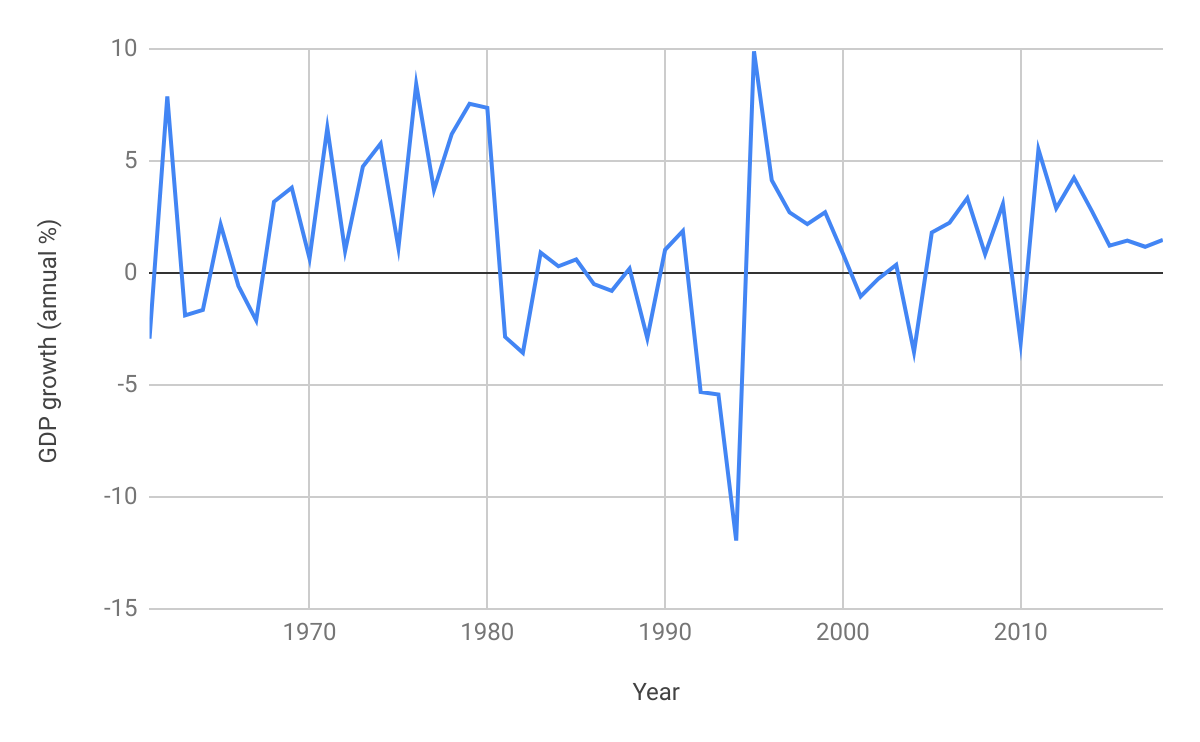
The graph below shows Haiti’s economic growth between 1960 and 2018. An October 2020 USAID report, citing World Bank figures available at the time, put GDP per capita in 2019 at US$756; this is a historical data vintage, rather than a value checked against subsequent revisions. Haiti ranked 169th out of 189 countries in the 2019 Human Development Report. The World Bank’s 2020 Human Capital Index was 0.45: under the pre-pandemic health and education conditions used in the model, a child born in Haiti could expect to reach 45% of the adult productivity associated with complete education and full health. Sources: USAID report, October 2020; World Bank Haiti HCI brief, October 2020
Rising economic inequality
In 2012, Haiti’s income-based Gini coefficient was approximately 0.61, indicating substantial income inequality. Around 6 million people lived below the historical national poverty threshold of US$2.41 per person per day, including approximately 2.5 million below the extreme-poverty threshold of US$1.23. These thresholds are expressed in 2005 purchasing-power-parity dollars; they are not current international poverty lines. Sources: World Bank poverty assessment · Assessment methodology.
Lack of access to infrastructure and appropriate technology
The combination of under-investment and the impact of natural disasters means that Haiti’s poor infrastructure represents a significant barrier to its economic growth.
- The Library of Congress’s May 2006 country profile reported 1,011 km of paved roads and 3,149 km of unpaved roads in 1999. It also described road construction during the US occupation of 1915–1934. These figures illustrate the historical infrastructure constraint; they are not a current inventory of Haiti’s road network. Source: Library of Congress Haiti profile, May 2006
- Public transport services exist, including privately operated shared vehicles, but poor roads, affordability and limited access constrain mobility, as described in the World Bank’s 2018 transport analysis.
- Telecommunications can reduce the cost of obtaining information and reaching markets. When assessing access, the number of subscriptions must be distinguished from the number of individual users and the population covered by a network: one person may hold several subscriptions.
- The World Bank’s October 2020 Human Capital Project brief reported that 32% of Haiti’s population used the internet in 2018. This dated measure describes internet use, rather than the number of telephone subscriptions or the reach of a mobile network. Source: World Bank Haiti HCI brief, p.2
The Library of Congress country profile published in May 2006 described Port-au-Prince as Haiti’s principal port and the location of its main international airport. It recorded four airports with paved runways and eight with unpaved runways. This is a historical infrastructure inventory, rather than a description of present airport capacity or safety. Sources: Library of Congress, May 2006.
Low levels of human capital
Bertelsmann’s BTI 2022 Haiti report, citing World Development Indicators, gives estimated literacy rates for 2016 of 58.3% for women and 65.3% for men. These historical estimates indicate a gender gap in literacy. The World Bank’s October 2020 Human Capital Project brief also reported government education spending of 2.8% of GDP in 2018. Limited education and public resources can constrain the accumulation of human capital. Sources: BTI 2022 Haiti country report; World Bank Haiti HCI brief, p.2
Dependence on primary sector production
Agriculture provides livelihoods but is vulnerable to damage from natural disasters. According to the Library of Congress’s May 2006 profile, agriculture, forestry and fishing together accounted for around 28% of GDP and 66% of the labour force in 2004. The GDP figure measures the combined sectors’ value added, not agricultural export revenue; the employment figure refers to the labour force, not the entire population. Source: Library of Congress Haiti profile, May 2006
The May 2006 country profile listed food processing, beverages, cement, soap and textiles among Haiti’s manufacturing activities. It reported that industry accounted for approximately 20% of GDP in 2004 but employed less than 10% of the labour force. Limited capital investment was one constraint on manufacturing development; it should not be treated as the sole explanation for the sector’s performance. Sources: Library of Congress, May 2006.
Lack of access to international markets
Haiti’s relatively low import tariffs did not, by themselves, imply easy access to overseas markets for Haitian exporters. The WTO’s 2015 trade review reported a simple average applied tariff of 4.9%, while also identifying other charges and obstacles to trade. Cheaper imports can benefit consumers and firms purchasing inputs, but expose some domestic producers to greater competition. These effects need to be distinguished from the separate question of exporters’ access to foreign markets. Sources: WTO trade review, 2015.
Haiti has been a WTO member since 30 January 1996 and is a member of CARICOM. CARICOM membership should not be taken to mean full participation in every arrangement of the CARICOM Single Market and Economy. The US HOPE and HELP programmes provide preferential access for eligible Haitian textile and apparel exports, subject to their rules. Official statements in September 2026 reported that these programmes had been extended through 31 December 2028; this was not a general exemption from tariffs for every Haitian export. Sources: WTO membership · CARICOM arrangements · Haiti investment agency, September 2026.
Informal economy
World Bank analysis of Haiti’s 2012 labour-market data described a small formal employment sector: roughly 13% of paid workers were in formal work, with around 40% in agriculture and 47% in urban informal activities. These are historical employment categories, not shares of the whole population. The Bank’s poverty assessment described informal earnings below half formal-sector earnings in its discussion of poor households; low earnings can constrain poverty reduction, but this does not mean every informal worker is poor. The same assessment estimated that, holding other social and demographic characteristics constant, working women were 6 percentage points more likely than men to work informally. Sources: World Bank Haiti country diagnostic, 2015, labour-status figure; US State Department, Haiti 2021 report; World Bank poverty assessment
Informal enterprises in Haiti include small vendors and other businesses selling food, household goods and clothing. The World Bank’s Doing Business 2012 country profile ranked Haiti 180th out of 183 economies on its starting-a-business indicator. This historical ranking illustrates obstacles to formal business entry; it does not establish that an individual informal enterprise will remain informal. Source: World Bank Doing Business 2012 Haiti profile
Indebtedness
Haiti’s high level of external debt has been a significant barrier to development, and has contributed to the country’s persistent poverty.
Haiti declared independence in 1804. In 1825, France imposed an indemnity intended to compensate former slaveholders for their losses. Borrowing to meet the indemnity created a further debt burden; the later refinancing obligations continued into the twentieth century, with the final payments in that debt chain made in 1947. This was not an unchanged indemnity paid directly to France throughout the period. Debt service can limit the resources available for public services and investment. Source: AP historical account, 17 April 2025
Geography
Haiti is exposed to natural hazards including hurricanes, floods and earthquakes. A World Bank/GFDRR account reports that more than 96% of the population was exposed to at least two hazards. Hurricane Matthew in 2016 caused estimated damages and losses equivalent to around 32% of Haiti’s 2015 GDP. This is a comparison of damages and losses with GDP, not a measured 32% fall in annual output. Sources: GFDRR Haiti disaster-risk account; World Bank project appraisal, 2017
Tropical climates and endemic diseases
Haiti suffers significantly from diseases, exacerbated by its poor health system:
- Haiti has faced a substantial burden of tuberculosis and HIV. PAHO’s October 2024 assessment identified tuberculosis incidence as among the highest in the region. This does not establish that Haiti ranks highest for both diseases under every measure. Sources: PAHO, October 2024.
- An archived PAHO country profile reported an estimated tuberculosis prevalence of 114 per 100,000 people in 1999. Prevalence refers to existing cases in a population; this figure should not be described as the number of new infections during that year. Sources: PAHO historical country profile.
- The HAPHIA household survey, conducted from July 2019 to November 2020, estimated HIV prevalence at 1.8% among adults aged 15–64. This is a dated prevalence estimate; it does not measure the proportion of deaths caused by AIDS.
- PAHO’s profile of registered deaths in 1999 identified intestinal infections, perinatal conditions, malnutrition and respiratory infections as important causes of death among children aged 0–4. Death registration was very incomplete, and many recorded causes were ill-defined. The figures therefore cannot reliably describe the distribution of causes across all child deaths in Haiti. Sources: PAHO historical country profile.
Political and social barriers
Weak institutional framework
Legal system
A well-functioning legal system is essential for development; without it, there is no way to create and enforce contracts, and no way to uphold property rights. Property rights refers to the legal right to own property/assets, the right to sell property/assets, and the right to benefit from property/assets.
Property rights allow people to own and benefit from private property. If property rights are not enforced, there will be less investment and therefore limited growth. Property rights are important for three reasons:
- Property rights incentivise owners of property to use their skills to earn income from the property.
- Owning property gives people an incentive to improve the value of that property, as they know that when they sell it they will profit from the increased values.
- Property can be used as collateral, for example for a loan. The ability to get credit allows low-income families to, for example, set up businesses.
Ineffective taxation structures
Tax revenue is very important for governments; it allows governments to finance government spending, for example on public services such as healthcare and education.
Ineffective taxation structures in developing countries mean that governments earn less taxation revenue. This means that they have less money to spend on public services, and less money to spend on improving infrastructure. This limits economic growth.
Taxation structures in developing countries are ineffective because of:
- Inefficient and corrupt administration, meaning that people are less incentivised to pay taxes and the taxes that are paid might not reach their intended destination;
- A low level of corporate activity, leading to low corporate tax returns;
- Although import and export tariffs are a major source of revenue for the governments of developing countries, countries are only able to gain significant tax revenue if they are involved heavily in foreign trade.
- If a country has large informal markets, the government will not earn tax revenue on a large proportion of economic activity.
Banking system
Many developing countries have ‘dual’ financial markets; that is, there are both official financial markets, which tend to be dominated by foreign commercial banks, and unofficial financial markets, which are not legally controlled, and mainly exist to lend money at very high interest rates.
Functional banking systems are necessary for growth as saving is necessary to make funds available for investment. Financial systems also allow people to manage their assets and allow them to increase in value, thereby giving them more money to invest in their human capital.
Gender inequality
Achieving gender equality helps development for two reasons: it helps the women themselves achieve development, and it has external benefits.
For example:
- The health and well-being of families improves as gender equality improves because better education means that women are better informed about healthcare, hygiene, and diet.
- The education of children improves as women pass on their own education and see education as more valuable, meaning that they prioritise it for their own children. This leads to an improvement in the quality of the workforce.
- Women have more control over contraception and marry later, meaning that family sizes are smaller and the rate of population growth is slower.
Lack of good governance/corruption
A lack of good governance leads to corruption, instability, and unequal power and status, thus threatening development.
Corruption, or the dishonest exploitation of power for personal gain, hinders growth and development because politicians act to further their own interests, not those of voters. Corruption leads to:
- The legal system is becoming less effective.
- Resource allocation is based on price, not need or efficiency, as resources are allocated to individuals who can bribe officials.
- Bribes increase the cost of business, driving up costs of production.
- Officials might divert investment into projects based on bribes.
- Regulations are less stringently upheld.
Unequal political power and status
Political instability might limit growth and development because it reduces the likelihood of Foreign Direct Investment (FDI) and reduces the degree to which the government can plan and run the economy in the long-term. It also causes uncertainty, reducing investment.
Unequal power and status also limits growth and development. When the ownership of resources and income are concentrated among a small percentage of the population, the wealthy have a disproportionate say in government policy, and low income people are less likely to become involved in the political process. This lack of representation means that their interests are unlikely to be foregrounded in government.
Malawi ranked 172nd out of 189 countries in the 2019 Human Development Report, using 2018 data. The World Bank’s October 2021 Poverty & Equity Brief estimated that 69.2% of the population lived below US$1.90 per person per day in 2016, measured using 2011 purchasing-power-parity prices. Following the poor 2015/16 growing season, approximately 6.5 million people—around 40% of the population—were assessed as needing food assistance during 2016/17. Assessed need does not establish that everyone received assistance. Sources: World Bank regulatory-governance profile; World Bank Poverty & Equity Brief, October 2021; WFP assessment documentation
Historical poverty measure: The $1.90 line quoted in this case uses the earlier 2011 PPP standard. The figures above refer to specified historical periods, rather than a single current snapshot. The World Bank updated its international extreme-poverty line to $3.00 a person per day in 2021 PPP prices in June 2025. Earlier $1.90 figures use 2011 PPP prices. PPP dollars are purchasing-power-adjusted units, not amounts converted at market exchange rates. Old poverty percentages cannot be relabelled with the new threshold; they require recalculation from the underlying survey data. World Bank: June 2025 update
Weak institutional framework
In the 2019 parliamentary election, the Democratic Progressive Party won 62 seats and independent candidates won 55 in the 193-seat National Assembly. Freedom House’s 2020 report, covering 2019, described loosely organised parties, frequent party switching and resource constraints affecting the electoral commission. These observations describe that election period, rather than every subsequent parliament. Sources: Freedom House, 2020.
Freedom House’s 2020 report, covering 2019, described shortcomings in due process and concerns about police conduct in Malawi. It cited a December 2019 investigation by the Centre for Human Rights Education, Advice and Assistance: among 43 alleged extrajudicial killings investigated, 28 victims had been shot by police and died in circumstances the researchers regarded as suspicious. This is an attributed finding about investigated cases, not a national incidence rate or a count of judicially established offences. Source: Freedom House Malawi 2020 report
The US Department of Labor’s 2019 findings documented child labour in Malawi, including in tobacco production, and gaps in enforcement. The report also recognised progress, including increased funding for the labour inspectorate. Weak enforcement can leave workers vulnerable, but does not by itself explain the level of wages across the economy. Sources: US Department of Labor, 2019.
Gender inequality
The 2019 Human Development Report recorded a Gender Inequality Index value of 0.615 for Malawi in 2018, ranking it 149th out of 162 countries. The index captures inequality between women and men in reproductive health, empowerment and labour-market participation. It reflects a loss in potential human development associated with these inequalities; it is not an observed percentage fall in GDP or in the Human Development Index. Sources: UNDP Human Development Report, 2019 · UNDP index definition.
The following historical indicators are from the 2019 Human Development Report. Reference years differ: the report presents 2018 values or the latest available observations for schooling, and observations from 2010–2018 for secondary education. Estimated GNI per capita is expressed in 2011 PPP dollars, not wages or US dollars converted at market exchange rates. The male parliamentary share is the complement of the reported female share. Sources: UNDP, tables 4 and 5.
| Measure | Female | Male |
|---|---|---|
| Life expectancy at birth (years, 2018) | 66.9 | 60.7 |
| Expected years of schooling (2018 or latest available) | 10.9 | 11.0 |
| Mean years of schooling, ages 25+ (2018 or latest available) | 4.1 | 5.1 |
| Estimated GNI per capita (2018, 2011 PPP $) | $925 | $1,400 |
| Share of parliamentary seats (2018) | 16.7% | 83.3% |
| Population aged 25+ with at least some secondary education (latest available, 2010–2018) | 17.6% | 25.9% |
Lack of good governance/corruption
Freedom House assesses political rights and civil liberties. Its Freedom in the World 2020 report, covering events in 2019, gave Malawi a score of 62 out of 100 and classified it as Partly Free. The description below comes from that historical report, rather than an assessment of current conditions: Source: Freedom House Malawi 2020 report
“Malawi holds regular elections and has undergone multiple transfers of power between political parties, though the changes were largely a result of rifts among ruling elites rather than competition between distinct groups. Political rights and civil liberties are for the most part respected by the state. However, corruption is endemic, police brutality and arbitrary arrests are common, and discrimination and violence toward women, minority groups, and people with albinism remain problems.”
The disputed May 2019 presidential election became known as the “Tipp-Ex” election because of alterations to result sheets. On 3 February 2020, the Constitutional Court annulled the presidential result; a fresh election followed on 23 June 2020. This illustrates both electoral weaknesses and the role of judicial accountability. Separately, Freedom House’s 2020 report recorded criticism of the Anti-Corruption Bureau as ineffective and politically compromised, rather than establishing that the agency itself was corrupt, and reported limited asset declarations in 2019. Malawi’s 2019 Open Budget Survey assessment recognised publication of the 2018/19 executive budget proposal, while identifying continuing transparency weaknesses. Sources: International IDEA, 2020 election · Freedom House, 2020.
Unequal political power and status
Freedom House’s 2020 assessment described a gap between constitutional guarantees of equality and the discrimination experienced by some groups in Malawi during 2019. Formal legal rights do not necessarily ensure equal treatment in practice. Sources: Freedom House, 2020.
- Under the Penal Code as consolidated on 31 December 2014, section 153 provided a maximum penalty of 14 years’ imprisonment for specified offences, while sections 137A and 156 provided five-year penalties for other specified same-sex sexual conduct. It is therefore inaccurate to assign a single 14-year penalty to all such conduct. These provisions describe that historical legal framework. Sources: Malawi Penal Code, 2014 consolidation.
- Freedom House’s report covering 2019 documented discrimination and attacks against people with albinism. This historical example illustrates how insecurity and exclusion can prevent people from exercising formal rights. Sources: Freedom House, 2020.
- Women remained under-represented in political life in 2019. In June that year, Catherine Gotani Hara became Malawi’s first female Speaker of the National Assembly, an important development within that historical context. Sources: Freedom House, 2020.