1.1 What is economics
Economics as a social science
The social nature of economics
Economics is a social science; that is, it is an academic study of society, human behaviour, and how people interact with each other. Sociology, psychology, economics and history are branches of social science.
We need resources to produce tangible goods and intangible services; however, the Earth only has a finite number of resources available. At the same time, the need and want for goods and services is infinite. This conflict between finite resources and infinite wants creates scarcity.
Economics examines the way that people act and interact with each other to overcome the problems that arise because of scarcity. Scarcity means that people have to make choices; economics therefore studies the choices that people make as they deal with scarcity.
The basis of the study of economics: microeconomics and macroeconomics
The study of economics can be divided into microeconomics and macroeconomics.
Microeconomics focuses on individuals and the choices they make in response to change. It analyses the way that people make choices about which goods and services to buy to improve their well-being given their budget constraints, and how firms make decisions given their limited resources.
Macroeconomics analyses the factors which affect the economy as a whole, including unemployment, inflation, and deflation. It also considers the way that government policies influence economic activity, and considers income distribution.
Introduction to the nine central concepts
| Scarcity | Scarcity results from the fact that wants are infinite while factors of production are finite. |
| Choice | Scarcity means that we have to make choices; since not all wants and needs can be satisfied, economic agents have to make decisions between alternatives and incur an opportunity cost. |
| Efficiency | When a production decision is made, economists seek to achieve efficiency. Allocative efficiency is achieved when it is impossible to reallocate resources to make an individual better off without making somebody else worse off; that is, resources are being used in the best way possible to produce the combination of goods and services that are optimal for society. |
| Equity | Equity refers to the concept of fairness; in economics, inequity usually refers to inequality, which may relate to the distribution of income, wealth, or economic opportunity. |
| Economic well-being | Economic well-being is a broader, multi-dimensional concept which relates to the level of prosperity and the quality of living standards enjoyed by members of an economy. It includes financial security, the ability to meet basic needs, the ability to make economic choices which allow the individual to achieve personal satisfaction, and the ability to maintain adequate income levels. |
| Sustainability | Sustainability refers to the ability of the present generation to meet its needs without compromising the ability of future generations to meet their own needs. Sustainability means that present generations might have to limit economic activities which cause harm to the environment. |
| Interdependence | Consumers, firms, households, workers and governments all interact with each other to achieve economic goals; this means that decisions by certain economic actors have consequences for other economic actors. |
| Government intervention | Government intervention in the workings of markets is sometimes necessary in order to achieve societal goals like equity and sustainability. |
| Change | Government intervention may also be necessary given constant change in the economy at the institutional, structural, technological, economic, and social levels. |
The problem of choice
Factors of production
People need to make choices about how to allocate limited resources to meet unlimited wants. ‘Resources’ in economics are the four factors of production.
Land includes the resources that nature produces which are used to make goods, such as soil, oil, minerals, and elements. It can also be referred to as ‘natural capital’.
Labour is the physical and mental effort used in production. Human capital refers to the skills, knowledge, experience and health embodied in workers, which influence their productivity.
Capital refers to anything which is man-made and used to produce a good or service; it includes buildings, offices, factories, infrastructure, and technology. It is also referred to as ‘physical capital’.
Entrepreneurs organise all other factors of production (i.e. land, labour and capital) to produce goods and services. They also take business risks.
Scarcity
We have a finite amount of resources with which to produce the goods and services that we need or want; this means that the quantity of goods (tangible things) and services (intangible things) available is also finite. However, human needs and wants are infinite.
This gives rise to the fundamental problem in economics: the problem of resource allocation under conditions of scarcity. Scarcity arises because finite resources are not enough to satisfy infinite human wants. Economics is the social science that examines the way that people behave and interact with each other to overcome the problems that arise as a result of the problem of scarcity.
Sustainability
The problem of scarcity raises the issue of sustainability. Sustainability means the development that meets the needs of the present without compromising the ability of the future generations to meet their own needs. The interdependence between different groups within an economy means that the choices made by particular groups can have a significant impact on other groups. Scarcity means that if we use up resources to meet the needs and wants of the current generation, we might threaten the well-being of future generations.
Opportunity cost
Since resources are finite while human wants are infinite, choices have to be made; for example, consumers have to decide which goods and services to buy, and producers have to decide which products to produce and how to produce them.
When making an economic choice, opportunity cost, that is the next best alternative foregone, is incurred. For example, when a government determines to spend $10 million on building a new school, the opportunity cost could be the benefit gained by building a hospital that also costs $10 million.
The concept of opportunity cost means that nothing is ‘free’ in economics. Even if, for example, you receive ‘free’ secondary education, the resources that go into providing that education could have been used for something else, for example, the provision of public healthcare services
In economics, free goods are defined as goods that are abundant that there is no scarcity. An example of a free good is air. Economic goods are goods that are scarce and whose use therefore incurs an opportunity cost.
The basic economic questions: what, how, and for whom to produce
The existence of finite resources and infinite wants means that choices have to be made. These can be expressed in terms of three questions which represent the basic economic problem:
- What to produce: what kind of goods should be produced, and in what quantities?
- How to produce: how will the product be produced? Using what types of input and technology?
- For whom to produce: how will the goods be distributed?
Means of answering the economic questions
Society can tackle the basic economic problems through either government intervention, or the free market. Depending on the level of government intervention in the economy, the economic systems can be divided into the following three types:
- Planned economy
In a planned economy, decisions about what, how, and for whom to produce are made by the government. Government bodies arrange production using collectively owned resources, and set prices. - Free market economy
In contrast to a planned economy, a free market economy uses the price mechanism to decide what, how, and for whom to produce. Prices are set by the interaction between demand and supply in the economy.
Producers decide whether or not to produce based on how much profit they stand to make; consumers decide whether or not to consume based on how much well-being they stand to gain.
Consider, for example, the market for skateboards. If demand for skateboards rises, the price of skateboards will rise, and producers will realise that they can make more profit from producing skateboards; resources will therefore be moved
to producing skateboards.Changes in demand therefore send ‘signals’ which bring about a chain of events which re-allocates the factors of production to meet consumer needs. This is how the free market achieves efficiency.
- Mixed economy
In practice, most modern economies are mixed economies; that is, they incorporate some elements of government planning and some elements of the free market in the decision of what, how and for whom to produce.
Both planned and free market economies come with disadvantages. The following table illustrates the disadvantages of both types of market systems:
| Planned economies | Free market economies |
|---|---|
| The planning authority has to collect a lot of data, allocate a lot of factors of production, and make decisions which may be arbitrary. | Demerit goods (goods which are bad for people, such as drugs) may be over-produced due to the profit incentive. |
| Workers who are given guaranteed employment and who cannot profit off of their labour may not be motivated to work. | Merit goods (goods which are good for people, such as education) may be under-produced as they will only be produced for those who can pay for them and will not be available universally. |
| Central planning may lead to a lack of personal liberty and freedom of choice. | Resources may be used up too quickly, leading to pollution and environmental damage. |
| The government may be corrupt or unpopular. | Members of society who are not able to look after themselves, such as the sick and the poor, may not survive. |
| Large firms might dominate industries, leading to a loss of efficiency. |
The production possibilities curve model (PPC)
The production possibilities curve (PPC) shows the combinations of two goods or services that an economy can produce with full employment of resources and constant technology over a period of time.
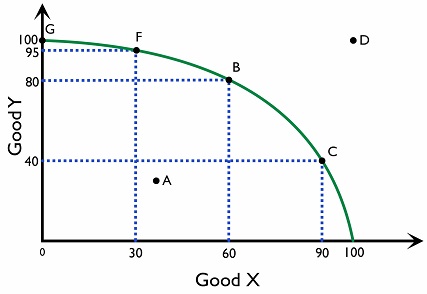
The production possibilities curve shows the potential output; that is, the maximum amount of both products that can be produced. According to Figure 1.1.1, under full utilization of resources with the given technology level, country A can produce either 100 units of good X or 100 units of good Y. In practice, the economy would allocate resources to produce somewhere along the curve, for example at point B, where it produces 60 units of good X and 80 units of good Y.
Assumptions of the model
The PPC model is an over-simplification of the real world which makes three assumptions:
- It assumes that the economy only produces two goods.
- It assumes that the resources available and the state of technology are fixed.
- It assumes that all the resources in the economy are fully employed.
Features of the model
The model can be used to illustrate several economic concepts.
- Illustration of scarcity
- Illustration of efficiency and unemployment
- Illustration of choices
- Illustration of opportunity cost
- Illustration of actual growth and potential growth in production possibilities
The PPC shows the constraints that a country faces. Points outside of the PPC (e.g. point D) is not attainable and implies scarcity. Country A can only produce at any combination of the two goods on or inside of the PPC.
In economics, efficiency is attained when it is impossible to produce more of one good without decreasing the production of other goods. In Figure 1.1.1, at many points along the PPC, say point B or C, the economy is productively efficient as we cannot produce more good X without reducing the production of good Y. However, if country A produces within the PPC, say point A, the bundle is attainable but inefficient as resources are not fully utilised. Country A can still produce more of good X without reducing production on good Y. Thus, unemployed resources exist.
Human wants are infinite and the economy would always like to produce at a point outside the PPC. With limited resources, our wants cannot be fully satisfied. We need to make choice and decide on which combinations of both goods to be produced on the PPC.
The negative slope of the PPC represents that it is impossible to produce more of one good without decreasing the production of other goods. When a country moves from producing at point B to point C, 30 more units of good X is produced, but the production of good Y decreases from 80 to 40 units. Therefore, the opportunity cost of moving from B to C is 40 units of good Y.
When the PPC is concave to the origin, it represents an increasing slope, that is increasing cost of production. In Figure 1.1.1, from G to F, the opportunity cost of producing 30 more units of good X is 5 units of good Y. Moving from F to B, the opportunity cost of producing 30 more units of good X is 10 units of good Y. Moving from B to C, the opportunity cost of producing 30 more units of good X increases to 40 units of good Y. This is because resources are not equally efficient for the production of all goods, and the opportunity cost increases when more units of a good are produced.
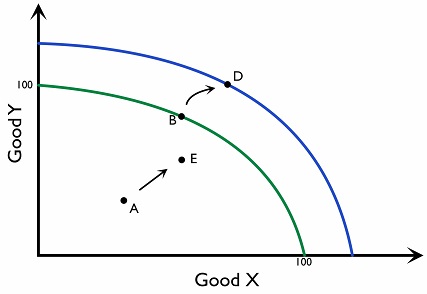
Actual growth occurs when there is an increase in aggregate demand and decrease in unemployment without any increase in the quantity and quality of the factors of production, there will be a move from point A to point E as shown in Figure 1.1.2, meaning existing resources are being utilised more efficiently.
Potential growth occurs when the quantity or quality of factors of production increases e.g. better education and training, technological advancement etc, country A is now able to produce more. This leads to an increase in the production capacity and an outward shift of PPC. Point D becomes attainable.
Increasing versus constant opportunity cost
The idea of increasing opportunity cost was introduced above; we saw that an economy which has an increasing opportunity cost of good X in terms of good Y will have a concave PPC, reflecting the fact that some factors of production are not equally suited to the production of both goods.
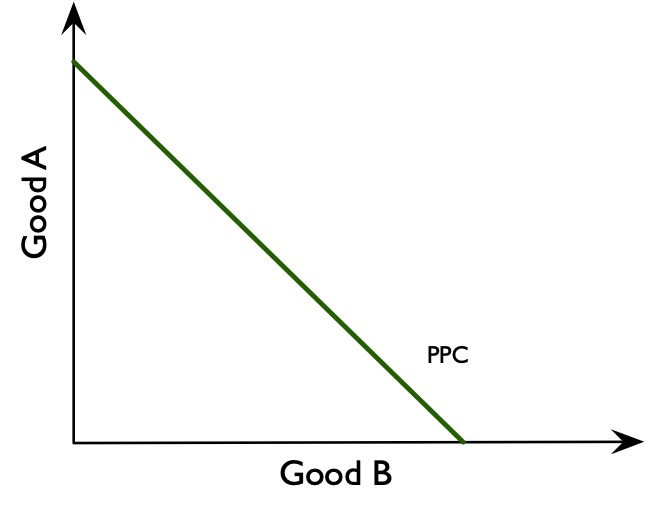
However, if the opportunity cost is constant, factors of production are equally suited to producing both goods, the PPC will be a straight line, meaning that an increase in production of x units of good A will always incur the same opportunity cost of y units of good B. This ratio would remain constant regardless of the number of units of good A or B produced.
Modelling the economy
The circular flow of income model
In a closed economy, there is no trade between the domestic economy and any other country. Consider a simple model of the economy, with only households and firms.
Households:
- Own and provide factors of production to firms and earn factor income from firms, including rent, wage, interest and profit. (Table 1.1.1)
- Make consumption decisions and pay consumption expenditure to firms.
Firms:
- Employ factors of production to produce goods and services, and pay households factor income.
- Make production decisions and earn consumption expenditure from the sale of goods and services.
Table 1.1.1: Returns to factors of production
| Factors of production | Factor income/Return |
|---|---|
| Labour | Wage |
| Capital | Interest |
| Land | Rent |
| Entrepreneurship | Profit |
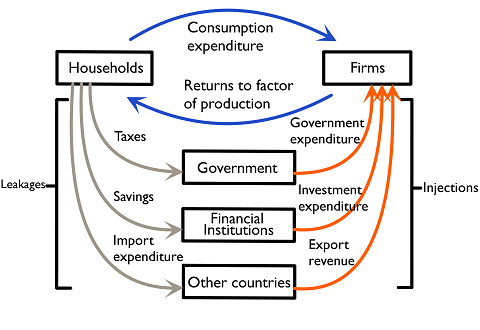
The circular income flow diagram can illustrate the flow of money and goods and services between household and firms. (Figure 1.1.4):
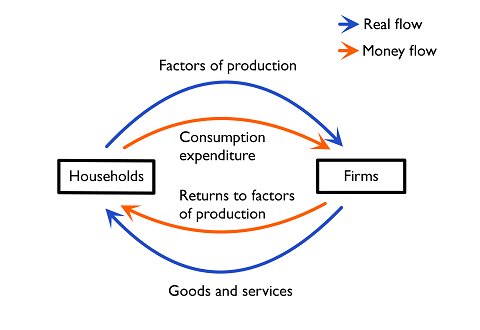
As firms pay out all returns to factors of production from the consumption expenditure it earns from households, the income flow is therefore numerically equivalent to the expenditure flow. The amount of consumption expenditure is equal to the value of the output households consume, and so expenditure flow is also equal to the output flow.
Income flow = Expenditure flow = Output flow
* Income, expenditure and output flow is equivalent only in a closed economy;
adjustments need to be made to equate the 3 flows in an open economy.
In an open economy, the domestic economy trades with other countries; therefore, these other countries have to be included in the circular flow of income. Besides households and firms, there are also other parties, including the government, financial institutions and other countries in an economy, as shown in Figure 1.1.5. Households pay taxes to the government, put savings with financial institutions, and incur import expenditure when purchasing imported goods. Taxes (T), savings (S) and import expenditure (M) are outflows from the circular income flow model and are known as leakages. The government incurs spending on domestically produced goods, financial institutions lend funds to firms to finance investments, and firms receive export revenue from other countries. Government expenditure (G), investment expenditure (I) and export revenue (X) are known as injections.