A production possibility frontier shows feasible output combinations with given resources and technology.
Must know
- Points on the frontier are productively efficient.
- Movement along the frontier reallocates resources.
- An outward shift increases productive potential.
Must know definitions
PPF: a curve showing the maximum possible combinations of two goods produced using all available resources.
Productive efficiency: all resources used to their maximum potential — any point on the PPF.
Inefficiency: resources unemployed or underused — a point inside the PPF.
Unattainable: beyond current resources/technology — a point outside the PPF.
Opportunity cost (PPF context): the amount of one good given up to produce more of another.
Potential economic growth: an increase in productive potential, shown by an outward shift of the PPF.
Capital goods: goods used to produce other goods, e.g. machinery.
Consumer goods: goods for final consumption, e.g. food, clothing.
Explain and apply
Mechanism in brief: More resources or higher productivity allow greater feasible output, shifting the frontier outward. Using unemployed resources instead moves production towards the existing frontier without changing capacity.
Distinguish: An unattainable point is not the same as an inefficient point; a bowed frontier implies rising opportunity cost.
Use the extract: Look for unused resources versus new capacity; decide whether the evidence implies movement towards the PPF or an outward shift.
Figure 1.1 Production possibilities and growth
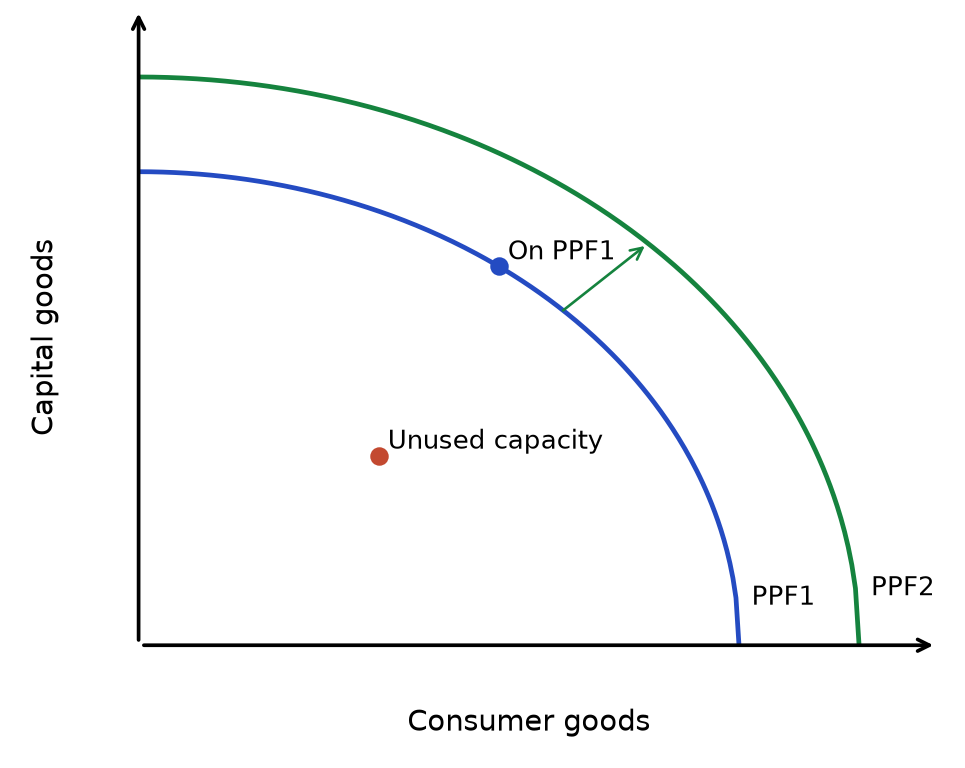
Read the diagram: A point inside the frontier uses resources inefficiently. Moving towards the existing frontier raises actual output; an outward shift increases productive potential. Moving along a bowed frontier involves increasing opportunity cost.
Assumptions: resources and technology are fixed for one frontier. A movement along it reallocates resources; moving towards it uses idle resources; shifting it changes productive capacity.
The use of production possibility frontiers (PPFs)
A production possibility frontier (PPF) is a curve showing the maximum possible combinations of two goods/services that can be produced using all available resources.
- Any point on the PPF is productively efficient — factors of production are used to their maximum potential.
- Any point inside the PPF is inefficient — some factors are unemployed or underemployed.
- Any point beyond the PPF is unattainable given current resources and technology.
PPFs also illustrate opportunity cost
moving along the curve to produce three more cows might incur an opportunity cost of four tonnes of wheat foregone.
| Position of the point | What it shows | Resource use |
|---|---|---|
| On the PPF | Productive efficiency | All factors used to maximum potential |
| Inside the PPF | Inefficiency | Factors unemployed or underemployed |
| Outside the PPF | Unattainable | Beyond current resources and technology |
The distinction between movements along, and shifts in, PPFs
A movement along the PPF reflects a reallocation of resources between the two goods, while a shift in the PPF reflects a change in the economy's productive capacity itself.
- A movement along the curve leaves overall productive capacity unchanged — only the mix of output changes.
- An outward shift shows economic growth — the economy can now produce more of both goods.
- An inward shift (e.g. a natural disaster destroying resources) shows a fall in productive potential.
reallocating resources between two goods is a movement along the PPF, not a shift — only a change in the quantity or quality of resources shifts the curve.
| Movement along the PPF | Shift in the PPF | |
|---|---|---|
| Cause | Resources reallocated from one good to another | Change in quantity/quality of factors of production |
| Productive capacity | Unchanged | Changes — outward = growth, inward = fall |
| Example | Producing more cows, fewer tonnes of wheat | New oil discovery (outward); natural disaster (inward) |
The distinction between capital and consumer goods
Capital goods are goods used to produce other goods, while consumer goods are goods intended for final consumption.
Capital goods
machinery, factories, tools.
Consumer goods
food, clothing.
An economy allocating more current resources to capital goods sacrifices consumer goods now, but builds greater productive potential for the future.
This trade-off is itself an opportunity cost — present consumption given up for future capacity.
| Capital goods | Consumer goods | |
|---|---|---|
| Purpose | Used to produce other goods | Final consumption |
| Examples | Machinery, factories | Food, clothing |
| Effect of producing more | Future productive potential ↑, consumption now ↓ | Consumption now ↑; less investment may slow future capacity growth |
The significance of capital goods for productivity and economic growth
Potential economic growth is an increase in an economy's productive capacity, shown by an outward shift of the PPF.
- Capital goods raise productivity (output per worker per hour), since better equipment lets a worker produce more in the same time.
- Higher productivity is closely associated with a higher rate of economic growth.
- Growth is caused by increases in the quantity or quality of factors of production — e.g. better-educated labour, hi-tech capital, or a new oil discovery.
capital goods ↑ → productivity ↑ → PPF shifts outward
An outward shift creates the possibility of higher living standards. Whether it delivers them depends on demand, distribution and the mix of goods produced; capacity growth alone does not establish a welfare gain.
Rapid recap
On the PPF is productively efficient; inside is inefficient or underused; outside is currently unattainable. Movement along shows a trade-off; an outward shift increases capacity.
Diagram cue: show a movement along, a movement towards and a shift of the PPF.
Related chapters: Unit 1 chapter 3 (p. 8) · Unit 2 chapter 6
Why this connects: Capacity growth in the PPF model becomes potential growth and an LRAS shift in Unit 2. Actual output can rise within existing capacity without either frontier shifting.