Development strategies work through different mechanisms and need to fit local constraints.
Must know
- Trade and investment can expand markets and capacity.
- Human capital and infrastructure support productivity.
- Aid debt relief and institutional reform have conditional effects.
Must know definitions
Trade liberalisation: the removal of barriers to international trade, such as tariffs and quotas.
Privatisation: the transfer of an asset or industry from public (government) ownership to private ownership.
Buffer stock scheme: a scheme using a price ceiling and price floor, with a stock of a commodity bought or released to keep price within that range.
Lewis structural dual-sector model: a model of development in which surplus agricultural labour migrates to the higher-wage industrial sector, with industrial profits reinvested to drive growth.
Soft loan: a loan given on more favourable terms than the market rate, typically at low or no interest.
World Bank: an international institution providing development and reconstruction loans to developing countries.
International Monetary Fund (IMF): an international institution focused on maintaining stability of the international monetary and exchange rate system and providing balance of payments support.
Explain and apply
Mechanism in brief: A well-targeted programme can relax a binding constraint, enabling investment and employment. Funding maintenance and building local skills help benefits persist after the initial project or external assistance ends.
Distinguish: No single strategy guarantees development; buffer stocks require finance, storage and a viable intervention range.
Use the extract: Match the proposed strategy to the country's constraint, financing and implementation capacity.
The impact of market-orientated strategies
Market-orientated strategies aim to promote growth and development by allowing market forces, rather than government intervention, to allocate resources:
Trade liberalisation
Removing trade barriers can allow specialisation according to comparative advantage and access to cheaper inputs → resources may be used more productively. Adjustment costs and market failures can limit the gains.
Growth link: access to overseas markets may raise exports and investment, while cheaper inputs can lower costs. Imports may also rise, so the net AD effect depends on changes in X and M rather than exports alone.
Development link: increased export earnings can fund imports of capital goods and technology, easing the foreign currency gap and supporting investment-led growth.
Living standards link: greater choice and lower prices for consumers (from imported goods) can raise real incomes and material living standards, though gains are not automatically shared evenly.
Downside: domestic industries lose protection from foreign competition → job losses and structural unemployment in import-competing sectors can offset some living-standards gains, at least in the short run.
Promotion of FDI
Attracting inward investment brings capital, technology, management expertise and jobs.
Growth link: FDI that finances new factories, equipment or other productive investment can raise AD and capacity. Buying existing shares or taking over an existing firm does not by itself add the same amount to GDP investment or productive capacity.
Development link: technology and skills transfer from foreign firms can raise domestic productivity and human capital over time, and FDI inflows strengthen the financial account of the balance of payments, easing a foreign currency gap.
Living standards link: jobs, wages, taxes and local supplier purchases can benefit residents even when profits are repatriated. Judge job quality, domestic value added and spillovers alongside pollution, concessions and outward profit flows.
Removal of government subsidies
Removing a subsidy can release resources from an inefficient activity and reduce fiscal costs. If the subsidy corrects an external benefit or another market failure, removing it may worsen allocation instead.
Growth link: resources move toward their most productive use, which can raise long-run output without any extra spending.
Development link: government funds previously spent on subsidies can be redirected toward direct development spending (e.g. education, health).
Living standards link: prices of subsidised necessities may rise, reducing poorer households’ purchasing power. Targeted compensation may protect access, but must be affordable and reach those affected.
Downside: previously-subsidised industries (e.g. domestic farmers) may struggle to compete without support.
Privatisation
Transferring state-owned assets to the private sector → profit incentive is argued to improve efficiency, and generates one-off government revenue.
Growth link: efficiency gains from stronger profit incentives can lower costs and raise output from the same resources; one-off privatisation revenue can fund productive government investment (e.g. infrastructure) that supports growth.
Development link: proceeds can, in principle, be directed toward development priorities such as education or healthcare spending.
Living standards link: risk that privatised essential services (e.g. water, electricity) become less affordable or accessible if profit motives outweigh universal provision, potentially harming living standards for lower-income groups.
Downside: critics argue essential services may be under-provided if profit becomes the main motive.
Floating exchange rate systems
A floating exchange rate responds to currency demand and supply. Removing an unsustainable overvalued peg may allow depreciation, but a floating currency does not necessarily depreciate or remain competitive.
Growth link: depreciation can support net exports after quantity adjustment if trade elasticities and export capacity are sufficient. The trade balance may initially worsen; higher imported-input costs can shift SRAS left and offset some output gains.
Development link: a more competitive exchange rate can support export-led industrialisation strategies and help correct a persistent balance of payments deficit without depleting foreign currency reserves.
Living standards link: depreciation raises the price of imports, which can push up cost-push inflation and reduce real incomes for consumers who rely on imported goods, so the living-standards effect is mixed.
Microfinance schemes
Small loans (microcredit) to very poor individuals who cannot access mainstream banking → enables them to start or grow small businesses.
Growth link: financing small enterprises raises investment and output at the grassroots level, particularly in the informal sector, aggregating into higher national output over time.
Development link: expands financial inclusion, giving the poorest access to credit and savings facilities for the first time, which is itself a component of development.
Living standards link: self-employment income from microfinance-backed businesses can directly raise household income and, particularly for female borrowers, can improve household welfare and bargaining power.
Downside: interest and repayment obligations can exceed returns where borrowers face weak demand, saturated local markets or shocks. Assess net income after debt service and whether finance removes the actual barrier to a viable business.
The impact of interventionist strategies
Interventionist strategies rely on active government involvement in the economy, rather than leaving outcomes to market forces:
Development of human capital
Government spending on education, training and healthcare raises workforce productivity.
Growth link: a more productive, healthier, better-educated workforce shifts the economy's PPF/LRAS outward → raises long-run trend (potential) growth.
Development link: better health and schooling outcomes raise HDI. Extra spending improves measured development only if it improves those outcomes.
Living standards link: better-educated, healthier populations tend to earn higher incomes and enjoy longer, healthier lives — a direct improvement in living standards beyond the growth effect.
Downside: gains take years to materialise, and require sustained funding that a government with a limited tax base may struggle to commit to.
Protectionism
Tariffs, quotas or other barriers can shield "infant industries" from foreign competition while they develop.
Growth link: protected industries can grow output and achieve economies of scale before facing full international competition, which supporters argue builds a stronger long-run industrial base.
Development link: can support industrialisation and diversification away from primary product dependency, potentially avoiding the Prebisch-Singer terms-of-trade problem.
Living standards link: consumers face higher prices and reduced choice while protection lasts, directly lowering material living standards in the short-to-medium run even if the strategy succeeds long-run.
Downside: distorts the market, raises prices for domestic consumers, and risks retaliation from trading partners.
Managed exchange rates
Central bank intervenes to keep the exchange rate within a target range rather than leaving it fully fixed or fully floating.
Growth link: a credible, reasonably stable rate can reduce exchange-rate risk and support trade and investment. An overvalued target can instead weaken competitiveness; limited reserves or inconsistent policies undermine credibility.
Development link: exchange rate stability can make a country more attractive for long-term FDI and trade, both of which support broader development goals.
Living standards link: exchange-rate stability can reduce import-price uncertainty. Maintaining an undervalued rate through foreign-currency purchases may expand domestic liquidity unless sterilised, creating inflationary pressure when demand exceeds capacity.
Infrastructure development
Government investment in transport, energy, water and telecoms lowers costs for firms.
Growth link: public infrastructure spending (G) raises AD in the short run and can expand productive capacity (LRAS/PPF) in the long run.
Development link: reliable access to electricity, clean water and transport is itself a component of higher living standards and is central to most definitions of development, separate from any growth effect.
Living standards link: reduces time and cost burdens on households (e.g. access to clean water, healthcare facilities reachable by road), directly improving quality of life.
Downside: infrastructure projects are expensive and often require foreign borrowing or aid, which can worsen a country's debt burden if projects are poorly targeted.
Promoting joint ventures with TNCs
Partnering domestic firms with transnational companies can bring technology transfer, access to export markets and shared risk.
Growth link: brings in capital and technology that raise domestic firms' productivity and export capacity, supporting both investment-led and export-led growth.
Development link: a joint venture may support skills and management-expertise transfer to the domestic partner. Compared with a wholly foreign-owned subsidiary, shared ownership can strengthen local participation, but spillovers depend on the agreement and firms’ capabilities. A cross-border joint venture can itself be FDI.
Living standards link: can create better-paid, more skilled local jobs than a wholly foreign-owned subsidiary, though this depends on how much control and profit the domestic partner actually retains.
Downside: profits and control may still largely rest with the foreign partner.
Buffer stock schemes
Government (or a buffer stock authority) sets a price ceiling and a price floor for a commodity.
Supply rises or demand falls → price threatens to fall below the floor → the authority buys stocks, increasing total demand.
Supply falls or demand rises → price threatens to exceed the ceiling → the authority releases stocks, increasing total supply.
Aims to stabilise prices and reduce income uncertainty; changing sales volumes mean producer incomes are not guaranteed to be stable.
Growth link: less volatile commodity prices may reduce one source of revenue uncertainty and encourage investment in yields and productivity. Total revenue still depends on output and sales volumes, so price stabilisation does not guarantee stable receipts.
Development link: directly counters the price volatility problem underlying primary product dependency, helping protect a key source of export earnings and foreign currency.
Living standards link: preventing a sharp price fall may protect producers from one source of income loss. The effect on household living standards also depends on harvests, sales volumes, production costs and how the scheme operates.
Downside: storage and transport costs are high, hard to balance supply and demand accurately in the long run, and limited participation by major producers can undermine the scheme.
Figure 4.14 Buffer stock intervention — Buy surplus
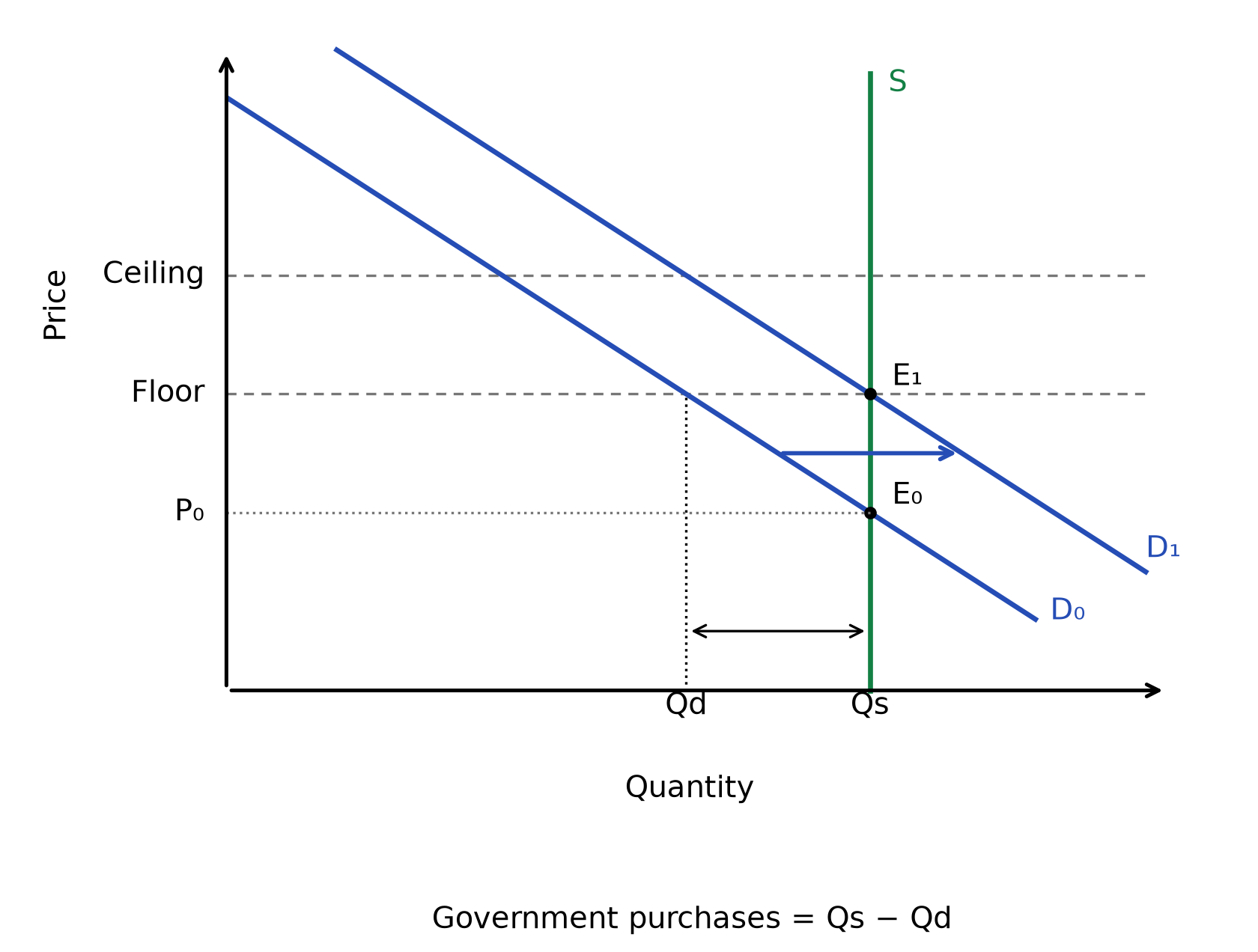
Figure 4.15 Buffer stock intervention — Release stocks
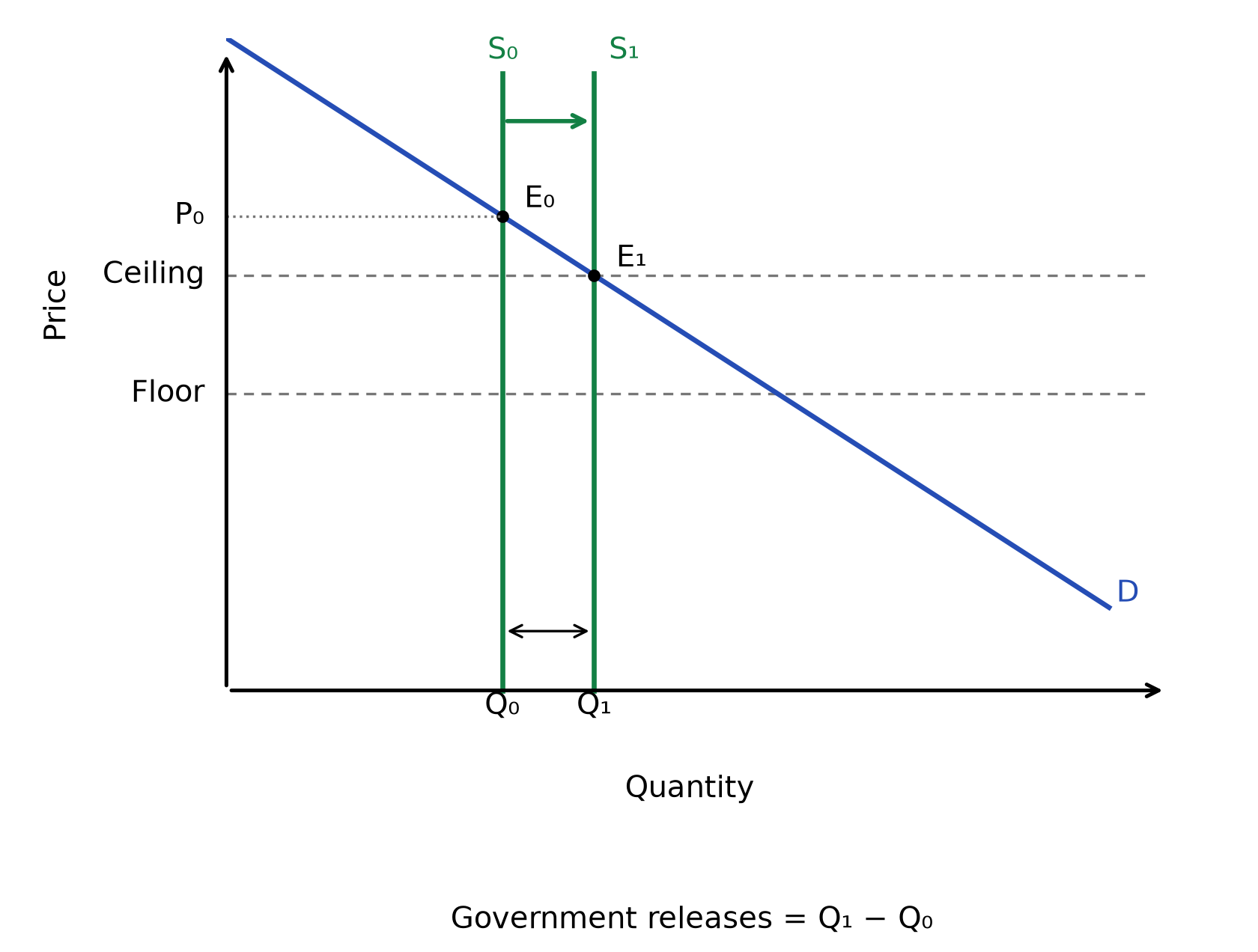
Read the diagrams: Vertical supply assumes a fixed crop harvest in the very short run. Above: E₀ is below the floor. Government purchases shift total demand D₀ → D₁ and raise price to the floor at E₁; purchases equal Qs − Qd. Below: E₀ is above the ceiling. Releasing stocks shifts total supply S₀ → S₁ and lowers price to the ceiling at E₁; releases equal Q₁ − Q₀. The floor and ceiling are the boundaries of the target range. Finance, storage and available stocks are essential.
The impact of other strategies
Industrialisation (the Lewis structural dual-sector model)
Growth occurs as surplus labour migrates from the low-productivity rural/agricultural sector to the higher-wage urban/industrial sector.
Profits from industry are reinvested to expand capital.
Growth link: reallocating labour from low-productivity agriculture to higher-productivity industry raises average output per worker, directly raising national output and GDP growth.
Development link: industrialisation diversifies the economy away from primary product dependency, reducing exposure to the Prebisch-Singer terms-of-trade problem and commodity price volatility.
Living standards link: urban industrial wages are typically higher than rural subsistence-agriculture incomes, so successful migration can raise household incomes — but only if urban job creation keeps pace.
Evaluation
assumes industrial production is labour-intensive, when in reality it is often capital-intensive; does not account for high urban unemployment (and associated fall in living standards for the urban poor) if job creation fails to keep pace with rural-urban migration.
Development of tourism
Earns foreign currency, creates (often labour-intensive) jobs, and can attract FDI.
Growth link: tourism spending is a direct export earning (X in AD) and supports growth in related sectors (hospitality, transport, retail) through the multiplier effect.
Development link: foreign currency earned can ease a foreign currency gap and fund imports of capital goods and technology needed for wider development.
Living standards link: labour-intensive job creation can raise incomes for relatively low-skilled workers who might otherwise be unemployed or underemployed.
Downside: profits may be repatriated abroad by foreign-owned hotel chains; can generate negative externalities (environmental damage, strain on local water and land use); revenue is vulnerable to the business cycle in tourists' home countries.
Development of primary industries
Countries with a comparative advantage in a primary product (e.g. a mineral or agricultural export) can build growth around exploiting it.
Growth link: exploiting an existing comparative advantage can quickly raise export revenue and output without the long lead times industrialisation requires.
Development link: export revenue can, if reinvested rather than solely consumed or repatriated, fund diversification into manufacturing or services over time.
Living standards link: incomes for those employed in the primary sector can rise, though gains are often unevenly distributed and vulnerable to the same price volatility affecting the wider economy.
Downside: risks the same price volatility and terms-of-trade problems associated with primary product dependency.
Debt relief
Cancelling or reducing developing countries' debt frees up government revenue previously used for debt-servicing, for spending on health, education and infrastructure instead.
Growth link: redirected spending toward infrastructure and human capital can raise both AD (government spending, G) and long-run productive capacity.
Development link: freed-up revenue can improve health and schooling outcomes and therefore HDI, if the spending is effective.
Living standards link: reduced pressure on the government budget can mean less need for austerity (tax rises or spending cuts elsewhere), protecting household living standards.
Downside: critics warn of moral hazard, where debt relief may encourage future irresponsible borrowing.
Aid
Types
humanitarian aid (emergency food/shelter), grants (money that does not need to be repaid), soft loans (repayable but at a concessionary interest rate).
Growth link: aid-funded infrastructure or capital projects raise investment and productive capacity in economies where domestic savings are insufficient (addressing the savings gap directly).
Development link: aid targeted at health, education and sanitation projects can raise HDI components more directly and quickly than growth-focused spending alone.
Living standards link: humanitarian aid can provide urgent, direct improvements to living standards during crises (famine, natural disasters, conflict) even where no growth effect exists.
Supporters
funds development that poor countries could not otherwise afford.
Critics
aid can be diverted through corruption, directed toward projects that attract media attention rather than genuine development need, and may reduce a country's incentive to build sustainable, self-sufficient institutions.
The role of international institutions
World Bank
Provides reconstruction loans to war-affected countries and development loans to underdeveloped countries for agriculture, irrigation, power, transport, water, education and health.
Encourages industrial development through economic reform.
Growth/development link: project loans directly fund the infrastructure and human capital investment that raises both productive capacity (growth) and HDI components (development).
Living standards link: agriculture, water and health projects target basic needs directly, aiming to raise living standards even where GDP growth is slow.
International Monetary Fund (IMF)
Aims to maintain stability of the international monetary system (the framework of exchange rates and cross-border payments).
Monitors member countries' economic and financial policies through "surveillance".
Provides financial support to countries facing balance of payments difficulties.
Growth/development link: emergency financial support prevents a balance of payments or currency crisis from forcing a sudden, disorderly contraction in imports and output, protecting growth in the short run.
Living standards link: IMF loans often come with conditionality (e.g. spending cuts, subsidy removal) that can worsen living standards for the poorest in the short run, even while stabilising the wider economy.
Non-government organisations (NGOs)
Independent, non-profit, voluntary groups operating at local, national or international level, often delivering community-based development directly.
Typically emphasise local control of small-scale projects, self-reliance, and environmental sustainability.
Growth/development link: small-scale, targeted projects (e.g. clean water, microfinance, local schools) build human capital and infrastructure from the bottom up, complementing larger institutional lending.
Living standards link: because NGOs often work directly with the poorest communities, their impact on living standards can be more immediate and better-targeted than large national-level programmes, even if the contribution to aggregate GDP growth is small.
Compare design and delivery with feasible alternatives. Weak accountability, tied procurement or poor maintenance can erode gains; a smaller sustainable programme may deliver more lasting benefit than a larger poorly supported one.
Rapid recap
Market-based strategies: trade, FDI and competition can expand markets and improve resource use; gains depend on adjustment, domestic links and effective institutions.
Public investment: education, health and infrastructure can raise productivity and access. Delivery quality, maintenance and suitable jobs determine the return.
Buffer stocks: buy surplus when price would fall below the floor; release stocks when price would exceed the ceiling. Purchasing shifts total demand; releases add supply. Finance, storage and available stocks limit effectiveness.
Aid, debt relief and finance: resources must reach productive projects or essential services. Judge conditionality, incentives, repayment and accountability rather than the headline funding amount.
Conclusion: match the strategy to the diagnosed constraint and compare feasible alternatives. Growth, distribution and wider development outcomes need separate assessment.
Diagram cue: use the strategy’s relevant diagram; for buffer stocks show purchases or releases.
Related chapters: Unit 4 chapter 16 (p. 73) · Unit 4 chapter 15 (p. 70)